
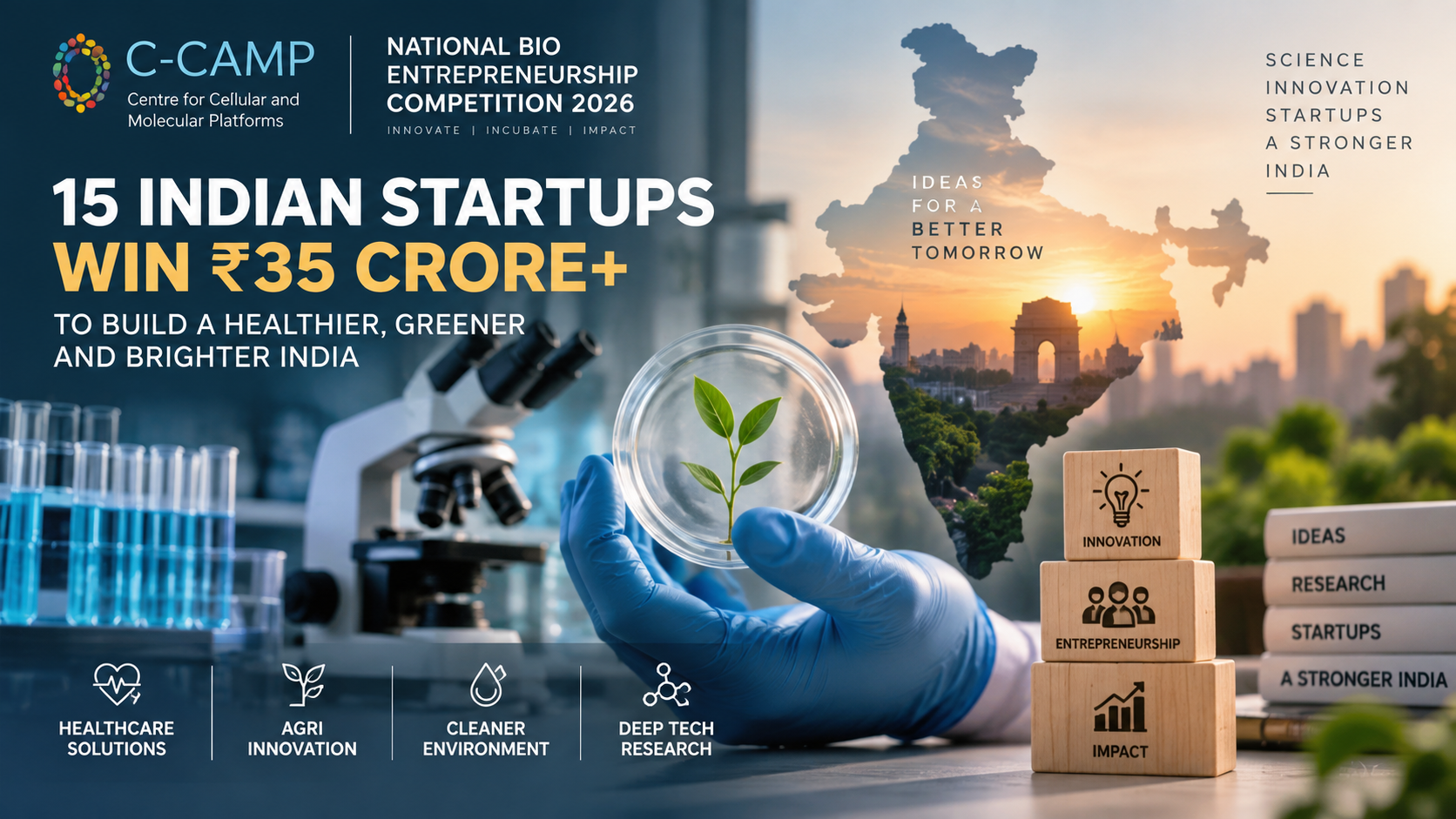
15 Indian Startups Win ₹35 Crore+ in C-CAMP’s National Bio Entrepreneurship Competition
Fifteen Indian startups and four student teams have emerged as winners of C-CAMP’s National Bio Entrepreneurship Competition 2026, securing ₹35 crore+ in cash prizes and investment opportunities.
Fifteen Indian startups and four student teams have emerged as winners of the ninth edition of the C-CAMP National Bio Entrepreneurship Competition (NBEC) 2026, highlighting the growing strength of India’s biotechnology and deep-tech startup ecosystem. The winners were announced at the competition’s grand finale in Bengaluru, where the startups received a combined package of more than ₹35 crore in cash prizes and investment opportunities, while the four student teams received ₹4 lakh in cash awards.
The National Bio Entrepreneurship Competition, organised by the Centre for Cellular and Molecular Platforms (C-CAMP), is designed to identify and support entrepreneurs developing biotechnology solutions with potential applications across healthcare, agriculture and the environment. The 2026 edition attracted more than 3,200 registrations from 34 states and Union Territories, with participation also coming from Tier 2 and Tier 3 cities. Women innovators accounted for around 40% of the applicants, reflecting the growing diversity of India’s biotechnology entrepreneurship ecosystem.
The scale of participation also shows how biotechnology is moving beyond traditional research institutions and into the startup ecosystem. After multiple rounds of evaluation, 74 startups reached the pre-final stage, with 25 finalists eventually presenting their ideas to the grand jury. The finalists were assessed on factors including the novelty of their ideas, scalability and business potential before the winners were selected.
The winning innovations cover a wide range of problems affecting healthcare, agriculture and sustainability. Among them are technologies for next-generation cancer pathology, quantum sensing for early detection of kidney injury, affordable insulin patch pumps and biopolymer-based approaches to bone regeneration. Other solutions focus on surgical training for low-resource settings, home-based greywater treatment, satellite-enabled smart spraying of agricultural inputs and bioformulations designed to improve soil health.
The diversity of these solutions is significant because it shows that India’s biotechnology opportunity is not limited to pharmaceuticals or laboratory research. Entrepreneurs are increasingly applying deep science to everyday challenges, from improving how diseases are detected and treated to making agriculture more efficient and developing technologies that can support environmental sustainability.
C-CAMP’s competition has also created a track record of turning early-stage scientific ideas into businesses. Across its first eight editions, the programme supported more than 130 winners, who have collectively raised more than $125 million in venture capital and launched more than 300 products in Indian and international markets. The organisation has provided more than ₹90 crore through cash prizes and investment opportunities over those editions.
The latest edition also reflects the increasing convergence between biotechnology, digital technology, artificial intelligence and deep tech. At the event, Biocon Executive Chairperson Kiran Mazumdar-Shaw highlighted the opportunity created by combining advances in biology with digital technologies and AI, while stressing that scientific innovation must ultimately be converted into scalable businesses.
For India, the development is important because building a strong bioeconomy requires more than scientific discoveries. It requires entrepreneurs who can turn those discoveries into affordable products, investors willing to support long development cycles, institutions that can provide mentorship and infrastructure, and markets capable of adopting new technologies. Platforms such as NBEC attempt to connect these different parts of the ecosystem.
The 2026 winners therefore represent more than a group of startups receiving awards. They offer a glimpse into the kinds of problems Indian entrepreneurs are attempting to solve through biotechnology and deep science. From healthcare and agriculture to water management and sustainable materials, these companies are working at the intersection of scientific research and commercial innovation.
As India looks to expand its bioeconomy in the coming decades, the ability to turn home-grown scientific ideas into scalable companies could become an important part of the country’s next phase of innovation. The growing participation of entrepreneurs from different parts of India also suggests that this opportunity is beginning to extend beyond the traditional startup hubs.
For more stories on Indian startups, innovation, entrepreneurship and the ideas shaping India’s future, visit Startup Times.

Leave a comment
Your email address will not be published. Required fields are marked *
Add a newsletter to your widget area.
Top Stories