
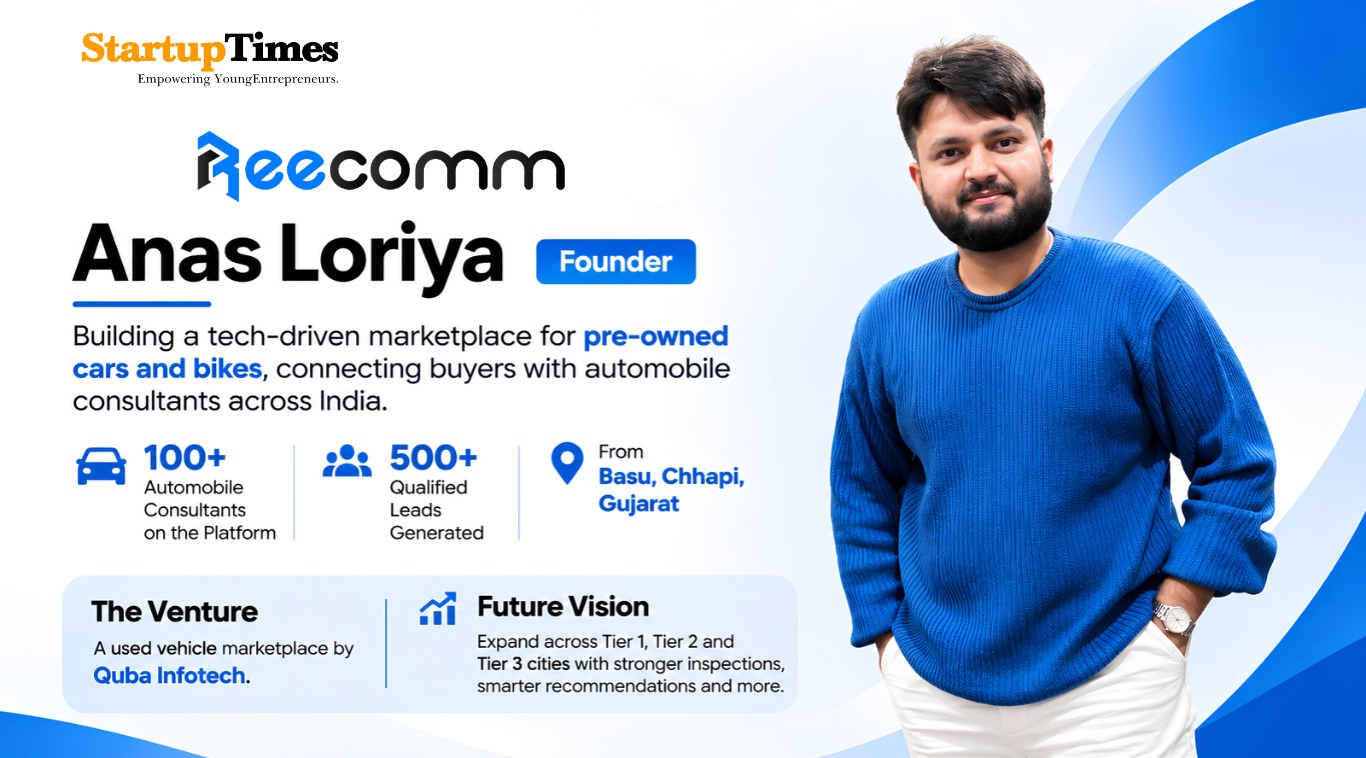
Anas Loriya’s Entrepreneurial Journey Building Reecomm Around Real Problems in the Used Vehicle Market
Anas Loriya, founder of Reecomm under Quba Infotech, is transforming India's pre-owned vehicle market through technology, trust and digital innovation.
For Anas Loriya, entrepreneurship began with an observation about an everyday transaction: buying or selling a used vehicle often takes more effort than it should. Buyers move between dealers, compare uncertain options and try to establish whether a vehicle is worth its asking price. Automobile consultants, meanwhile, may have suitable vehicles but limited visibility beyond their local networks. Loriya saw two groups with complementary needs and an opportunity to connect them more effectively. That observation led to Reecomm, a pre-owned cars and bikes marketplace developed under his entrepreneurial venture, Quba Infotech.
Loriya came to the problem with a background in technology. He holds a master’s degree in computer science and has worked on enterprise software solutions, with experience in Java, Spring Boot, microservices and full-stack development. His professional journey also exposed him to product development and team leadership. These experiences provided a foundation for building digital products. However, developing Reecommwould require him to look beyond software and understand the habits, concerns and expectations of people working in the used vehicle market.
With its roots in Basu, Chhapi, Gujarat, Reecomm represents Loriya's ambition to build technology-driven businesses from smaller towns and take solutions developed at the grassroots level to a wider national market. Through Quba Infotech, he aims to demonstrate that meaningful innovation is not limited to major metropolitan technology hubs. Reecomm gives that ambition a specific direction. Instead of starting with technology and searching for an application, he describes a venture shaped by problems he observed: fragmented discovery, limited digital infrastructure and a lack of accessible information that helps buyers make confident decisions.
The consultant’s position particularly interested him. Many independent automobile consultants and small dealers already had inventory, customer relationships and market knowledge. What they often lacked was a structured digital platform to showcase vehicles and manage enquiries. Loriya wanted Reecomm to support these participants alongside buyers. His approach was to create a marketplace where consultants could establish a digital presence while customers gained a more convenient way to explore available vehicles and contact sellers.
Today, Reecommallows buyers to discover pre-owned cars and bikes, compare options and connect directly with sellers. Consultants can list multiple vehicles, manage inventory and receive enquiries. A “Make Your Own Offer” feature allows buyers to propose prices for selected vehicles. Through Reecomm Inspections, buyers and consultants can request independent inspections and receive reports. These services reflect Loriya’s view that a useful marketplace should help people with the decisions surrounding a transaction, alongside making vehicles easier to find.
The transition from developing software to building a business brought difficult lessons. One of the earliest was the challenge of balancing vehicle supply with buyer demand. Buyers need enough relevant options to find a platform useful, while consultants need interested buyers to justify listing their inventory. Loriya says the team responded by focusing on consultant acquisition and gradually expanding its supply network across cities. Building participation became an ongoing task, closely connected to the value each side received.
Another challenge involved changing established behaviour. Consultants who were comfortable using personal contacts, phone calls and WhatsApp did not necessarily need another platform simply because one was available. Reecomm had to demonstrate practical benefits. The team focused on visibility, inventory management and opportunities to receive buyer enquiries. For Loriya, this reinforced an important distinction between creating a product and encouraging adoption. Features needed to translate into something that made sense within a consultant’s existing working day.
Buyer trust presented a separate problem. Concerns about vehicle condition, documentation and pricing could not be resolved through promotional messaging alone. Loriya says these concerns informed the introduction of independent inspection services within Reecomm’s broader offering.
Customer acquisition has also been an important part of Reecomm's development. The team has focused on understanding customer behaviour, strengthening engagement and reaching relevant audiences. For Loriya, the emphasis is on building meaningful connections between prospective buyers and automobile consultants, rather than measuring progress through visibility alone.
According to the company, Reecomm has reached more than 100 automobile consultants on its platform and generated over 500 qualified leads through its campaigns. Loriya regards these milestones as early validation. Consultant participation indicated willingness to explore digital tools, while lead generation helped the team understand demand and acquisition strategies. He remains measured about what the numbers represent. His larger definition of success is a platform that consistently generates meaningful enquiries, helps consultants close deals and becomes a trusted destination for buyers.
Over the next five years, Loriya wants Reecomm to expand across Tier 1, Tier 2 and Tier 3 cities. The roadmap includes stronger inspection services, improved discovery and comparison, smarter recommendations, pricing insights and automated lead management. These ambitions are accompanied by lessons about execution and business fundamentals. He encourages entrepreneurs to understand customer problems, start with something useful and pay attention to acquisition costs, retention and operational efficiency. Growth, in his view, requires learning from behaviour and numbers while remaining willing to revise assumptions.
His advice captures the principle behind the venture: “Don’t fall in love with your idea. Fall in love with solving the problem.” Reecomm is still working towards the consistent outcomes Loriya considers its real breakthrough. Yet his journey already illustrates the demands of moving from technical expertise to entrepreneurship: listening to customers, earning adoption and responding when the market behaves differently from expectations. For Loriya, building the business means continuing that process, with the original problem providing a clear reason to keep improving.
Connect with Anas on LinkedIn - https://www.linkedin.com/in/anas-loriya/

Leave a comment
Your email address will not be published. Required fields are marked *
Add a newsletter to your widget area.
Top Stories