
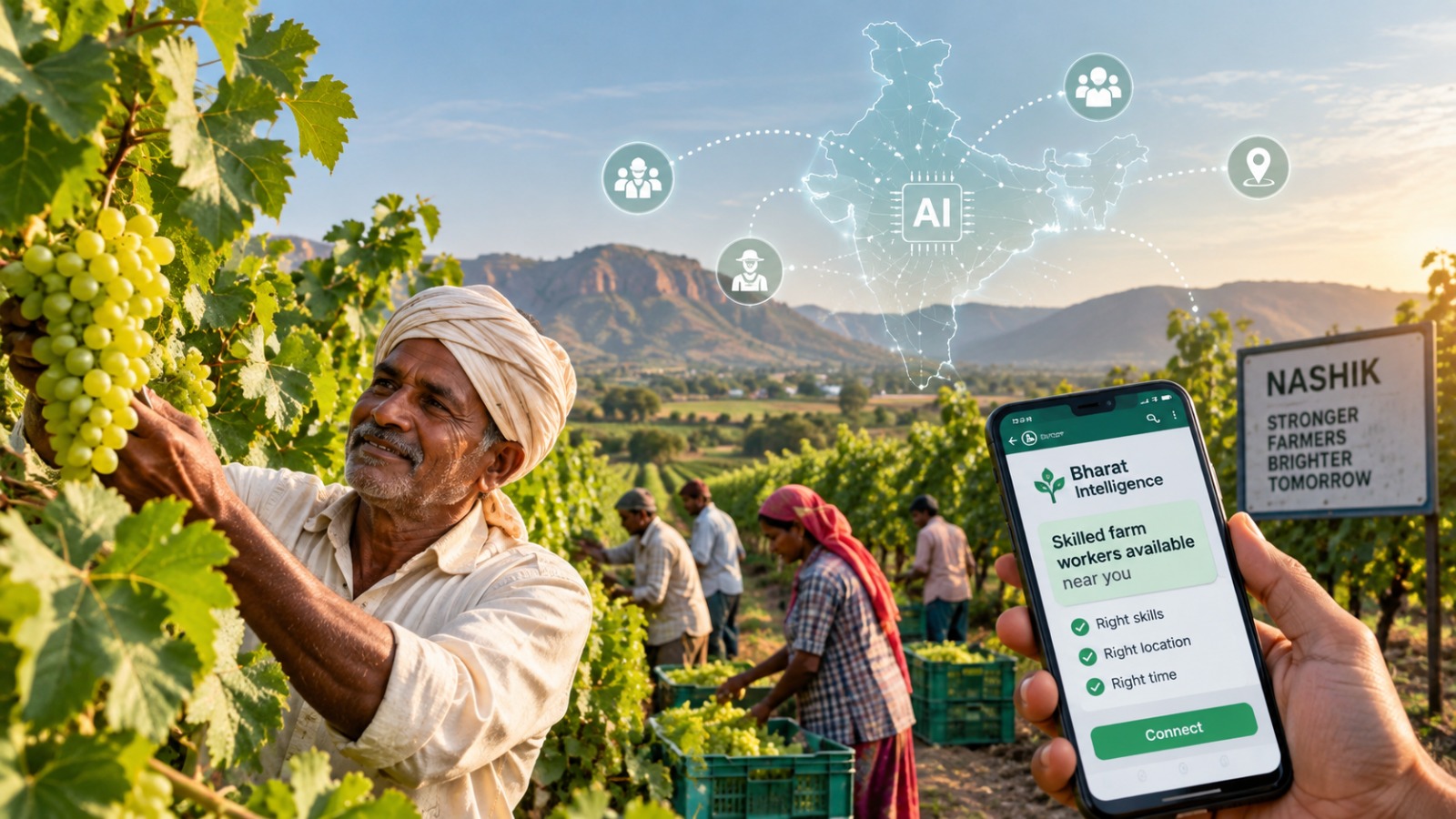
Bharat Intelligence Raises ₹7 Crore to Tackle India’s Farm Labour Crisis With AI
Bharat Intelligence raises ₹7 crore in pre-seed funding led by Sahyadri Farms to build an AI-powered platform connecting Indian farmers with skilled agricultural workers.
Bharat Intelligence, an agritech startup focused on India’s agricultural labour market, has raised ₹7 crore in a pre-seed funding round led by Sahyadri Farms.Founded in 2024 by Azhaan Merchant and Gourav Sanghai,Bharat Intelligence is using artificial intelligence and technology to address one of the less visible challenges facing Indian agriculture: connecting farmers with reliable, skilled labour when they need it. The investment will support the company’s product development and expansion across the horticulture belts of Western Maharashtra.
The funding stands out for another reason. More than 22,500 farmers associated with Sahyadri Farms have joined Bharat Intelligence as shareholders, giving the farming community a direct stake in the startup. The arrangement also gives farmers a voice in the company’s governance, with Sahyadri Farms chairman Vilas Shinde represented on the board. Instead of treating farmers simply as customers of an agricultural technology product, the model places them closer to the ownership and decision-making side of the business.
The startup was founded after Azhaan Merchant spent time examining horticulture value chains across rural Maharashtra and identified labour availability as a major constraint for farmers. While mechanisation is often presented as the answer to agricultural labour shortages, the founders concluded that replacing human labour was not always practical or economical, particularly for labour-intensive horticultural work. Their approach was to improve the way existing workers and farms are connected, using technology to make an informal labour market more organised.
Bharat Intelligence initially operates in Nashik, one of Maharashtra’s most important horticultural regions and a major grape-growing belt. The company is building its model around crops including grapes, bananas, tomatoes and pomegranates, where farm operations can require large numbers of workers at particular stages of the crop cycle. A shortage of workers during a critical period can affect the timing and efficiency of farm operations, while workers themselves can struggle to find consistent employment between seasonal opportunities.
At the centre of Bharat Intelligence’s model is an AI-powered matching system designed to connect farmers with skilled agricultural work crews. The platform considers factors such as the type of work required, worker skills, location and availability. Rather than expecting rural users to adopt a complicated standalone application, the company has built much of its front-end interaction around familiar tools such as WhatsApp and voice calls. This allows farmers and workers to communicate through channels they already understand while the technology works behind the scenes to organise the information.
The company has built detailed profiles of farms in its operating region and uses geospatial and agricultural data to understand when particular farms are likely to require labour. On the worker side, the challenge is more complex because agricultural labour is highly seasonal and often involves migration between villages. Bharat Intelligence says it has developed a digital model covering around 40,000 villages in Maharashtra, analysing thousands of data points for each village to understand demographics, labour pools, skills and seasonal availability. The objective is to build what the company describes as a “village calendar” that can help predict where and when particular groups of workers are likely to be available.
This approach turns the farm labour shortage into a problem of coordination rather than simply a problem of supply. According to the company's founders, the issue is not necessarily that there are no workers available. Farmers and workers often lack visibility into each other. A farmer may need a specific number of people for a particular task on a particular day, while workers may be looking for their next opportunity elsewhere. By bringing information from both sides into one system, Bharat Intelligence is attempting to make the market more predictable.
The company's early operations have focused on grape farmers in Nashik. Reports indicate that the startup has already facilitated work across more than 5,000 acres of vineyards in the region. Its model is operationally intensive, with the company involved not only in matching workers and farmers but also in coordinating deployments and ensuring that work is completed. This makes Bharat Intelligence different from a conventional software platform: its technology is being combined with on-ground operations in order to solve a physical problem.
The impact is intended to extend to workers as well as farmers. More predictable access to jobs can help agricultural workers earn more consistently instead of depending entirely on seasonal hiring and informal networks. Recent reports on the company's operations indicate that some workers using the platform have seen substantial increases in monthly earnings, while some farm families have also reported significant increases in annual income. These figures are early outcomes rather than evidence of a nationwide impact, but they illustrate the potential of improving coordination in a fragmented labour market.
The funding from Sahyadri Farms gives Bharat Intelligence an important advantage as it attempts to scale. Sahyadri has a large network of farmers and is closely connected to the horticultural value chain in Maharashtra. This provides Bharat Intelligence with access to the very communities whose problems its technology is designed to address. The involvement of thousands of farmer shareholders also creates a feedback mechanism that could influence how the company's technology develops as it expands.
The startup's ambitions extend beyond simply helping farmers hire workers. Bharat Intelligence describes its broader objective as building technology for India's physical and rural economy, where many important transactions still happen offline and where conventional digital datasets often fail to capture local realities. Agricultural work is influenced by factors such as crop cycles, weather, migration, community relationships and local practices, all of which can be difficult for conventional software systems to understand.
That makes Bharat Intelligence's approach notable within India's growing AI ecosystem. Much of the current AI startup conversation is concentrated around software development, enterprise automation, customer service and content creation. Bharat Intelligence is applying the technology to a much more physical problem: coordinating people working in farms. Its bet is that AI can become useful not by replacing people, but by making the systems around those people more efficient.
The company plans to use the new capital to strengthen its product, expand its team and scale its operations across Western Maharashtra's horticultural regions. Its longer-term growth will depend on whether the model developed in Nashik can be adapted to other crops, regions and labour markets while maintaining the trust of both farmers and workers.
Bharat Intelligence is still at an early stage, but its funding round represents an unusual combination of technology, agriculture and farmer ownership. With more than 22,500 farmers becoming shareholders through Sahyadri Farms, the startup is attempting to build an agricultural technology business in which the people facing the problem are also part of the company's ownership structure.
For a country where agriculture remains deeply dependent on human labour, solving the farm labour problem may not require replacing workers with machines. It may begin with something simpler: making it easier for the right farmer to find the right worker at the right time. Bharat Intelligence is betting that artificial intelligence can help make that connection possible at a scale that India's traditional agricultural labour networks have struggled to achieve.
For more stories on India’s startups, entrepreneurs, innovation and emerging businesses, visit Startup Times.

Leave a comment
Your email address will not be published. Required fields are marked *
Add a newsletter to your widget area.
Top Stories