CRM vs ERP: What Is the Difference? Complete Guide
CRM vs ERP explained: discover the key differences, features, benefits, use cases, and how to choose the right system for your business.
CRM vs ERP: What Is the Difference?
Businesses today rely heavily on technology to manage customers, employees, finances, sales, operations, and other critical activities. Two of the most commonly used business management systems are CRM (Customer Relationship Management) and ERP (Enterprise Resource Planning).
Although CRM and ERP systems both help businesses improve efficiency and organize information, they serve different purposes. Understanding the difference between CRM and ERP can help businesses choose the right technology for their specific needs.
What Is a CRM?
A Customer Relationship Management (CRM) system is software designed to help businesses manage their interactions and relationships with existing and potential customers.
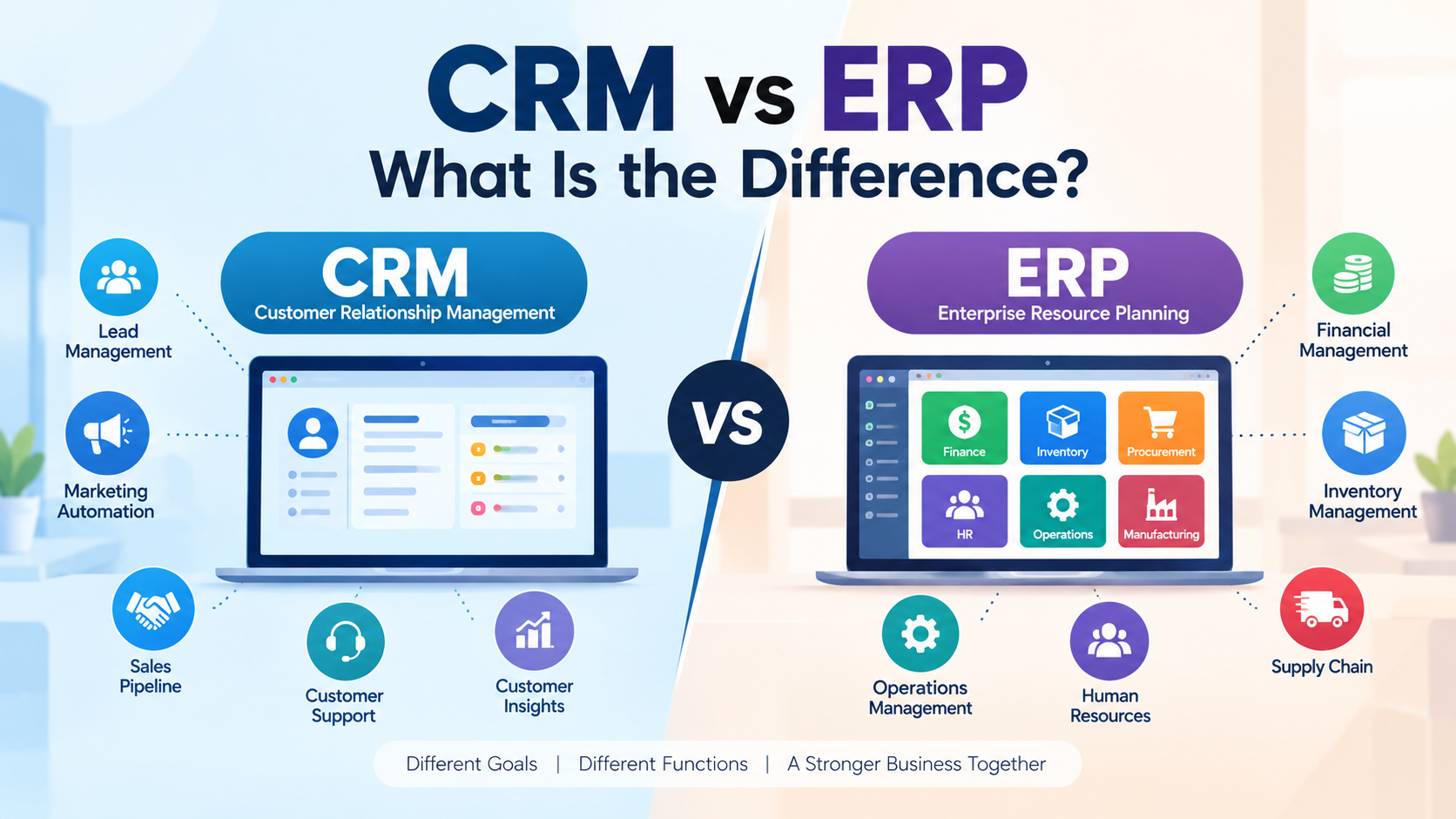
CRM systems primarily focus on sales, marketing, customer service, and customer relationships. They help companies store customer information, track leads, manage sales pipelines, automate marketing activities, and improve customer communication.
For example, a sales team can use a CRM to record customer conversations, schedule follow-ups, track opportunities, and monitor the progress of a potential deal.
Key Functions of CRM
A CRM typically helps businesses with:
- Lead and prospect management
- Customer data management
- Sales pipeline management
- Email and marketing automation
- Customer support and service
- Follow-up management
- Sales forecasting
- Customer interaction tracking
- Reporting and analytics
The main objective of CRM is to attract customers, convert leads, improve customer relationships, and increase sales.
What Is an ERP?
Enterprise Resource Planning (ERP) is a business management system that integrates different internal business processes into one centralized platform.
ERP systems are generally focused on business operations, finance, accounting, inventory, procurement, human resources, manufacturing, and supply chain management.
Instead of maintaining separate systems for different departments, an ERP can bring important business data together so departments can work with consistent and centralized information.
Key Functions of ERP
An ERP system can help businesses manage:
- Accounting and financial management
- Inventory management
- Procurement and purchasing
- Supply chain operations
- Human resources
- Manufacturing
- Project management
- Order management
- Business reporting
- Operational planning
The primary objective of ERP is to improve internal efficiency, integrate business processes, reduce duplication, and provide better control over operations.
CRM vs ERP: Key Difference
The simplest way to understand the difference is:
CRM focuses mainly on customers and revenue generation, while ERP focuses mainly on internal operations and resource management.
CRM helps answer questions such as:
- Who are our customers?
- Which leads are ready to buy?
- What stage is each sales opportunity in?
- When should the sales team follow up?
- How can we improve customer service?
ERP focuses on questions such as:
- What is our financial position?
- How much inventory do we have?
- What products need to be purchased?
- What are our operational costs?
- How efficiently are our resources being used?
CRM vs ERP Comparison
| Feature | CRM | ERP |
|---|---|---|
| Main focus | Customers and sales | Business operations and resources |
| Primary users | Sales, marketing, customer service | Finance, HR, operations, procurement |
| Main objective | Improve customer relationships and sales | Improve operational efficiency |
| Lead management | Yes | Usually limited |
| Sales pipeline | Yes | Limited or integrated |
| Accounting | Usually limited | Core function |
| Inventory management | Limited | Core function |
| HR management | Limited | Commonly included |
| Marketing automation | Common | Usually not the primary focus |
| Customer service | Strong | Limited or integrated |
| Supply chain | Limited | Strong |
| Financial management | Limited | Strong |
When Should a Business Choose CRM?
A CRM may be the better choice when a business primarily needs to improve its customer-facing activities.
For example, a growing company may have hundreds of leads but struggle to track conversations and follow-ups. A CRM can organize these leads and give sales representatives a clear view of every customer interaction.
CRM can be particularly useful for:
- Sales-driven companies
- Marketing agencies
- Service businesses
- Startups
- E-commerce businesses
- Companies with large sales teams
- Businesses focused on customer retention
If the major challenge is managing leads, sales, communication, and customer relationships, CRM should be considered.
When Should a Business Choose ERP?
An ERP system may be more appropriate when a business has complex internal operations and needs better coordination between departments.
For example, a manufacturing company may need to coordinate inventory, purchasing, production, accounting, and supply chain activities. An ERP can connect these processes through a centralized system.
ERP can be particularly useful for:
- Manufacturing companies
- Large organizations
- Retail businesses
- Distribution companies
- Companies with complex supply chains
- Businesses managing multiple departments
- Organizations that need centralized financial and operational data
If the major challenge is managing finance, inventory, resources, procurement, or operations, ERP may be the better solution.
Can a Business Use Both CRM and ERP?
Yes. In many organizations, CRM and ERP work together rather than competing with each other.
A company may use CRM to manage the customer journey from lead generation to sales and use ERP to manage what happens behind the scenes after the sale.
For example, a customer may contact a company through its sales team. The CRM can track the lead, sales conversations, and order. Once the customer places an order, relevant information can be transferred to the ERP system for inventory, invoicing, accounting, procurement, and fulfillment.
This integration can create a more connected business ecosystem.
Benefits of Integrating CRM and ERP
Connecting CRM and ERP can provide several advantages.
1. Better Data Visibility
Employees can access relevant customer and business information from connected systems, reducing the need to switch between multiple platforms.
2. Improved Customer Experience
Sales and customer service teams can gain better visibility into orders, invoices, product availability, and customer history.
3. Reduced Data Duplication
Integration can reduce the need to enter the same information into different systems manually.
4. Faster Decision-Making
Management can use combined customer, sales, financial, and operational information to make more informed decisions.
5. Increased Efficiency
Automating the movement of information between CRM and ERP can reduce manual work and minimize errors.
CRM or ERP: Which One Does Your Business Need?
There is no universal answer because the right system depends on the organization's goals and challenges.
Choose CRM if your primary priority is:
- Generating and managing leads
- Increasing sales
- Improving customer relationships
- Managing sales teams
- Improving customer service
Choose ERP if your primary priority is:
- Managing finances
- Controlling inventory
- Managing procurement
- Improving internal operations
- Coordinating multiple departments
Choose both if your organization needs comprehensive management of both customer-facing activities and internal business operations.
Final Thoughts
CRM and ERP are both powerful business technologies, but they solve different problems. CRM is primarily customer-focused, helping businesses manage leads, sales, marketing, and customer relationships. ERP is primarily operations-focused, helping businesses manage finance, inventory, procurement, human resources, supply chains, and other internal processes.
For growing businesses, the decision should not simply be about choosing the most advanced software. Instead, organizations should identify their biggest operational challenges, understand their business requirements, and select a system that can support long-term growth.
In many cases, the most effective approach is to use CRM and ERP together, allowing customer-facing and internal business processes to work as part of a connected ecosystem.


Leave a comment
Your email address will not be published. Required fields are marked *
Add a newsletter to your widget area.
Top Stories