
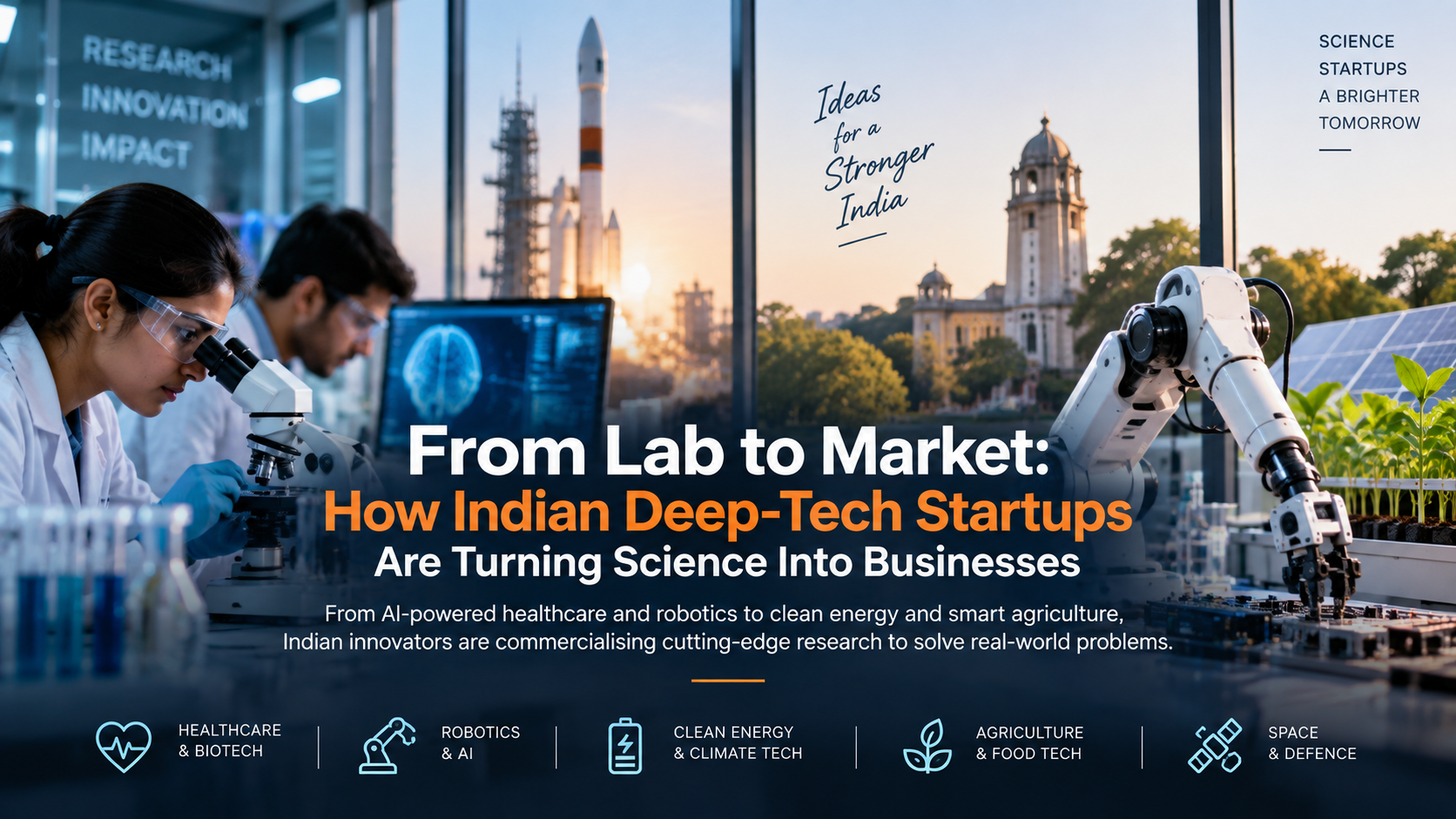
From Lab to Market: How Indian Deep-Tech Startups Are Turning Science Into Businesses
From AI-powered healthcare and robotics to thermal batteries and smart agriculture, Indian deep-tech startups are turning advanced research into real-world products and businesses.
For years, some of India’s most advanced scientific research remained inside laboratories, universities and research institutions. Today, a growing number of startups are attempting to take that research beyond the lab and turn it into products that can solve real-world problems.
This shift is particularly visible in deep technology, where startups are working across healthcare, robotics, defence, energy, agriculture and space. Unlike many conventional startups that can launch a product relatively quickly, deep-tech companies often spend years developing and validating complex technologies before they reach the market.
When Research Becomes a Startup
A recent look at startups emerging from the Indian Institute of Science (IISc), Bengaluru, shows how academic research is increasingly being converted into commercial technologies. Several startups incubated through IISc's Foundation for Science, Innovation and Development are working on technologies ranging from AI-powered medical diagnostics to robotics, surveillance systems, thermal batteries and advanced solar cells.
One example is Enlife, which is developing an AI-powered blood test designed around Indian genetic profiles to help detect the risk of Alzheimer's disease and other neurodegenerative conditions at an early stage. The idea demonstrates how advances in artificial intelligence and biomedical research can potentially move from scientific research into practical healthcare applications.
Robots Moving Beyond Industrial Floors
Robotics is another area where Indian deep-tech companies are attempting to build indigenous technology.
Botloka, an IISc-linked startup, has developed Jiva, a home robot vacuum cleaner, with plans to expand towards a broader consumer robotics platform. The company's work illustrates a larger ambition within India's robotics ecosystem: developing technologies not only for factories and industrial environments, but also for everyday consumers.
The move is significant because consumer robotics requires more than mechanical engineering. Robots operating inside homes need to combine sensors, artificial intelligence, navigation, software and hardware into a single system.
Technology for Defence and Surveillance
Deep-tech innovation is also finding applications in defence.
Thinking Balloon is working on autonomous tethered balloon surveillance systems intended for defence applications. The technology is being developed as a potentially more cost-effective alternative to conventional surveillance infrastructure such as radar towers.
The wider Indian defence ecosystem is also creating more opportunities for startups and MSMEs to participate in research and development. Recent government initiatives have focused on areas including artificial intelligence, drones, cybersecurity and quantum technologies, while also encouraging collaboration between industry and research institutions.
Solving the Energy Challenge
Energy is another major area where deep technology can have an industrial impact.
Voltanova is developing thermal battery systems aimed at industrial applications such as factories and data centres. Thermal energy storage can become increasingly important as industries look for ways to improve energy efficiency and reduce emissions.
Meanwhile, ABX3PV is working on perovskite solar technology. Perovskites are being researched as an alternative material for solar cells because of their potential for efficient and flexible applications.
These technologies highlight an important characteristic of deep-tech startups: their products are often based on scientific breakthroughs that could eventually influence entire industries rather than simply adding another feature to an existing product.
Bringing Advanced Technology to Agriculture
Deep technology is not limited to laboratories, factories or high-tech industries. It is also being applied to agriculture.
Green Collar Global has developed TARAM, a portable system designed to assess the quality of agricultural commodities such as spices and grains using near-infrared analysis. Faster testing could help businesses across the agricultural value chain make decisions without relying entirely on conventional laboratory processes.
This is an example of how sophisticated technologies can be designed around very practical problems. A farmer, trader or food-processing business may not think of their challenge as a “deep-tech problem”, but technologies such as sensors, AI and spectroscopy can provide new ways to address it.
The Funding Story Behind Deep Tech
The growing number of commercial applications is also attracting investors.
According to Tracxn data reported by Mint, Indian deep-tech startups had raised $2.3 billion across nearly 200 deals in 2026 as of September 1, compared with $1.62 billion across 453 deals during all of 2025. The numbers point towards larger amounts of capital being concentrated in fewer deals.
However, deep-tech investment comes with a different set of challenges. Developing hardware, scientific technologies and new materials can require significant research, testing and regulatory approval before revenue begins to scale.
This means investors have to look beyond short-term user growth and consider factors such as intellectual property, technical feasibility, development timelines and the ability to eventually commercialise the technology.
From Imported Technology to Indigenous Innovation
Another important part of India's deep-tech story is the effort to develop technologies domestically.
The Indian government's Research Development and Innovation scheme has a stated focus on areas including quantum technology, robotics, space, artificial intelligence, agriculture, healthcare, biotechnology, medical devices and clean technology. The scheme has an outlay of ₹1 lakh crore over six years.
India has also changed aspects of its startup framework to account for the longer development cycles associated with deep-tech companies. In 2026, the government extended the period during which deep-tech companies can be treated as startups from 10 years to 20 years and increased the revenue threshold for certain startup benefits.
Such measures reflect the fundamental difference between a conventional software startup and a company developing a new battery, medical device, satellite technology or advanced semiconductor.
The Road Ahead
India's deep-tech ecosystem is still developing, but the direction is becoming increasingly visible. Universities and research institutions are becoming sources not only of academic publications but also of commercial technologies, while incubators and government programmes are helping researchers take the next step towards entrepreneurship.
The challenge now is turning promising research into reliable, scalable and commercially viable products.
The journey from a laboratory prototype to a product used by millions can take years. But if more Indian research can successfully make that journey, deep-tech startups could play a significant role in building technologies across healthcare, agriculture, energy, defence, robotics and space.
The future of India's startup ecosystem may therefore not be built only on apps and software. Some of its most important companies could emerge from laboratories, where scientists are working on technologies that are only beginning to find their way into the real world.
For more insightful stories on Indian startups, emerging technologies, innovation, funding and the entrepreneurs shaping tomorrow, visit Startup Times


Leave a comment
Your email address will not be published. Required fields are marked *
Add a newsletter to your widget area.
Top Stories