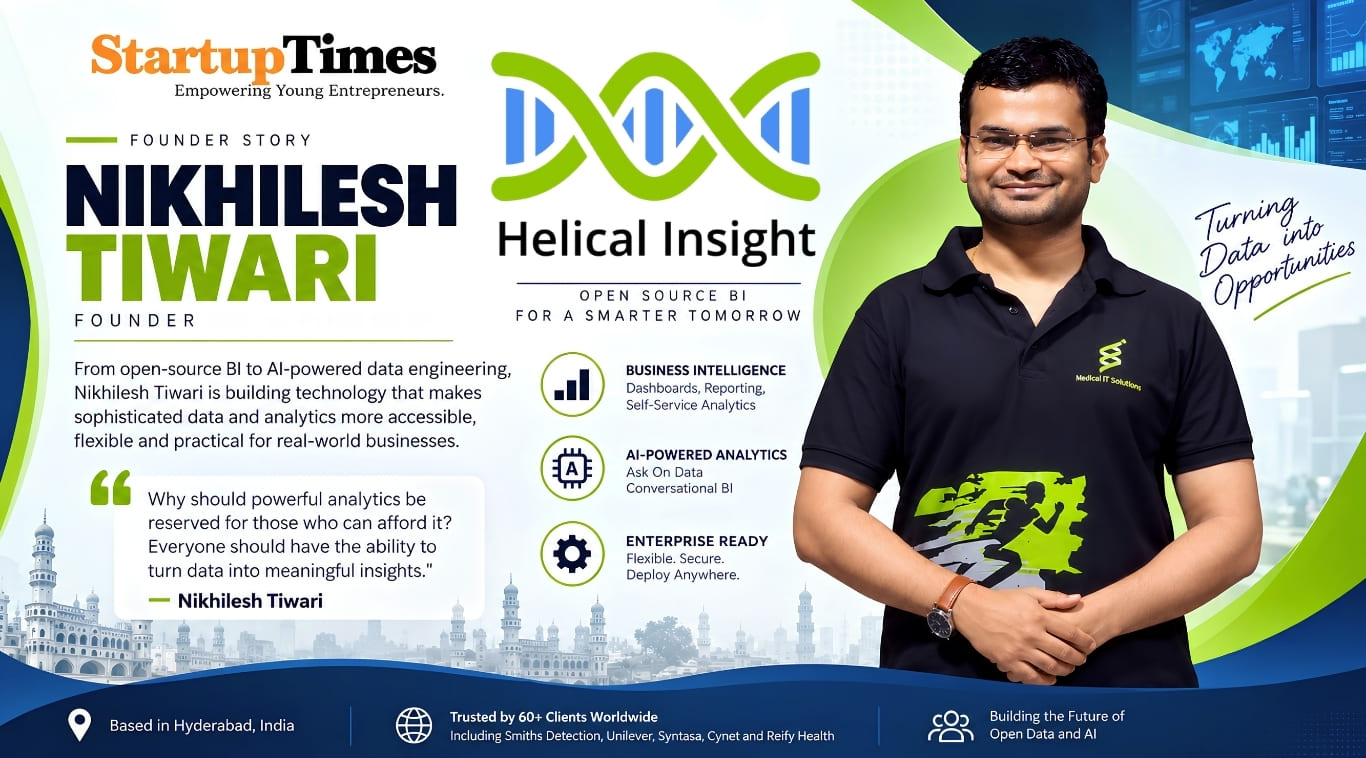
Most startup stories begin with a big idea. Nikhilesh Tiwaris began with a problem that kept repeating. Working with organisations across industries and geographies, he saw the same situation again and again: companies had plenty of data, yet turning it into meaningful insight demanded expensive tools, complex implementations and significant licensing costs.
More than a decade later, that observation has grown into three connected ventures based in Hyderabad. Helical IT Solutions is a data and analytics services company. Helical Insight is an open-source business intelligence platform. Ask On Data is an AI-driven tool that lets people build data pipelines through a chat interface. Together they trace a founders path from services to product, and from dashboards to conversation.
For Tiwari, one idea runs through all of it. In his words, the venture has been driven by the same idea from the beginning: make sophisticated data and analytics technology more accessible, flexible, and practical for real-world businesses.
Learning the trade at Helical IT Solutions
Tiwari co-founded Helical IT Solutions in October 2012. The company started as a software services firm specialising in open-source data warehousing and business intelligence, with deep expertise in the Jaspersoft and Pentaho suites and in ETL tools such as Talend and Pentaho Data Integration. Its work covered the full project life cycle, from tool selection and BI solution development to training, support, cloud migration, plugin development, white labelling, security, multi-tenancy, data modelling and data warehouse design.
The early project list shows how broad that grounding was. Helical delivered work in human resources, energy, insurance, social media analytics, e-commerce, travel, manufacturing and healthcare supply chain. For a young founder, that variety was an education in itself. Every organisation brought different data sources, security requirements, reporting formats and deployment models, and nearly all of them wanted answers without an unreasonable bill.
Over the years the services business has worked with clients such as Fractal Analytics, Tata Communications, Technip and the Government of Micronesia, and its toolkit has widened to include Apache Spark, AWS Glue, Snowflake, Databricks and generative AI. But it was the early years of hands-on implementation that planted the seed of a product.
The question behind Helical Insight
In May 2016, Tiwari co-founded Helical Insight. The motivation, he says, was simple: why should powerful business intelligence be available only to companies willing to pay high licence fees? The team wanted to build an open-source platform that organisations could use, customise, embed into their own applications and run on their own infrastructure.
In its early years, Helical Insight was pitched as a developer-friendly BI framework, one that could evolve as technology and business expectations changed, and that reduced the dependence on a single vendor common with conventional BI tools. The approach found buyers. According to Tiwaris professional profile, more than 60 clients use the product, including names such as Smiths Detection, Unilever, Syntasa, Cynet and Reify Health.
As the platform matured, customer conversations kept revealing the same gaps in the market.
Four gaps that shaped the product
- Ageing reporting tools. Crystal Reports, SSRS, Pentaho Reports, BIRT and JasperReports have served enterprises for years, but innovation in the category has not kept pace with modern data teams. Organisations still need highly formatted, parameterised and scheduled reports, yet they also want dashboards, self-service analytics, APIs, embedding, AI and cloud-ready architecture.
- Paywalled open source. Several open-source BI platforms have built strong communities, but many advanced enterprise capabilities sit inside paid editions.
- Locked-in AI. Many AI analytics products are tied to their own models or cloud ecosystems. Tiwari believes organisations should control which models they use, particularly with sensitive business data. That belief led Helical toward a bring-your-own-LLM approach.
- Fragmentation. Businesses often run one product for dashboards, another for pixel-perfect reporting, another for embedded analytics and, increasingly, another for AI.
Helical Insights answer is a single platform that combines interactive dashboards, self-service BI, paginated reporting, embedded analytics, multi-tenancy, row-level security, single sign-on, scheduling and AI-powered conversational analytics. It can run on-premises, in a private cloud or in a public cloud, which gives organisations control over where their data and analytics infrastructure lives.
From dashboards to conversation
The arrival of generative AI opened a second opportunity. Instead of asking every employee to learn a complex BI interface, Helical Insight could let users ask questions in natural language and receive meaningful analysis. Conversational analytics became a core part of the platform, with organisations free to connect the AI model of their choice or to run models inside their own environment.
The same conviction led to Ask On Data, which Tiwari co-founded in January 2024. Ask On Data applies natural-language processing and AI to data engineering, the technical work of cleaning, loading, transforming, migrating and integrating data. Users build pipelines by typing in a chat interface, with no coding required. The company describes it as the worlds first NLP-based data engineering tool and says it aims to end everyday dependence on specialist data engineers. It also stresses that it does not simply outsource the work to general-purpose tools such as ChatGPT, a design choice made with data security in mind.
Taken together, the two products point at the same future: analytics and data engineering that ordinary business users can operate simply by asking.
The hard parts
Tiwari is candid that the road was not easy. The first challenge was building an enterprise-grade BI product in a market dominated by large, well-established platforms. Enterprises expect strong security, reporting, embedding, scalability, integrations and support, and delivering all of that under an open-source model takes time, engineering effort and persistence.
The second was perception. Many organisations associate open source with basic functionality and assume that serious capabilities will eventually require a commercial licence. Helical had to show, through customer implementations and continuous development, that an open-source platform could offer the depth, security and reliability enterprises need.
The third was the pace of change. BI has moved from traditional reporting to self-service analytics, embedded BI, cloud deployment and now AI. Rather than launch a new product for each wave, Helical kept expanding one platform. Along the way, the team balanced the needs of customers in different industries and geographies, each with its own data sources and compliance requirements. Working closely with those customers, Tiwari says, helped the company prioritise real-world problems rather than industry trends.
Perhaps the most important lesson, in his telling, is that building a technology company is a long-term process of improving the product, listening to customers, adapting to the market and staying committed to a philosophy.
The turning point: a full platform, free
The breakthrough was a decision about philosophy rather than technology. After years of building Helical Insight, the team concluded that the traditional open-core model, where a basic product is free and important enterprise features sit behind paid editions, did not fit what they wanted to achieve. Instead of asking users to upgrade, they made the full functional platform available in the free Community Edition, including AI-powered analytics, dashboards, reporting, embedding, security, SSO and multi-tenancy.
The markets response has been encouraging. Within a month of the change, the Helical Insight repository on GitHub crossed 1,000 stars and 700 forks. Tiwari does not treat those as vanity metrics; they represent developers and organisations discovering the project and choosing to keep it on their radar. The release of version 7.0 has also drawn coverage from outlets including MarTech Series, AI Weekly, The Executive Outlook and Open Source For You magazine.
"For us, the real breakthrough was seeing the open-source community begin to validate that there is a demand for enterprise-grade BI without feature gating."
The shift also sharpened the companys direction. Helical will keep building a unified, open-source analytics platform while earning revenue from commercial support, implementation and enterprise services for organisations that want them.
Where Helical is headed
Tiwaris long-term vision is for Helical Insight to become a globally recognised free and open-source platform for business intelligence, analytics and AI-driven data exploration. Over the next few years, he plans to keep investing in the convergence of BI and AI: a future in which users do not depend solely on dashboards and report builders, but ask questions conversationally, pose follow-ups, discover trends, generate analyses and eventually use AI agents to assist with parts of the analytics workflow.
Over the next five years, the company wants to expand its global presence, build a much larger developer and user community, grow adoption among enterprises and startups, and establish Helical Insight as a leading free and open-source alternative to commercial BI platforms. The business model will continue to rest on enterprise support, implementation, customisation, training and related services.
Advice for aspiring founders
Asked what he would tell entrepreneurs starting out, Tiwari offers four ideas drawn from his own journey.
- Solve a real problem. Focus on a genuine customer frustration rather than simply trying to build a company. Some of the best opportunities sit in areas people have long accepted as the way things are.
- Think long term. There will be periods of slow growth and strong competition. Keep learning, keep listening to customers and stay committed to the underlying problem.
- Challenge convention. You do not always have to follow the conventional business model. Helicals choice to go fully free and open source came with challenges, but it created a clear identity and a community that believed in the same idea.
- Start before you are ready. Dont wait for perfection. Build something, put it in front of real users, learn from their feedback, and keep improving.
Tiwaris journey shows how a founder can turn repeated customer pain into a product, and then have the nerve to rethink how that product is sold. From Jaspersoft and Pentaho projects in 2012, to an open-source BI framework in 2016, to AI-driven analytics and chat-based data engineering today, the direction has stayed constant: make sophisticated data technology practical for real-world businesses.
To connect with their team :
Visit their website : https://www.helicalinsight.com
Company LinkedIn : https://www.linkedin.com/showcase/helical_insight/
Nikhilesh Tiwari's LinkedIn: https://www.linkedin.com/in/nikitiwari/
Story Featured By Team Startup Times.