Google Selects 4 Indian Startups for AI for the Planet Climate-Tech Programme
Google selects four Indian climate-tech startups for its AI for the Planet programme, supporting AI, satellite technology, agriculture and carbon solutions.
India's startup ecosystem is increasingly moving beyond traditional technology and fintech ventures, with climate technology and artificial intelligence emerging as important areas of innovation. In a significant development, Google has selected four Indian climate-tech startups for its inaugural Google DeepMind Accelerator: AI for the Planet programme.
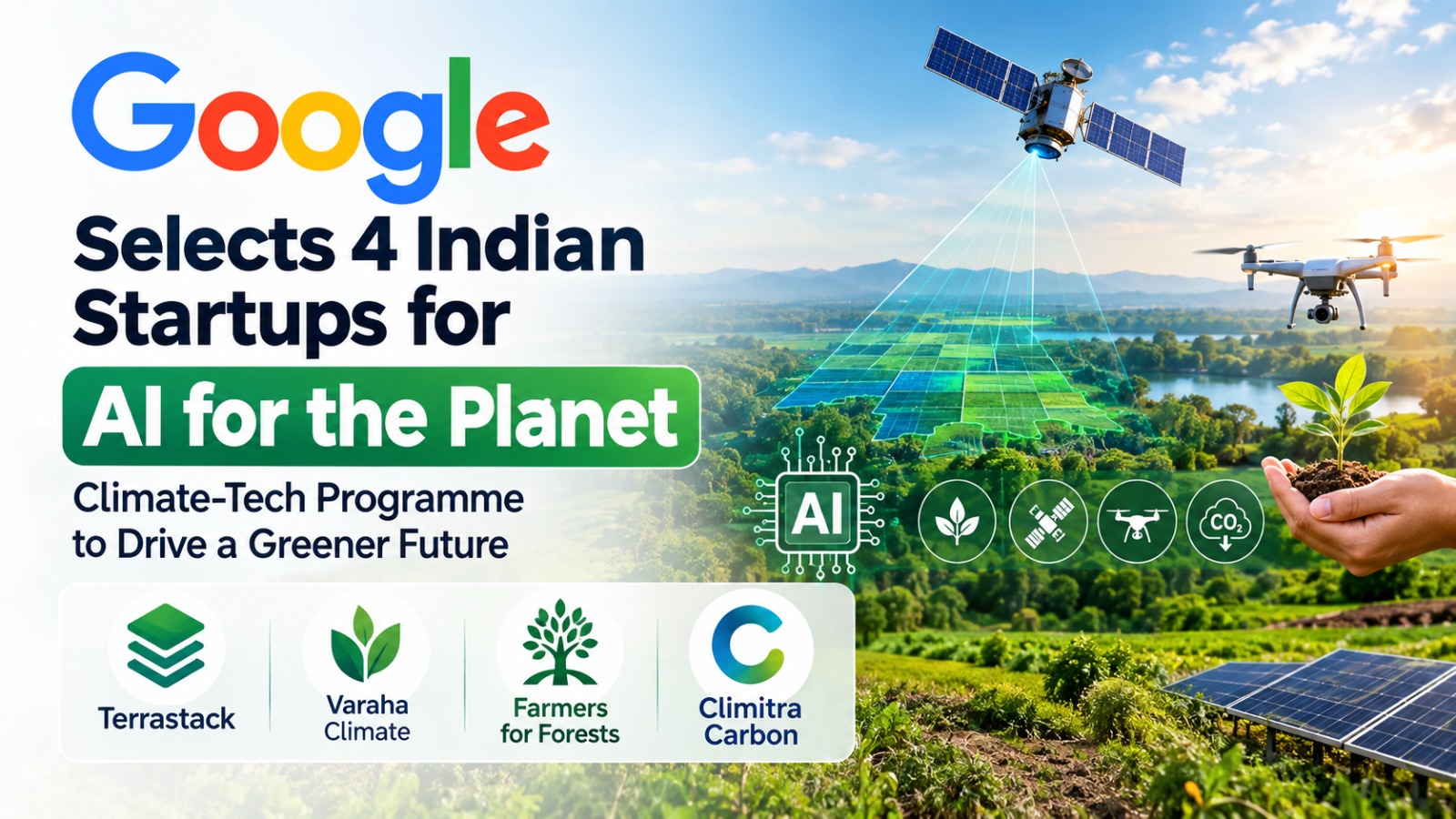
The selected startups are Terrastack, Varaha Climate, Farmers for Forests and Climitra Carbon. They are among 16 organisations selected across the Asia-Pacific region and will receive access to Google's AI technology stack, technical support and expert mentorship over a three-month programme.
The announcement highlights the growing intersection of artificial intelligence, satellite technology, agriculture and climate action in India's startup ecosystem.
Four Indian Startups Selected by Google
The four startups are developing technology-driven solutions for some of the world's major environmental and agricultural challenges.
1 Terrastack combines satellite and agricultural data to provide detailed land intelligence for smallholder farmers. Its technology aims to make agricultural decision-making more accurate and accessible.
2 Varaha Climate focuses on helping small farmers generate carbon credits by using remote sensing and artificial intelligence to verify regenerative agriculture and carbon-removal activities.
3 Farmers for Forests is using AI-powered drones to support agroforestry while measuring carbon and biodiversity outcomes at scale.
4 Meanwhile, Climitra Carbon is using Geo-AI to verify the removal of invasive species and their conversion into biochar, connecting land restoration with carbon-removal solutions.
Why Google's AI Programme Matters for Indian Startups
The selection is significant because it demonstrates how AI is expanding beyond conventional applications such as chatbots, software development and automation.
AI is increasingly being applied to areas such as agriculture, environmental monitoring, carbon measurement and biodiversity protection. For startups, this creates opportunities to develop technology that addresses real-world challenges while also building scalable businesses.
Google's support could also help these companies strengthen their technology, access technical expertise and expand their solutions to larger markets.
AI and Sustainable Agriculture
Agriculture is one of the areas where AI and satellite technology can potentially create significant impact.
Farmers and agricultural organisations can use data from satellites, drones and remote-sensing systems to better understand soil conditions, crop health and land use. Combining this information with AI can help turn large amounts of environmental data into practical insights.
The involvement of Terrastack and Varaha Climate in Google's programme demonstrates how AI-powered agriculture and climate solutions are becoming increasingly connected.
For India's large agricultural sector, technologies that improve resource efficiency, monitor farmland and support sustainable farming could become increasingly important.
Google Expands Its Climate-Tech Initiatives in India
Google's announcement goes beyond supporting the four startups.
The company also announced initiatives related to India's clean-energy transition, including an expansion of an AI-powered solar API aimed at supporting rooftop solar applications. Google also announced a long-term agreement with Renew Power involving a 150 MW utility-scale solar generation project in Rajasthan.
Another initiative with Mitti Labs will focus on helping smallholder rice farmers in Telangana adopt alternate wetting and drying practices, while Google is also opening opportunities for research and innovation proposals through the Centre's Manthan platform.
These initiatives indicate that technology companies are increasingly looking at climate action not only as an environmental issue but also as an area for technological innovation and business development.
What This Means for India's Startup Ecosystem
The development is another indication that India's startup ecosystem is becoming more diversified.
While fintech, e-commerce and consumer technology have traditionally received significant attention, sectors such as climate tech, deep tech, biotechnology, space technology and AI are gaining momentum.
The combination of AI with climate technology could create opportunities in areas including:
- Smart agriculture
- Carbon measurement
- Renewable energy
- Biodiversity monitoring
- Environmental intelligence
- Water management
- Sustainable supply chains
- Climate-risk analysis
For entrepreneurs, this represents an opportunity to build companies around problems that require both technological innovation and measurable real-world impact.
The Growing Role of AI in Climate Innovation
The Google programme also reflects a broader shift in how artificial intelligence is being developed and applied.
Instead of using AI only to improve existing digital products, startups are increasingly using it to interpret satellite imagery, analyse environmental data, monitor ecosystems and support sustainable business models.
This convergence of AI and climate technology could become an important area of innovation over the coming years.
For India, the opportunity is particularly significant because the country has a large agricultural sector, rapidly expanding renewable-energy capacity and a growing technology talent base.
Conclusion
Google's selection of Terrastack, Varaha Climate, Farmers for Forests and Climitra Carbon for its first AI for the Planet accelerator is an important development for India's climate-tech ecosystem.
The programme demonstrates how Indian startups are using artificial intelligence, satellite intelligence, remote sensing and drones to tackle challenges in agriculture, carbon removal, biodiversity and environmental sustainability.
As AI continues to evolve, its biggest impact may not come only from consumer applications. Its combination with climate science, agriculture and environmental technology could create a new generation of businesses focused on solving some of the world's most important challenges.
For India's startup ecosystem, the message is clear: AI innovation is expanding into the real world—and climate technology could be one of its most important frontiers.
To Read more such News Visit Startup Times


Leave a comment
Your email address will not be published. Required fields are marked *
Add a newsletter to your widget area.
Top Stories