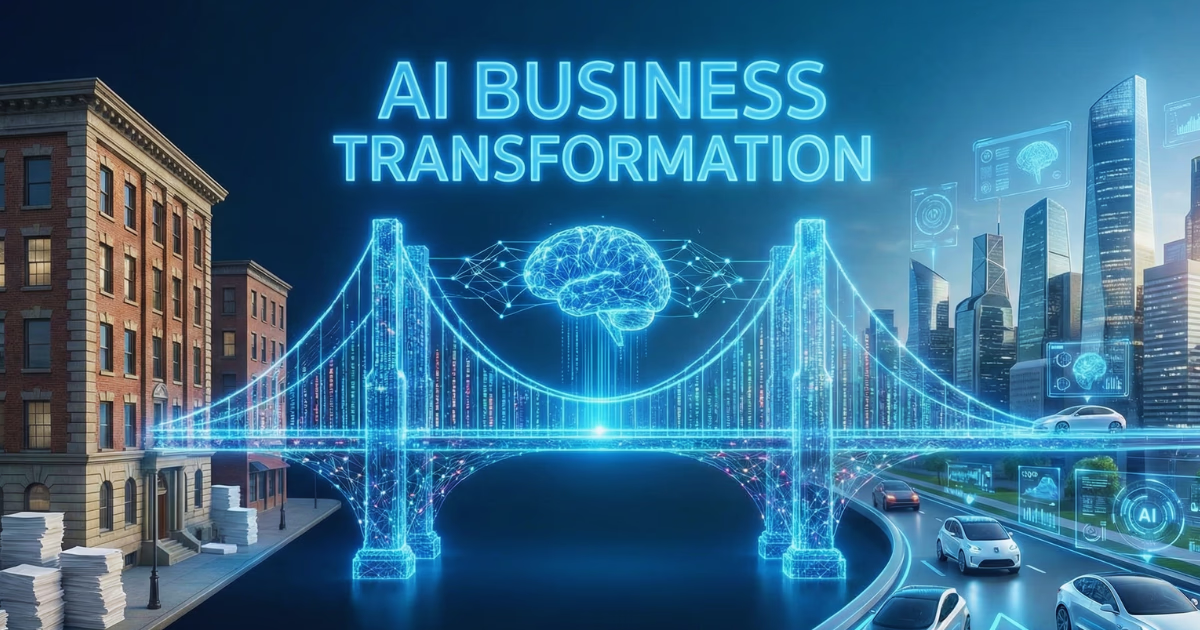
How AI Is Changing Small Businesses in India: Opportunities, Challenges and the Future
Discover how AI is changing small businesses in India, from automation and customer service to marketing, productivity, and smarter decision-making.
How AI Is Changing Small Businesses in India: Opportunities, Challenges and the Future
Artificial intelligence (AI) is no longer limited to large technology companies. It is rapidly becoming an important business tool for startups, entrepreneurs and small businesses across India. From automating repetitive tasks to improving customer service and creating marketing content, AI for small businesses in Indiais opening new opportunities for companies that may have limited employees, budgets and resources.
As competition increases across almost every industry, small businesses are looking for ways to reduce costs, save time and provide better customer experiences. AI can help businesses achieve these goals by making everyday operations faster, more efficient and increasingly data-driven.
Why AI Matters for Small Businesses
Small businesses often operate with limited resources. Business owners may have to manage marketing, customer support, sales, accounting and daily operations simultaneously. AI can assist with many of these tasks, allowing entrepreneurs and employees to focus more on strategic and creative work.
AI-powered tools can help businesses generate content, analyze customer data, answer common customer questions, organize information and automate repetitive administrative activities. This can improve productivity without requiring businesses to significantly expand their workforce.
For startups in particular, this can be a major advantage. A small team equipped with the right AI tools can potentially handle tasks that previously required multiple people or significant amounts of time.
AI Is Transforming Business Automation
One of the biggest advantages of AI is automation. Businesses can use AI to automate repetitive processes such as responding to frequently asked questions, organizing leads, scheduling appointments and generating reports.
For example, an online retailer can use AI-powered customer service tools to respond to basic queries around the clock. A marketing team can use AI to generate content ideas and analyze campaign performance, while sales teams can use AI to identify promising leads.
This type of AI business automation can help small companies improve efficiency while allowing employees to spend more time on activities that require human judgment.
AI Can Improve Customer Experience
Customers increasingly expect fast and personalized interactions with businesses. AI can help small companies meet these expectations without requiring a large customer-service department.
AI chatbots and virtual assistants can answer common questions, provide product information and guide customers through basic processes. AI can also analyze customer behavior and preferences, helping businesses provide more relevant recommendations and marketing messages.
For startups competing against established companies, providing a smooth customer experience can become an important competitive advantage.
AI and Digital Marketing for Small Businesses
Marketing is another area where AI is creating significant opportunities. Small businesses can use AI tools to brainstorm social media content, analyze audience behavior, identify trends and personalize marketing campaigns.
AI can also support search engine optimization by helping marketers identify content topics, organize information and understand search intent. However, businesses should avoid publishing low-quality AI-generated content without human review. Original ideas, expertise, accuracy and a genuine understanding of customers remain essential for successful digital marketing.
AI Can Support Better Business Decisions
Business decisions are often based on information collected from sales, customers, websites and marketing campaigns. AI can help analyze large amounts of data and identify patterns that may not be immediately obvious.
For example, a business could analyze sales data to determine which products are performing best, identify changes in customer demand or understand which marketing channels generate the strongest results.
This allows entrepreneurs to make more informed decisions instead of relying entirely on assumptions or intuition.
Challenges of Using AI
Despite its advantages, AI also creates challenges for small businesses. Cost, data privacy, cybersecurity and a lack of technical knowledge can make adoption difficult.
Businesses must also understand that AI systems can produce inaccurate or misleading information. Human oversight is therefore important, particularly when AI is being used for financial decisions, customer communications, legal information or other sensitive areas.
Another concern is employee adaptation. Introducing new technology without proper training can create confusion rather than improve productivity. Businesses should gradually introduce AI tools and ensure employees understand how to use them responsibly.
How Startups Can Begin Using AI
Small businesses do not need to completely transform their operations overnight. A practical approach is to identify repetitive tasks that consume significant amounts of time and determine whether AI can help.
Businesses can begin with simple applications such as content assistance, customer-support automation, meeting summaries, data organization or basic analytics. After evaluating the results, they can expand AI adoption to other areas.
The goal should not be to use AI simply because it is popular. Instead, businesses should focus on whether a particular AI solution saves time, reduces costs, improves customer satisfaction or contributes to revenue growth.
The Future of AI for Indian Businesses
AI adoption is likely to become increasingly important as technology becomes more accessible. Startups and small businesses that learn how to combine AI with human creativity, expertise and decision-making may gain a significant advantage in competitive markets.
The future of business will not necessarily be about replacing people with AI. Instead, it is increasingly likely to involve people working alongside AI to complete tasks faster, analyze information more effectively and create better customer experiences.
For Indian entrepreneurs, this represents both an opportunity and a challenge. Businesses that experiment responsibly with AI today can build valuable skills and systems that may help them compete in an increasingly digital economy.
Conclusion
AI for small businesses in India is moving from an emerging concept to a practical business opportunity. Whether it is used for automation, marketing, customer service, data analysis or productivity, AI can help small businesses accomplish more with limited resources.
However, successful AI adoption requires more than simply purchasing new tools. Businesses need clear objectives, employee training, human oversight and responsible data practices. For startups willing to adapt and experiment, AI could become one of the most valuable technologies shaping the next generation of Indian businesses.

Leave a comment
Your email address will not be published. Required fields are marked *
Add a newsletter to your widget area.
Top Stories