
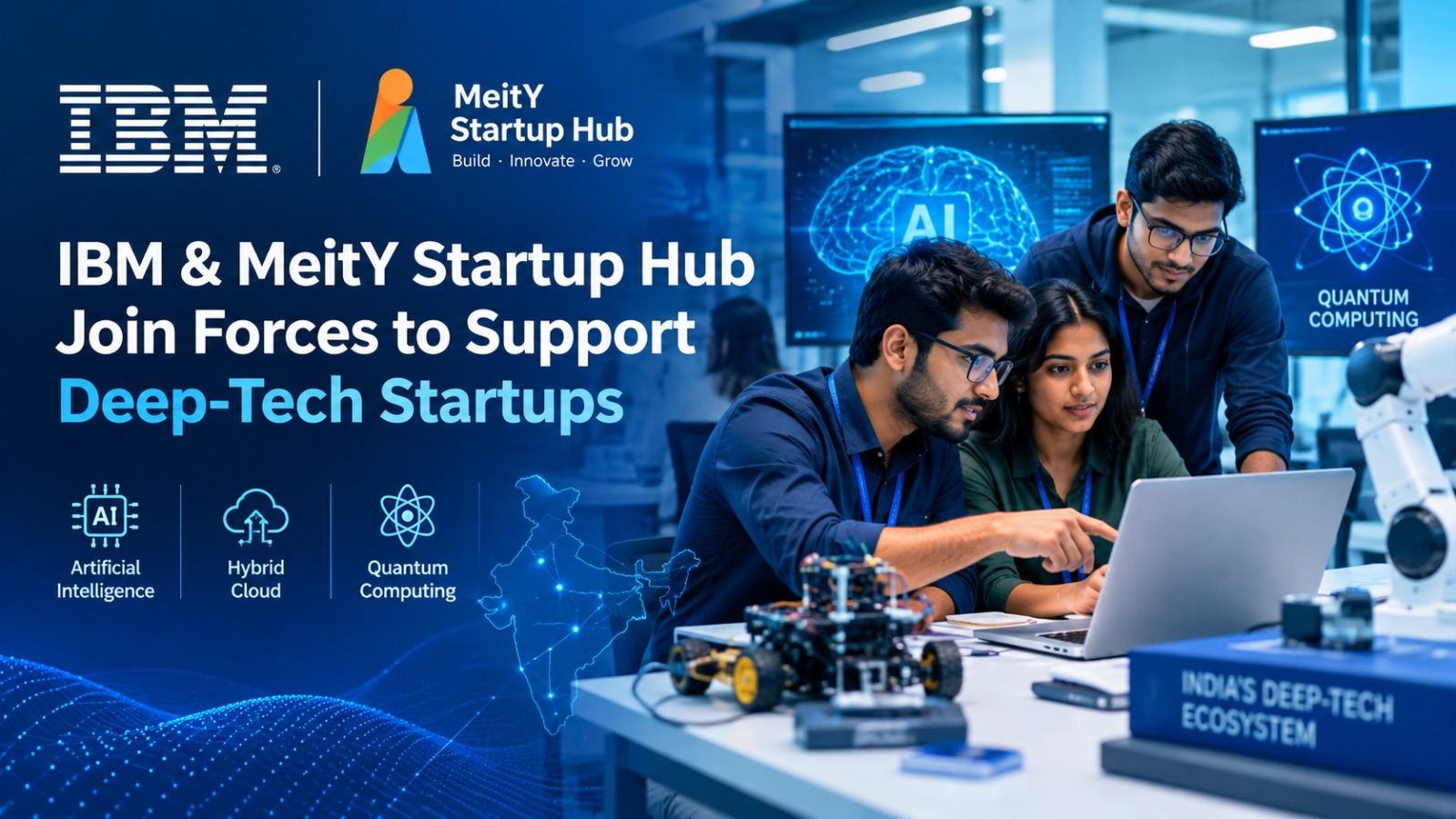
IBM and MeitY Startup Hub Partner to Support India’s Deep-Tech Startups
IBM and MeitY Startup Hub partner to support Indian deep-tech startups with AI technology, mentorship, skills training and enterprise connections
India's deep-tech startup ecosystem is receiving fresh support through a new partnership between IBM and the MeitY Startup Hub (MSH), an initiative associated with the Ministry of Electronics and Information Technology. The two organisations have signed a memorandum of understanding (MoU) aimed at helping startups develop advanced technology solutions, strengthen technical capabilities and connect with enterprise customers.
The collaboration will focus on areas such as artificial intelligence (AI), hybrid cloud and quantum computing. It is designed to help emerging technology companies access tools, technical guidance and industry opportunities that can support the development and commercialisation of their products.
The announcement reflects India's broader ambition to strengthen its domestic innovation ecosystem and encourage startups to build technology solutions for complex business and industrial challenges.
What the IBM and MeitY Startup Hub Partnership Includes
Under the agreement, IBM and MeitY Startup Hub will work to provide deep-tech startups with access to technology platforms, mentorship, skills training and enterprise engagement opportunities.
Startups working on advanced technology products often require more than an initial business idea. They need technical infrastructure, specialised knowledge, opportunities to test their solutions and access to potential customers. The partnership aims to address some of these requirements by connecting startups with technology resources and industry expertise.
The collaboration is expected to help eligible startups explore IBM platforms and develop proof-of-concept projects. These projects can demonstrate how a technology solution works in practice before businesses invest in wider implementation.
The initiative will also encourage engagement with open-source projects and provide opportunities for startups to connect with larger enterprises.
According to reporting by Express Computer, the programme will pay particular attention to promising startups in Tier 2 and Tier 3 cities, helping expand opportunities beyond India's established technology centres.
Focus on Artificial Intelligence, Hybrid Cloud and Quantum Computing
The partnership identifies several advanced technology areas that could shape the next generation of Indian startups.
Artificial Intelligence
Artificial intelligence is becoming increasingly important across industries, including healthcare, education, manufacturing, retail and financial services.
Startups are developing AI-powered products for customer support, business automation, data analysis, software development and specialised industry applications. Access to technology platforms and technical mentorship can help founders test their ideas, improve product performance and identify practical commercial applications.
The partnership's AI focus could be particularly relevant for startups building enterprise software and solutions designed to automate complex business processes.
Hybrid Cloud
Hybrid cloud combines private computing environments with public cloud services, allowing organisations to manage applications and data across different infrastructure settings.
For startups serving enterprise customers, understanding hybrid cloud architecture can be important for building scalable, secure and flexible products.
Technology support in this area may help founders develop solutions that integrate with existing business systems while meeting customer requirements for performance, security and reliability.
Quantum Computing
Quantum computing remains an emerging field with the potential to address certain specialised computational problems. Although practical applications are still developing, research and experimentation are creating opportunities for companies working in advanced computing and related technologies.
For Indian deep-tech startups, access to specialised platforms, technical guidance and research communities could help build expertise in this complex area.
The long-term commercial impact will depend on technological progress, practical use cases and the ability to turn research into solutions that businesses can adopt.
Why Deep-Tech Startups Need Industry Support
Deep-tech companies differ from many conventional digital startups because their products often depend on advanced research, specialised engineering and lengthy development cycles.
A startup building a simple online service may be able to launch an initial product relatively quickly. By contrast, a company developing advanced AI infrastructure, quantum computing applications or sophisticated industrial technology may need substantial testing, technical validation and access to specialised resources.
These requirements can make early development challenging.
Industry partnerships can help founders obtain technical feedback, improve their products and understand enterprise expectations. They may also provide opportunities to validate solutions through proof-of-concept projects before attempting larger commercial deployments.
However, access to technology alone does not guarantee business success. Startups must also demonstrate customer demand, maintain strong security practices, develop sustainable business models and build products that solve clearly defined problems.
Opportunities for Startups Beyond Major Technology Cities
India's technology ecosystem extends well beyond established hubs such as Bengaluru, Hyderabad, Delhi-NCR, Mumbai and Pune.
Entrepreneurs in Tier 2 and Tier 3 cities are increasingly exploring software products, AI applications, industrial technologies and specialised digital services. Yet access to experienced mentors, enterprise customers and advanced technical resources can vary significantly by location.
By highlighting startups from smaller cities, the IBM–MeitY Startup Hub collaboration could help broaden participation in India's deep-tech ecosystem.
For founders, such programmes may provide a route to strengthen technical capabilities and build relationships with organisations that could eventually become customers or implementation partners.
The success of this approach will depend on how effectively startups can access the programme, use the available resources and convert their work into viable commercial products.
How Enterprise Connections Can Help Startups Scale
Developing a working prototype is only one stage of building a successful technology business. Startups must also demonstrate that their products can solve real problems for customers.
Enterprise engagement can help founders understand business requirements, regulatory expectations, integration challenges and purchasing processes.
For example, a startup developing an AI-powered business tool may need to demonstrate how its product integrates with an organisation's existing software, protects sensitive information and produces measurable operational improvements.
Similarly, a company developing cloud infrastructure solutions must demonstrate reliability, scalability and security before larger customers consider adoption.
Opportunities to engage with established enterprises can therefore help startups refine their products and better understand the requirements of commercial deployment.
The partnership's emphasis on proof-of-concept development and enterprise engagement is intended to support this journey from technical development towards practical applications.
What the Partnership Means for India's Startup Ecosystem
India's startup ecosystem has expanded across consumer technology, software services, digital commerce and enterprise applications. Deep-tech innovation represents another important area of development because it involves building advanced technological capabilities and potentially creating intellectual property with long-term commercial applications.
Collaborations between technology companies and startup-support organisations can help connect entrepreneurial talent with technical expertise and industry requirements.
The IBM and MeitY Startup Hub initiative is positioned to support startups working on complex technologies while encouraging wider participation across India's geography.
Its broader significance will depend on the number of startups that benefit, the quality of the technical support provided and the extent to which participating companies successfully develop and commercialise their solutions.
For founders, the opportunity is to use these resources to solve real-world problems rather than focus solely on technological experimentation.
Conclusion
The partnership between IBM and MeitY Startup Hub marks another effort to strengthen India's deep-tech startup ecosystem through technology access, mentorship, skills development and enterprise connections.
By focusing on artificial intelligence, hybrid cloud and quantum computing, the initiative aims to support startups developing solutions in advanced technology fields. Its emphasis on proof-of-concept projects and opportunities for founders outside major technology centres could also help broaden access to innovation resources.
As India continues to develop its technology ecosystem, collaborations between established technology companies and emerging startups may play an important role in turning research and experimentation into practical business solutions.
For entrepreneurs, the key opportunity lies in combining technical innovation with customer understanding, responsible technology development and a clear path towards commercial adoption.
To Read More Such News Visit Startup Times .

Leave a comment
Your email address will not be published. Required fields are marked *
Add a newsletter to your widget area.
Top Stories