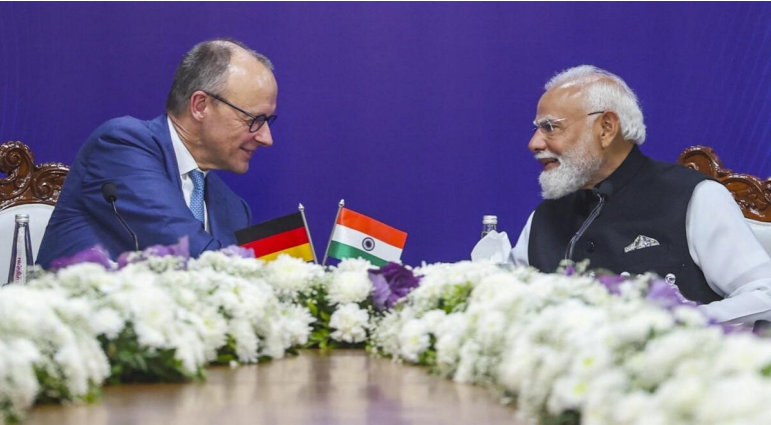
India and Germany have taken a decisive step toward deepening their bilateral relationship, formalising 19 memoranda of understanding and agreements spanning defence cooperation, trade expansion, critical minerals, advanced technology and semiconductor collaboration. The agreements were concluded during the official visit of Friedrich Merz, marking one of the most comprehensive rounds of cooperation between the two countries in recent years.
The expanded partnership reflects a shared strategic intent to strengthen economic resilience, diversify supply chains and align more closely on high-technology and security priorities. At a time of geopolitical uncertainty and global economic realignment, New Delhi and Berlin are positioning their relationship as both economically complementary and strategically relevant.
The agreements come at a moment when both countries are recalibrating their global economic and strategic priorities. India is seeking to accelerate industrial growth, attract high-value foreign investment and secure technology partnerships that support its ambitions in manufacturing, clean energy and digital infrastructure. Germany, meanwhile, is looking to diversify supply chains, reduce strategic dependencies and deepen engagement with fast-growing economies beyond Europe.
Against this backdrop, the expanded India–Germany cooperation reflects a shared recognition that long-term competitiveness and strategic autonomy will increasingly depend on trusted partnerships across defence, technology and critical resources.
Scope and Scale of the 19 Agreements
The agreements signed cover a wide spectrum of cooperation, underscoring the breadth of the India–Germany relationship. Key focus areas include defence collaboration, trade facilitation, technology partnerships, critical minerals, and semiconductors—sectors increasingly viewed as essential to national security and long-term economic competitiveness.
Defence cooperation agreements aim to enhance joint research, development and industrial collaboration, aligning with India’s broader push for defence indigenisation and Germany’s interest in strengthening strategic ties in the Indo-Pacific. In parallel, trade-related MoUs seek to reduce barriers, promote investment flows and enable closer engagement between Indian and German businesses.
The inclusion of critical minerals and semiconductor cooperation reflects a strategic convergence. Both countries are seeking to reduce dependence on concentrated global supply chains while ensuring secure access to resources and technologies vital to manufacturing, clean energy and digital infrastructure.
High-Technology and Semiconductor Collaboration
Technology cooperation emerged as a central pillar of the agreements. India and Germany committed to enhanced collaboration in high-tech sectors, including advanced manufacturing, digital technologies and semiconductor ecosystems. These initiatives are designed to support India’s ambition to emerge as a global manufacturing and technology hub, while offering German firms opportunities to diversify production and innovation networks.
Semiconductor cooperation is particularly significant, given global shortages and the strategic importance of chips across industries—from defence systems to consumer electronics and artificial intelligence. The agreements open pathways for joint research, talent exchange and industrial partnerships, potentially linking Germany’s engineering expertise with India’s growing electronics manufacturing base.
Officials described the technology accords as forward-looking, aimed not only at immediate commercial gains but at building long-term innovation capacity across both economies.
Critical Minerals and Supply Chain Resilience
Another notable component of the agreements is cooperation on critical minerals, an area of rising geopolitical and economic importance. With clean energy transitions accelerating worldwide, access to minerals essential for batteries, renewable energy systems and advanced electronics has become a strategic priority.
India and Germany agreed to work more closely on securing, processing and managing critical mineral supply chains. The collaboration is intended to reduce vulnerability to supply disruptions and promote sustainable sourcing practices. Analysts view this as part of a broader effort by both countries to hedge against global supply concentration and geopolitical risk.
By aligning on critical minerals, the two nations aim to support industrial growth while advancing shared climate and sustainability objectives.
Mobility and Trade Facilitation
Beyond strategic industries, the agreements also include measures aimed at easing mobility and strengthening people-to-people connections. Among the notable initiatives is visa-free airport transit for Indian travellers to Germany, a move expected to simplify travel and enhance business, academic and cultural exchanges.
Trade facilitation measures are designed to encourage deeper commercial engagement, particularly for small and medium-sized enterprises. German companies are among the largest European investors in India, and the new agreements seek to create a more predictable and enabling environment for future investment.
Officials emphasised that stronger mobility and trade frameworks are essential to sustaining long-term economic ties and fostering mutual understanding between the two societies.
Strategic and Geopolitical Significance
The timing and scale of the agreements underscore their broader strategic importance. As global economic power shifts and geopolitical tensions reshape alliances, both India and Germany are seeking reliable partners beyond traditional blocs.
For India, deeper engagement with Germany strengthens its links with Europe’s largest economy and technological powerhouse. For Germany, closer ties with India reinforce its Indo-Pacific strategy and economic diversification goals.
The visit by Chancellor Merz and the signing of 19 agreements signal a shared recognition that bilateral cooperation must extend beyond trade into areas such as security, technology sovereignty and supply-chain resilience. Observers note that the partnership complements India’s multi-alignment foreign policy and Germany’s efforts to recalibrate its global economic and strategic posture.
Outlook
While the signing of 19 agreements marks a significant milestone, the focus now shifts to implementation. Effective execution will determine whether the partnership delivers tangible outcomes in investment, innovation and strategic cooperation.
If carried forward successfully, the expanded India–Germany framework could serve as a model for deeper collaboration between emerging and advanced economies. As both countries navigate a rapidly changing global environment, the agreements reflect a clear intent to anchor their relationship in long-term strategic trust, economic opportunity and shared technological ambition.