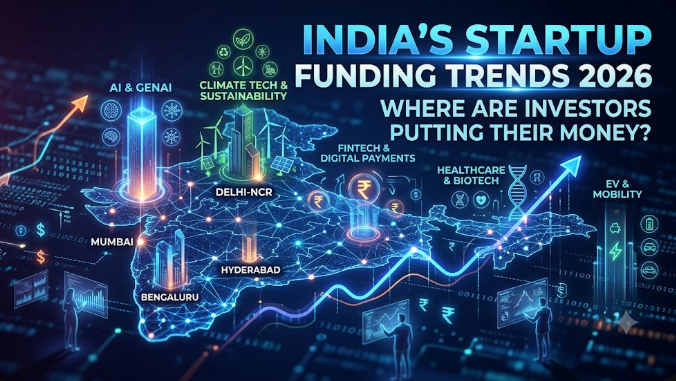
India’s Startup Funding Trends: Where Are Investors Putting Their Money in 2026?
startup funding in India 2026, Indian startup funding, investors in Indian startups, AI startup funding India, fintech funding India, deeptech startups India
New Delhi: India’s startup ecosystem is entering a more selective phase in 2026. While overall startup funding has moderated compared with the previous year, investors continue to put money into businesses with strong technology, scalable models, clear market opportunities and a path toward sustainable growth.
Indian startups raised around $5.2 billion across 501 funding deals during the first half of 2026, according to Inc42. The total funding was down 9% year-on-year from $5.7 billion in H1 2025, but the number of deals increased by 7%. This indicates that investors have not abandoned Indian startups; instead, capital allocation is becoming more selective and diversified.
The biggest change in India's startup funding landscape is the growing importance of artificial intelligence, deeptech, advanced hardware, climate technology and other technology-led businesses.
At the same time, traditional sectors such as fintech and ecommerce continue to attract significant capital, although funding in these categories has become more disciplined.
India Startup Funding in 2026: A More Selective Market
The funding environment in 2026 is very different from the "growth at any cost" period that dominated the Indian startup ecosystem a few years ago.
Investors are increasingly looking at revenue quality, margins, customer retention, technology advantages and the ability of a startup to build a sustainable business.
In H1 2026, Indian startups raised $5.2 billion across 501 deals. While funding declined 9% from the same period in 2025, deal activity actually increased.
The median funding ticket remained around $3 million, while mega rounds of $100 million or more became less common. Only four such mega funding rounds were recorded during H1 2026, compared with 11 in H1 2025.
This suggests a shift from a market dominated by a small number of massive fundraising rounds toward a broader funding environment where investors are backing more companies with relatively smaller cheques.
Interestingly, around 64% of investors surveyed by Inc42 said they planned to increase their venture capital allocation during the second half of 2026.
For founders, this means funding is still available—but investors are becoming more careful about where they deploy it.
Artificial Intelligence Becomes a Major Investment Magnet
Artificial intelligence has emerged as one of the strongest themes in India's startup funding market in 2026.
Indian AI startups raised approximately $676 million across 57 deals during H1 2026, representing a 317% increase compared with the $162 million raised across 30 deals in H1 2025. AI funding therefore grew more than four times year-on-year even as overall startup funding declined.
The increase is being driven by growing investor interest in areas such as enterprise AI, AI infrastructure, foundation models, automation, cybersecurity and industry-specific AI applications.
The emergence of large Indian AI companies is also attracting greater attention to the sector.
For example, Sarvam AI raised $234 million in June 2026, becoming India's second AI unicorn. The company's funding round highlighted the increasing willingness of investors and strategic technology companies to place large bets on India's domestic AI capabilities.
The AI opportunity is not limited to software applications. Investors are increasingly looking at the infrastructure required to power AI—including computing capacity, data centres, chips and advanced hardware.
This is creating opportunities across the wider technology ecosystem.
Deeptech and Advanced Hardware Gain Momentum
Another important trend in India's startup funding market is the growing investor interest in deeptech.
Startups working on advanced hardware and technology raised approximately $365 million in H1 2026, up 17% year-on-year. The sector also recorded 66 deals, representing a 53% increase in deal volume.
This growth reflects a wider shift in investor thinking.
For years, India's startup ecosystem was heavily associated with consumer internet companies, fintech platforms and ecommerce businesses. In 2026, investors are increasingly looking at companies building technology that can create long-term competitive advantages.
This includes semiconductors, robotics, defence technology, space technology, industrial automation and other advanced technologies.
The Indian government's focus on initiatives such as the IndiaAI Mission and semiconductor development is also influencing investment decisions. Inc42 reported that around 66% of institutional investors surveyed said the IndiaAI Mission had influenced their AI investment thesis, while 61% said the semiconductor mission had shaped their outlook toward deeptech and hardware.
SpaceTech Attracts Bigger Investor Bets
India's private space sector is another area attracting increasing investor attention.
In September 2026, Bengaluru-based space technology startup Pixxel raised $100 million in a Series C funding round, led by Temasek and Seraphim Space Investment Trust. Reuters reported that the round was the largest funding round for an Indian space technology company and took Pixxel's total funding to $195 million.
The investment is expected to support Pixxel's satellite constellation, high-resolution imaging capabilities and Aurora Earth-intelligence platform.
The deal reflects a broader trend in India's startup ecosystem: investors are increasingly willing to back businesses that combine technology with strategic infrastructure.
Earlier in 2026, Indian SpaceTech startups had already attracted $113 million in equity funding, taking cumulative investment in the sector since 2021 to $871 million, according to data reported from Tracxn.
As India's private space sector expands, areas such as satellite data, Earth observation, launch technology, communications and space infrastructure could attract more capital.
Fintech Remains the Largest Funded Sector
Despite the rapid growth of AI funding, fintech remains one of the biggest destinations for startup capital in India.
Indian fintech startups raised around $1.3 billion during H1 2026, making fintech the most funded startup sector during the period. However, this was a 19% decline compared with $1.6 billion in H1 2025.
The slowdown does not mean investors have lost interest in financial technology.
Instead, the market is becoming more mature.
Investors are increasingly interested in fintech companies that can demonstrate strong risk management, sustainable unit economics and regulatory compliance.
Areas such as digital lending, wealth management, insurance technology, payments infrastructure and financial software continue to provide opportunities.
Recent funding activity also shows that established fintech companies can still attract significant capital.
For example, Navi announced plans to raise $100 million from Prosus ahead of a potential IPO, highlighting continued investor interest in established digital financial services businesses.
Ecommerce Funding Becomes More Selective
Ecommerce remains an important part of India's startup ecosystem, but investors are becoming more cautious about consumer internet businesses.
Ecommerce startups raised approximately $779 million in H1 2026, down 35% year-on-year. However, ecommerce recorded 112 funding transactions, making it the sector with the highest number of deals during the period.
The trend suggests that investors are still interested in consumer businesses, but the investment criteria have changed.
Instead of simply rewarding rapid customer acquisition, investors are increasingly examining gross margins, repeat purchases, customer acquisition costs, contribution margins and cash flow.
This could benefit startups operating in specialised consumer categories rather than companies competing purely on discounts.
Premium consumer products, health-focused products, specialised D2C brands and businesses with strong distribution networks may continue to attract funding if they demonstrate sustainable economics.
Climate Tech and Clean Energy Continue to Attract Capital
Climate technology is another area receiving increasing investor attention.
India's transition toward renewable energy, electric mobility, energy storage and sustainable infrastructure is creating opportunities for startups solving large industrial and environmental problems.
Investors are increasingly interested in businesses that combine climate impact with commercial scalability.
Recent funding activity has included companies working in renewable energy, electric mobility, energy infrastructure and carbon-related technologies.
The investment opportunity is also connected to India's broader industrial development.
As companies and governments focus on reducing emissions, improving energy efficiency and building cleaner infrastructure, startups that can provide commercially viable solutions could become increasingly important.
This makes climate tech different from some consumer startup categories: many of its opportunities are linked to long-term infrastructure and industrial spending.
Enterprise SaaS and Software Remain Important
India's software ecosystem continues to attract investors, particularly where startups can sell technology to global businesses.
Enterprise software and SaaS companies can offer investors an attractive combination of recurring revenue, international markets and scalable technology.
However, the SaaS investment environment has also become more selective.
Investors are increasingly looking for businesses with strong retention, efficient customer acquisition and clear differentiation.
Instead of simply asking how quickly a SaaS company can acquire customers, investors are looking more closely at whether those customers stay, expand their spending and generate attractive lifetime value.
This shift favours startups that can demonstrate strong product-market fit and efficient growth.
Healthcare and HealthTech Remain on the Investment Radar
Healthcare is another sector that continues to attract capital, although funding can vary significantly between months and business models.
India's growing healthcare demand, expansion of private healthcare services and increasing adoption of technology create opportunities for startups working in diagnostics, healthcare delivery, medical technology and biotechnology.
The broader healthcare investment environment also extends beyond traditional venture capital.
According to an EY report, India's private credit market deployed approximately $3.5 billion across more than 100 transactions above $10 million in H1 2026. Healthcare accounted for 13% of private-credit deal value, making it the second-largest sector after real estate.
This demonstrates that healthcare companies are attracting not only equity investors but also alternative forms of capital.
Investors Are Looking for Profitability and Strong Unit Economics
Perhaps the biggest startup funding trend in India in 2026 is not a particular sector but a change in investor expectations.
The market has moved toward capital efficiency.
Investors want startups to show that every rupee invested can generate meaningful business growth.
This means metrics such as customer acquisition cost, lifetime value, gross margin, retention, burn rate and cash runway have become increasingly important.
Recent comments from investors also point toward greater emphasis on profitability and sustainable business models. Financial Express reported that 3one4 Capital is expanding its investment focus into areas including agriculture, health, deeptech and energy transition while placing greater emphasis on capital efficiency.
This does not mean investors are no longer willing to take risks.
Instead, the risks they are willing to take are increasingly associated with technology and large market opportunities rather than simply high customer growth.
Late-Stage Funding Faces More Pressure
While early and growth-stage startups continue to receive investor attention, late-stage funding has become more challenging.
According to Inc42, late-stage funding declined to approximately $2.2 billion in H1 2026, while growth-stage funding increased 15% to $2.3 billion. Seed-stage funding also increased 18% to $478 million.
This suggests investors are willing to fund startups earlier in their journeys when the potential upside is significant, while mature companies face greater scrutiny over valuation and financial performance.
At the same time, late-stage deals that do happen can be substantially larger.
Economic Times reported that the average late-stage startup deal in India reached about $86 million during the first half of 2026, more than double the average of the previous two six-month periods. The capital was concentrated in areas such as AI infrastructure, data centres, clean energy, lending and established consumer platforms.
This creates an interesting two-speed market: fewer late-stage companies may receive funding, but those considered strong enough can attract very large cheques.
What Investors May Prioritise in the Rest of 2026
The second half of 2026 is likely to remain focused on technology, efficiency and businesses addressing large markets.
AI is expected to remain one of the strongest investment themes, particularly as enterprises increase spending on AI infrastructure and automation.
Deeptech, semiconductor-related businesses, space technology and defence technology could also benefit from India's push toward technological self-reliance.
Climate technology and energy transition businesses may attract patient capital because of their long-term infrastructure opportunities.
Fintech and consumer businesses will continue to receive funding, but startups in these sectors may need stronger financial fundamentals to compete for investor attention.
The growing IPO market could also influence private startup funding. India's IPO pipeline has expanded significantly, with hundreds of companies preparing to potentially access public markets. This could provide venture investors with more exit opportunities and potentially improve confidence in later-stage investments.
The Bigger Picture for India's Startup Ecosystem
India's startup funding market in 2026 is not simply shrinking or growing. It is changing.
The $5.2 billion raised during H1 2026 was lower than the previous year's figure, but deal volume increased. AI funding grew more than four times, deeptech gained momentum, fintech remained the largest funded sector, and investors continued to back businesses in climate tech, healthcare, SaaS, space and advanced technology.
The message from investors is becoming clearer.
Startups need more than a large market and a fast-growing user base. They need technology, differentiation, strong execution and a credible path to sustainable economics.
For founders, this means the fundraising pitch in 2026 needs to answer tougher questions: What problem does the company solve? Why is its technology difficult to replicate? How efficiently can it grow? Can it build a strong margin profile? And what will make customers stay?
For investors, meanwhile, India's large consumer market, expanding digital economy and growing technology capabilities continue to offer significant opportunities.
The result is a startup ecosystem that may be less speculative than the funding boom of previous years—but potentially more mature.
In 2026, India's startup funding story is increasingly about quality over quantity. Investors are still putting billions of dollars into Indian startups, but the money is moving toward companies that combine innovation with execution, technology with real-world demand, and growth with a credible path to profitability.


Leave a comment
Your email address will not be published. Required fields are marked *
Add a newsletter to your widget area.
Top Stories