How Luis von Ahn Turned Language Learning Into a Daily Habit With Duolingo
The story of Luis von Ahn and Severin Hacker’s Duolingo: accessible education, learning habits, a freemium model, and the journey to public markets.
A language lesson competes with everything else a person could do on a phone. Even a learner with a strong reason to study can find it difficult to return tomorrow, and the day after that. Luis von Ahn and Severin Hacker built Duolingo around both sides of that problem: widening access to education and creating a product people would choose to use repeatedly. The combination made motivation a product challenge rather than an assumption.
The US company’s founder story reaches from computer-science research to consumer software and public markets. It also raises questions that matter far beyond education technology. How can a free service support a durable business? Which engagement measures indicate meaningful progress? How does a founder preserve a mission when the organization must also recruit, invest, and generate revenue? Duolingo offers a useful case study precisely because those tensions remain part of the work.
An experienced builder starts an education company
Duolingo’s investor biography records that von Ahn founded the company with Hacker in August 2011. Before that, he led reCAPTCHA until its acquisition by Google in 2009. His background in computer science and internet-scale systems provided experience relevant to building a product intended for a very large audience, even though language learning presented a different problem.
The transition is important because expertise does not transfer automatically between markets. Technical skills can help a team build software, test ideas, and analyze behavior. Education also requires decisions about what should be taught, how it should be sequenced, and how to know whether a learner understands. A founder moving into a new field needs to combine prior strengths with people and methods suited to the new task. The technology is a means of delivering the learning experience.
The mission shaped the business question
In his letter marking Duolingo’s 2021 public listing, von Ahn described an ambition to make high-quality education available regardless of a person’s resources or location. The mission was not simply a line beside the product; it created a commercial design constraint. If broad access was essential, the company needed a model capable of supporting users who would not all become paying subscribers.
That is a demanding starting point for an entrepreneur. A mission can clarify what a company is trying to achieve, but it cannot replace an operating model. The organization still needs people, infrastructure, research, and ongoing product development. The useful question is how the business can finance those activities without undermining the access it is trying to create. A sustainable answer must account for both the learner’s experience and the resources required to keep delivering it.
Launching a product people could return to
A 2020 founder letter about Duolingo’s values recounts the collaboration with Hacker and the app’s 2012 launch. The later success of a learning app should not obscure the basic product challenge at that point: an educational opportunity is valuable only if people can incorporate it into their lives. The phone offered distribution and convenience, but not automatic commitment.
Learning differs from many transactional software tasks. Booking a meeting or sharing a file has a relatively immediate completion point. Developing language ability requires repeated work over time. The product therefore needs to help a person begin, recognize progress, and resume after interruption. This makes pacing and feedback central to the experience. A founder cannot assume that a customer’s stated intention to learn will translate directly into consistent behavior.
Making a small lesson feel achievable
Short, approachable interactions reduce the practical burden of starting. A person may not have the time or energy for a long class, yet still be willing to complete a smaller exercise. This is a general product principle rather than proof that every short session produces the same educational result. The design must connect manageable effort with a coherent path toward improvement.
For founders, the lesson is to identify the smallest unit of value that can genuinely help the user. Making an activity brief is useful when it removes unnecessary friction. It becomes less useful if the simplification strips away what the customer needs to accomplish. In education, the balance requires attention to understanding and retention, not only task completion. An attractive interface can support learning, but it cannot serve as the sole evidence that learning is happening.
Habit is valuable, but it is not the entire outcome
Duolingo’s association with daily practice illustrates the importance of return behavior in consumer products. A learner who keeps coming back has more opportunities to improve than one who stops immediately. Yet engagement and effectiveness should be examined separately. Repeated use is a necessary input for many learning goals; it is not a complete measurement of whether those goals have been achieved.
The distinction is relevant to founders in health, productivity, and personal development as well. A product may encourage useful behavior while also generating activity that is easy to count. The team needs to know which measures connect to the customer’s underlying purpose. Otherwise, optimizing a visible metric can distract from the desired result. Duolingo’s category makes that tension unusually clear because the user ultimately wants an ability, not merely a record of opening an app.
A free service needs a carefully designed economic engine
Duolingo’s public product information presents free learning alongside paid offerings. The commercial logic of such a model is to allow broad participation while giving some customers reasons to purchase additional value. The existence of free access does not mean the service is costless to operate, and the existence of paid plans does not by itself establish whether the balance serves learners well.
For entrepreneurs considering a similar model, the important questions concern cost, conversion, and experience. What can be provided sustainably to everyone? What paid benefits are meaningful without making the basic service unusable? How does the company explain those choices? A freemium model is a set of product and financial decisions, rather than a distribution trick. It works only when the experience and economics reinforce each other over time.
Scientific methods and product judgment
A software learning platform can observe how people respond to different exercises, interfaces, and sequences. That creates opportunities to test ideas and improve the experience. Duolingo maintains a research presence focused on questions about learning and its products. The broader point is that a digital education company can treat improvement as an ongoing investigation rather than a curriculum frozen at launch.
Experimentation still needs judgment. A test may establish that one design increases completion, while leaving unanswered whether the change improves long-term understanding for every group of learners. Different users can have different goals and starting points. Founders should therefore match the evidence to the claim. Product metrics, research studies, and user feedback can inform one another, but they should not be treated as interchangeable answers to the same question.
Growing from an app into an institution
At its 2021 listing, Duolingo said it offered courses in more than 40 languages to around 40 million monthly active learners and had a team of over 400. Those figures describe that historical moment, not the company’s present scale. They show the organizational distance between a founding idea and an education business serving a broad public.
That distance changes the founder’s responsibilities. Hiring, management, prioritization, and institutional processes become part of delivering the mission. A small team can coordinate informally; a larger organization needs clarity about decisions and standards. Growth also creates more varied customer needs. A new learner, an advanced learner, and someone preparing for a specific opportunity may expect different things from the same product. The founder must help the organization make coherent choices rather than simply accumulating requests.
Public markets added another audience
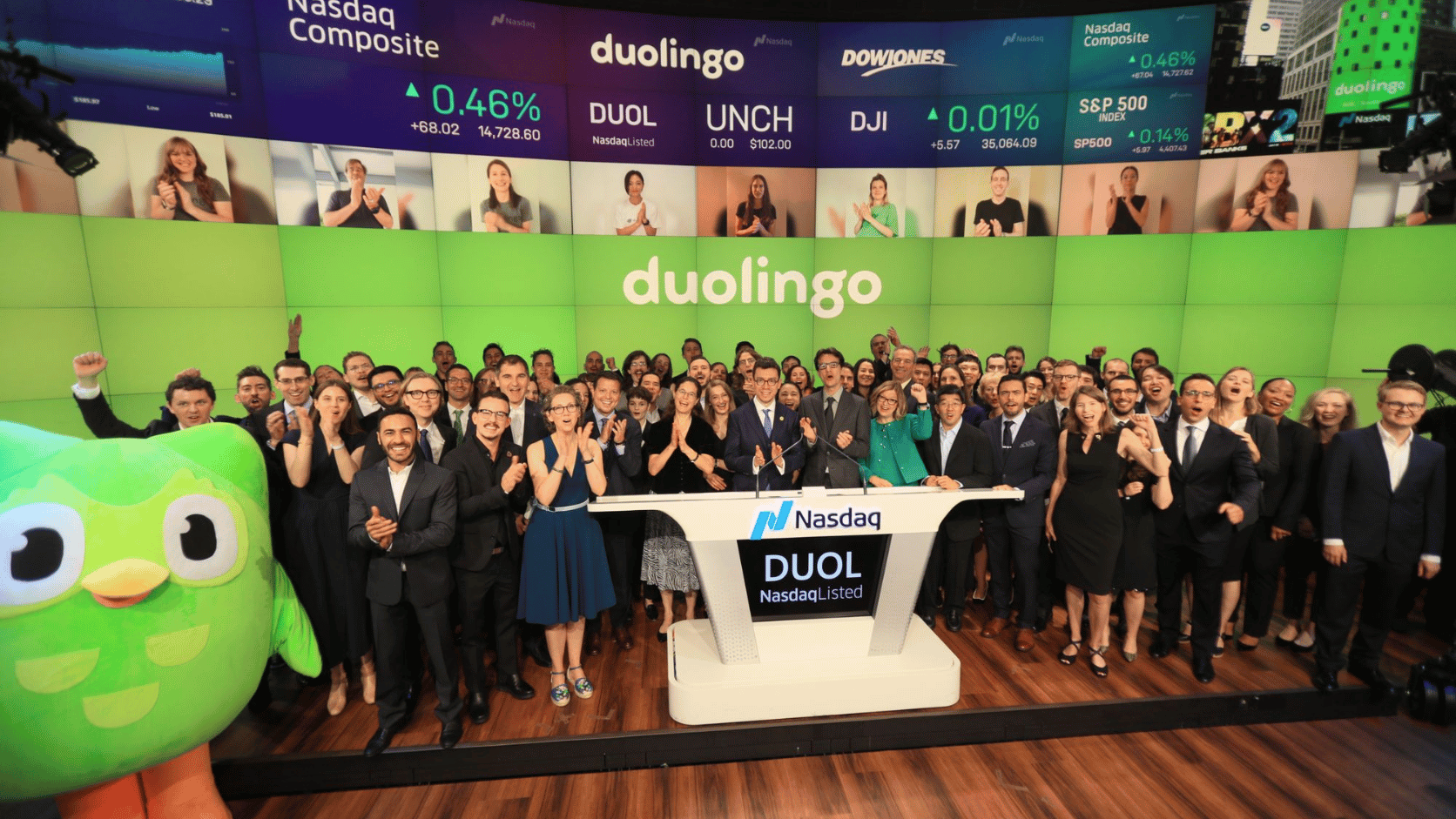
Duolingo began trading on Nasdaq under the symbol DUOL in 2021. In the founder’s listing letter, the event was framed as a step toward building a lasting institution. Public ownership added investors to the company’s audiences, alongside learners, employees, and educational stakeholders. It did not make the mission-versus-economics question disappear.
For founders, this is a reminder that financing decisions affect the operating context. More resources can support investment, but expectations and reporting obligations also change. A company must communicate its priorities clearly enough that stakeholders understand how near-term decisions relate to the longer-term purpose. The durable challenge is to make those connections observable in the product and business, rather than relying on a mission statement to reconcile every competing demand.
What entrepreneurs can learn from von Ahn’s story
Duolingo’s journey suggests that a large ambition becomes actionable through specific design choices. Access shaped the business model. The need for repeated practice shaped the experience. Technical expertise supported iteration, while educational questions required attention to evidence and outcomes. The company’s development illustrates how these choices become linked as adoption broadens.
The strongest founder lesson is to stay clear about the customer’s real goal. In this case, the goal is learning; engagement, distribution, and revenue help make the service possible but do not replace that purpose. Von Ahn and Hacker built a company around making an enduring activity easier to begin and continue. For other entrepreneurs, the practical challenge is similar: reduce the burden of participation while preserving the substance of what the customer came to achieve.
This article draws on public founder letters, Duolingo’s investor biography, and product and research materials. Business observations are Startup Times analysis, not a newly conducted interview. Explore more entrepreneurial journeys.
Image credit: Duolingo. Luis von Ahn and the Duolingo team marking the company’s 2021 Nasdaq listing.


Leave a comment
Your email address will not be published. Required fields are marked *
Add a newsletter to your widget area.
Top Stories