
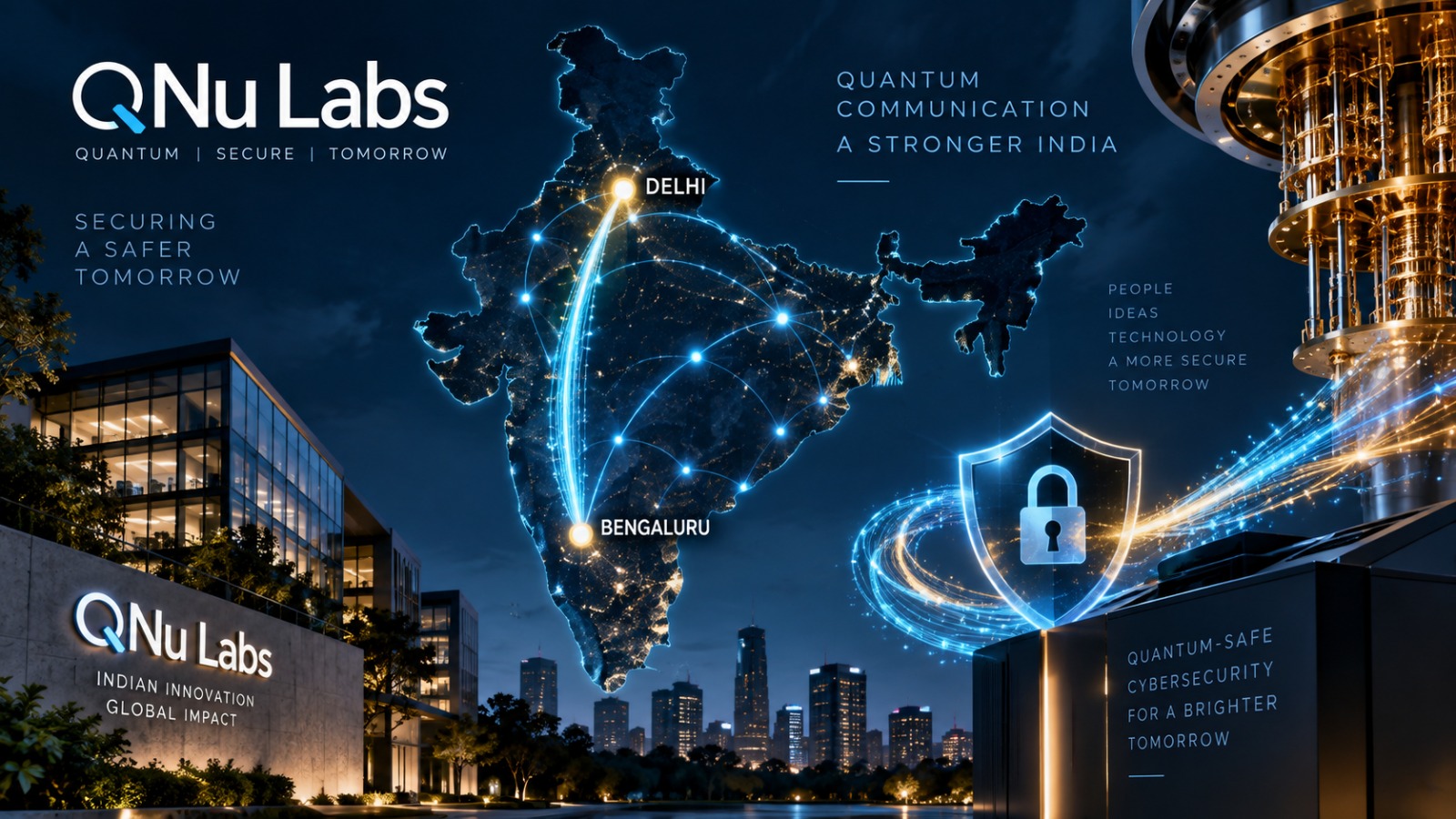
QNu Labs Raises ₹200 Crore to Scale Quantum-Safe Cybersecurity
Bengaluru-based deep-tech startup QNu Labs has raised ₹200 crore in a Series A1 round led by the National Quantum Mission and Speciale Invest to scale its quantum-safe cybersecurity technology and expand into global markets.
Bengaluru-based deep-tech cybersecurity startupQNu Labs has raised ₹200 crore in a Series A1 funding round as demand for quantum-safe cybersecurity gains momentum globally. The round was led by India’s National Quantum Mission (NQM) and deep-tech venture capital firm Speciale Invest, with participation from Sony Innovation Fund, Gaja Capital and Artha Ventures, among other investors. The latest round takes QNu Labs’ total capital raised to ₹375 crore.
Founded in 2016 and incubated at IIT Madras, QNu Labs focuses on cybersecurity technologies designed to address a problem that could become increasingly important as quantum computing develops. Many of today’s digital systems rely on cryptographic techniques to protect sensitive information, financial transactions and communications. The development of sufficiently powerful quantum computers could eventually challenge some of the cryptographic systems currently in use, creating a need for technologies that can provide protection against future quantum-related threats.
This is where the term “quantum-safe cybersecurity” comes into the picture. Rather than waiting for quantum computers to become powerful enough to pose a practical threat, companies and governments are working on security technologies that can be deployed in advance. QNu Labs is building solutions around quantum communication and cryptography, including technologies aimed at securing data and communications against emerging threats. The company says its solutions have already been deployed across government, critical infrastructure and the banking, financial services and insurance (BFSI) sectors.
The fresh ₹200 crore investment will be used primarily to accelerate research and development, strengthen QNu Labs’ sales and go-to-market operations and expand its presence in India and international markets. The company also plans to extend its technology stack into areas including quantum sensing and artificial intelligence. A portion of the funding will contribute to an approved Research, Development and Innovation (RDI) project focused on building the technology backbone for India’s Quantum Secure and Sensing Networks (IQSN).
The funding comes at a significant point in India’s development of quantum technology. The government’s National Quantum Mission, approved in 2023 with an outlay of ₹6,003.65 crore, focuses on four broad areas: quantum computing, quantum communication, quantum sensing and metrology, and quantum materials and devices. The mission also aims to support startups and strengthen collaboration between research institutions and industry.
QNu Labs has already been involved in one of the mission’s notable milestones. In April 2026, the Department of Science and Technology reported that a 1,000-kilometre quantum communication network had been successfully demonstrated under the National Quantum Mission using indigenous technology developed by QNu Labs. The achievement was part of the mission’s longer-term objective of developing secure quantum communication infrastructure across a much larger distance.
One of the technologies involved in this field is Quantum Key Distribution (QKD). In simple terms, QKD uses principles of quantum physics to help two parties establish and protect encryption keys used for secure communication. Any attempt to interfere with the quantum transmission can potentially be detected, making the technology particularly relevant to communications where security is critical. QKD is therefore being explored alongside other approaches to prepare networks for a future in which existing encryption methods may face new challenges.
For QNu Labs, the opportunity extends beyond developing individual cybersecurity products. The company is positioning itself as part of a broader transition toward quantum-safe infrastructure. Governments, financial institutions, telecom networks and other organisations handle enormous amounts of sensitive digital information, and changing the underlying security infrastructure across these systems can take years. This is creating interest in technologies that can help organisations begin preparing before quantum computing reaches a stage where existing cryptographic protections become more vulnerable.
The startup’s latest funding also highlights the growing role of government-backed initiatives in India’s deep-tech ecosystem. Unlike many software startups that can scale primarily through cloud infrastructure and relatively short product cycles, quantum technology companies often require specialised hardware, scientific research, engineering talent and long development timelines. The involvement of the National Quantum Mission alongside private investors reflects the strategic importance being placed on developing domestic capabilities in this area.
QNu Labs says it has spent more than a decade building its technology stack and currently has a team of engineers, physicists and mathematicians working across quantum cryptography and communication. With the new capital, the company intends to move beyond research and early deployments toward wider commercial adoption in India and overseas markets.
The larger story is therefore not only about a ₹200 crore funding round. It is also about how India’s startup ecosystem is beginning to participate in technologies that sit at the intersection of cybersecurity, quantum computing, advanced communications and national digital infrastructure. As countries and companies prepare for the potential security implications of future quantum computing, startups such as QNu Labs are attempting to develop the technologies that could help protect digital systems before that transition arrives.
To read more such startup, technology and business news, visit Startup Times.


Leave a comment
Your email address will not be published. Required fields are marked *
Add a newsletter to your widget area.
Top Stories