Reliance Investment in Andhra Pradesh: ₹1 Lakh Crore CBG Plan
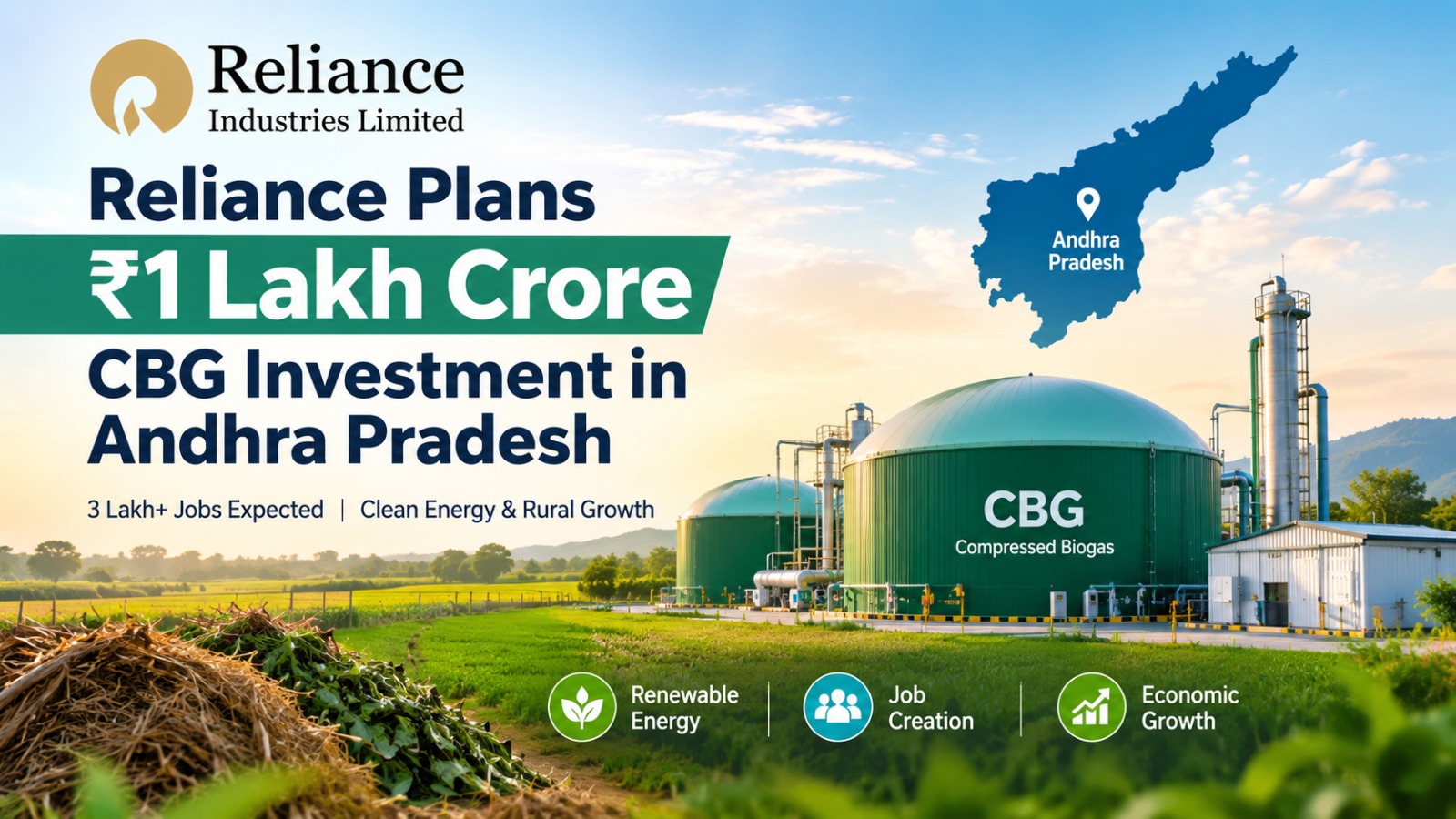
Reliance investment in Andhra Pradesh includes a proposed ₹1 lakh crore CBG plan, with over 3 lakh jobs expected from the projects.
Reliance Industries is planning to invest ₹1 lakh crore in Andhra Pradesh to establish compressed biogas (CBG) plants, marking a major proposed investment connected with India's renewable-energy and agricultural economy. The announcement was made by Reliance Industries Executive Director Anant M. Ambani on October 2, 2026, during the foundation stone-laying ceremony for the Rayalaseema Horticulture Hub and Indian School of Agriculture in Madanapalle.
According to Ambani, the proposed CBG projects are expected to create more than 3 lakh jobs and generate nearly ₹60,000 crore in revenue for Andhra Pradesh over the coming decades. These figures represent projected outcomes associated with the planned investment, rather than already-created jobs or realized state revenue.
Reliance's Growing Focus on Compressed Biogas
The proposed Andhra Pradesh investment fits into Reliance's broader bioenergy strategy. Reliance's official bioenergy business says it has been developing compressed biogas facilities using agricultural residue, cattle dung, food waste and other organic materials. The company describes CBG as a renewable alternative that can be used in applications similar to conventional natural gas.
Reliance Bioenergy states that it is developing multiple CBG plants across India as part of its broader clean-energy strategy. The company's existing bioenergy activities include CBG production as well as the processing of digestate into organic manure.
Connecting Agriculture With Clean Energy
A major element of the proposed investment is the connection between agriculture and energy production. CBG can be produced from organic waste and agricultural residues, creating a potential additional market for biomass generated in rural areas.
The proposed model could therefore connect farmers and agricultural supply chains with the renewable-energy sector. Ambani described this opportunity in terms of farmers contributing not only to India's food security but also to energy security.
CBG production involves processing organic materials through anaerobic digestion to produce biogas, followed by purification and upgrading. The resulting gas can be used as a renewable fuel. Reliance says its CBG has methane content above 96% and can be integrated with existing CNG infrastructure.
Government Push for India's CBG Sector
The Reliance announcement comes at a time when the Indian government is also strengthening the policy framework around compressed biogas.
On October 1, 2026, the Ministry of Petroleum and Natural Gas announced the GOBARdhan Central Sector Scheme for developing India's CBG sector. According to the Press Information Bureau, the scheme has an outlay of ₹23,731 crore and provides a ten-year framework covering FY2026–27 to FY2035–36. It aims to increase domestic CBG production nearly tenfold to around 5 MMSCMD.
The scheme includes measures relating to assured offtake, pricing, capital assistance, pipeline connectivity, credit support and ecosystem development, according to the government announcement.
This policy environment could provide additional institutional support for investment in India's CBG ecosystem.
Potential Impact on Andhra Pradesh
The proposed ₹1 lakh crore investment could have implications across several areas of Andhra Pradesh's economy if the projects proceed as announced.
The planned CBG plants could create demand for agricultural residues and other biomass feedstocks. This may create new opportunities across collection, transportation, processing, plant operations and related services.
The investment could also support the development of rural supply chains around renewable energy. Business Standard reported that the proposed projects are intended to support cleaner energy while creating additional opportunities for farmers.
However, the projected employment and revenue figures should be understood as future estimates associated with the proposed projects. Their eventual impact will depend on project implementation, investment timelines, plant capacity, feedstock availability and other operational factors.
CBG and India's Energy Transition
Compressed biogas is increasingly being considered as one component of India's transition toward alternative fuels.
CBG can be produced using materials such as crop residue, cattle dung and organic waste. This gives the technology a connection with both waste management and energy production.
Reliance says its bioenergy strategy is designed to address multiple objectives, including reducing dependence on fossil fuels, supporting rural economic development and creating value from organic waste.
The government's newly launched GOBARdhan framework also indicates that CBG is receiving greater policy attention as India seeks to expand domestic renewable-gas production.
What the Investment Means for India's Business Landscape
The proposed Reliance investment highlights the growing intersection of large-scale corporate investment, agriculture, renewable energy and infrastructure in India.
For businesses, the expansion of the CBG ecosystem could create opportunities in areas such as biomass collection, logistics, plant technology, equipment manufacturing, waste management, agricultural services and renewable-energy infrastructure.
For Andhra Pradesh, the investment could become part of a broader effort to attract capital into clean energy and rural economic development.
For India's energy sector, increased CBG capacity could contribute to diversification of fuel sources and greater utilization of domestic biomass resources.
Conclusion
Reliance Industries' proposed ₹1 lakh crore investment in Andhra Pradesh for compressed biogas plants is one of the notable business developments reported on October 2, 2026. The company has projected that the projects could create more than 3 lakh jobs and generate nearly ₹60,000 crore in state revenue over the coming decades.
The announcement also comes alongside a new government framework for expanding India's compressed biogas sector, creating a broader policy backdrop for investment in renewable gas.
As the proposed projects move toward implementation, their actual economic impact will depend on execution, investment deployment and the development of supporting agricultural and energy infrastructure.
To Read More Such News Visit Startup Times .


Leave a comment
Your email address will not be published. Required fields are marked *
Add a newsletter to your widget area.
Top Stories