The Next Wave of Indian Startups May Come From Solving Farmers' Everyday Problems
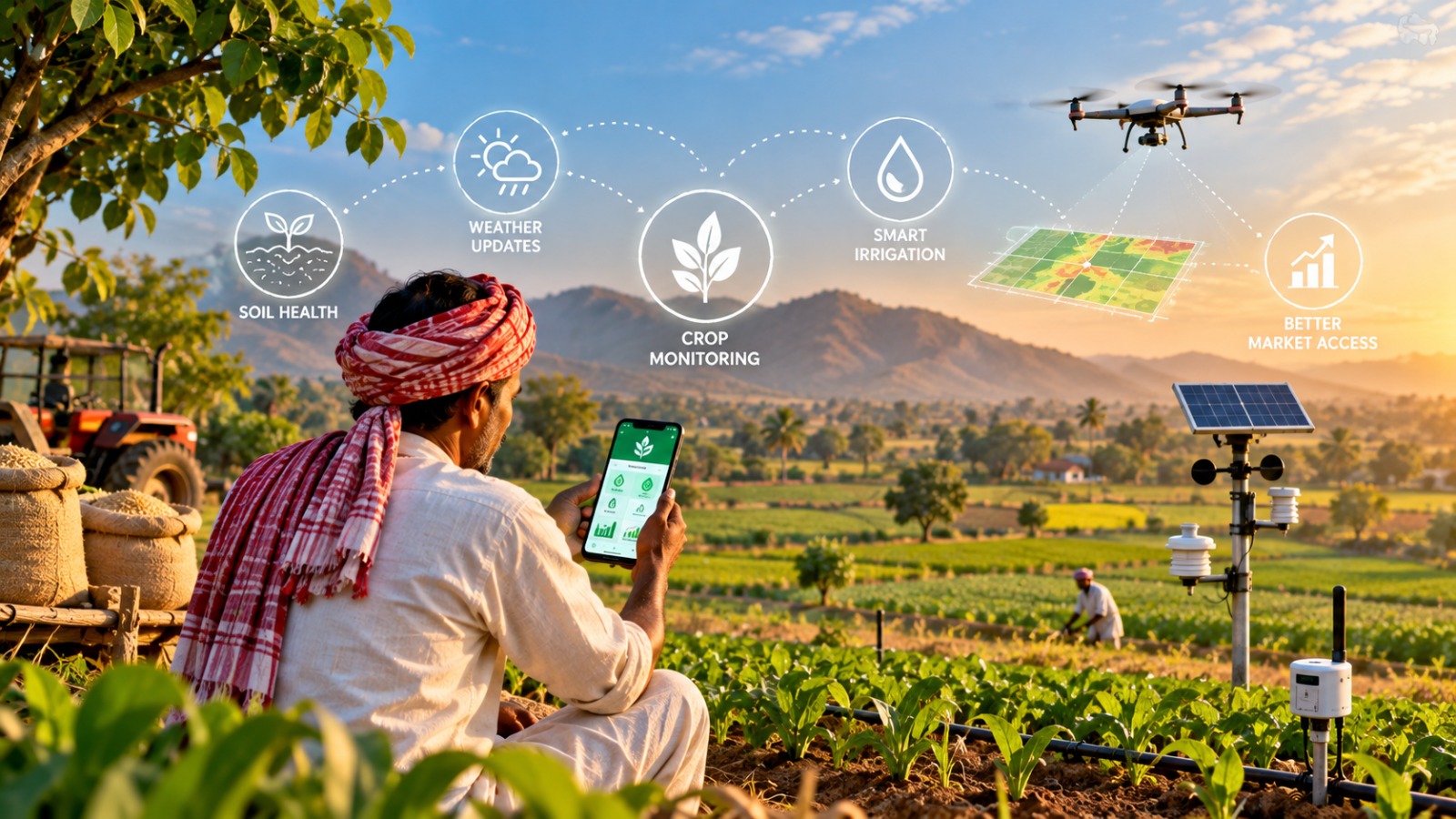
From AI-powered crop monitoring to smart irrigation and better market access, discover how Indian agritech startups are turning everyday farming challenges into opportunities for innovation and business growth.
Introduction: Looking Beyond Technology to Real-World Problems
When people think about startups, they often imagine artificial intelligence, food delivery apps, fintech platforms, or the next big consumer brand. However, some of the most meaningful business opportunities may come from an industry that has supported India's economy for generations: agriculture. Behind every crop grown in a field are several challenges that farmers must deal with, including unpredictable weather, rising input costs, pest attacks, water shortages, storage problems, and uncertainty about where to sell their produce.
These challenges are not new, but the way they can be addressed is changing. With the development of artificial intelligence (AI), Internet of Things (IoT) sensors, satellite imagery, mobile applications, and data analytics, entrepreneurs have new ways to solve problems that once required extensive manual effort or access to specialised expertise. This is where agritech, the use of technology to improve agriculture and its related supply chains, is creating opportunities for innovation.
The opportunity is not simply to introduce more technology into farming. It is to understand what farmers struggle with every day and build solutions that are practical, affordable, and useful in real farming conditions. For India's startup ecosystem, solving these everyday problems could open up new markets while helping farmers make better decisions and manage their resources more effectively.
Understanding the Everyday Challenges Farmers Face
Farming involves making decisions under conditions of uncertainty. A farmer must decide when to sow seeds, how much water to use, when to apply fertilisers, how to manage pests, and when to harvest. A sudden change in weather or an unexpected crop disease can affect an entire season's work. For small and marginal farmers, who may have limited financial reserves, even a single poor harvest can have serious consequences.
Access to reliable information is another challenge. Farmers may depend on local experience, advice from other farmers, agricultural input dealers, or government extension services. These sources can be valuable, but timely, crop-specific information is not always readily available when a problem arises. A farmer noticing unusual spots on leaves, for example, needs to identify the possible cause quickly before the damage spreads.
Problems also continue after the crop is harvested. Limited access to suitable storage, transportation costs, fluctuating market prices, and the involvement of multiple intermediaries can affect how much farmers ultimately earn. In some cases, produce may lose quality before reaching buyers. These difficulties show that agriculture is not just about growing crops; it is also about managing information, resources, logistics, and markets.
For startups, each of these challenges represents a potential area for innovation. Instead of developing a product simply because a technology is available, entrepreneurs can begin by identifying a specific farming problem and understanding why existing solutions are not sufficient.
AI and Data Analytics: Helping Farmers Make Better Decisions
Artificial intelligence can help farmers interpret information about their crops, weather conditions, and farming practices. By analysing images, historical records, weather patterns, and other relevant data, digital tools can provide guidance that supports decisions about crop health, pest management, and farm planning.
For example, a farmer who notices discolouration on crop leaves could use a smartphone application to upload an image and receive information about possible diseases or nutrient deficiencies. Such a tool could help the farmer identify the next steps to investigate, although the result should not replace expert advice where accurate diagnosis is important. Similarly, weather-based alerts could help farmers plan irrigation, spraying, or harvesting activities more carefully.
These applications are becoming increasingly relevant in India. In an August 2026 feature, the World Bank described how AI-powered agricultural services are being developed to provide farmers with practical advice in local languages, including guidance on crops, pests, weather, and markets. The feature also discussed digital agriculture initiatives in states such as Kerala and Maharashtra.
The opportunity for startups lies in making these tools accessible and relevant to individual farmers. An application that provides complicated technical information may have limited value if users cannot understand or act on its recommendations. Solutions that offer clear guidance in familiar languages, work on basic smartphones, and account for local farming conditions may be more useful than products designed around technology alone.
Smart Irrigation: Using Water More Efficiently
Water management is another area where technology can address a practical and increasingly important farming challenge. Farmers need sufficient water for healthy crop growth, but over-irrigation can waste water, increase pumping costs, and contribute to pressure on groundwater resources. At the same time, insufficient irrigation can affect crop quality and productivity.
Smart irrigation systems can help farmers make more informed decisions by combining soil-moisture sensors, local weather information, and crop requirements. Rather than irrigating according to a fixed schedule, a system may indicate when a field needs water and how much may be appropriate under the prevailing conditions. Some systems can also automate parts of the irrigation process.
For startups, the opportunity extends beyond selling sensors or installing automated equipment. Businesses could develop affordable irrigation services, provide equipment on a rental basis, or work with farmer groups to make the technology accessible to more people. This matters because a sophisticated system may be difficult to adopt if its initial cost is too high or its maintenance requires specialised support.
The World Bank has highlighted the importance of micro-irrigation, digital tools, and improved water management in India's efforts to use water more efficiently. The broader lesson for entrepreneurs is that successful innovation must account for both the technical performance of a product and the financial realities of the people expected to use it.
Crop Monitoring and Precision Agriculture
Another opportunity lies in helping farmers understand what is happening across their fields. Traditional crop monitoring often requires farmers or agricultural workers to inspect plants manually. Although field visits remain important, monitoring large or multiple plots can be time-consuming, and certain problems may not be noticed immediately.
Precision agriculture uses technologies such as sensors, satellite imagery, drones, and data analytics to provide more detailed information about crop conditions. These tools can help identify variations in crop growth, highlight areas that may need attention, and support more targeted use of water, fertilisers, and crop-protection measures.
Indian agritech company Fasal, for example, describes a technology platform that combines farm monitoring, predictive insights, and automated irrigation and fertigation for supported farming operations. Its approach illustrates how data can be translated into practical recommendations rather than simply collected and displayed.
For startups entering this space, the key question is how to turn monitoring into measurable value. Farmers are more likely to see the benefit when a tool helps them identify a problem earlier, avoid unnecessary input use, or make a better-informed decision. A dashboard full of data is not enough on its own; the information must lead to an action that makes sense for the crop, the location, and the farmer's budget.
Improving Storage, Supply Chains, and Market Access
Agriculture does not end when harvesting is complete. Moving produce from a farm to a market involves several stages, including sorting, grading, storage, transportation, and distribution. Weaknesses in these stages can reduce the quality of produce and affect the income farmers receive.
Startups can help address these problems through digital marketplaces, logistics platforms, traceability systems, storage services, and tools that connect producers with potential buyers. Better coordination between farmers, warehouses, transport providers, processors, and retailers can reduce information gaps and improve planning.
Technology can also help businesses track produce as it moves through the supply chain. Cropin, an agricultural technology company, offers digital farm-management, crop-monitoring, and traceability solutions that support different participants in the agriculture value chain. Its work illustrates how agritech can serve not only farmers but also food processors, agricultural businesses, and other organisations that depend on reliable information about crops and their origins.
However, digital marketplaces cannot guarantee better prices on their own. Their success depends on factors such as the availability of buyers, transportation costs, quality standards, payment reliability, and the bargaining power of producers. Startups that combine digital platforms with dependable physical operations and local partnerships may be better positioned to address these challenges.
Why Agritech Startups Must Understand Farmers Before Building Products
One of the biggest mistakes a startup can make is assuming that a technologically advanced product will automatically attract users. Agriculture is diverse, and the needs of a farmer growing rice in Maharashtra may differ significantly from those of a horticulture farmer in Karnataka or a fruit grower in Himachal Pradesh. Climate, soil conditions, land size, crops, access to credit, and local markets all influence which solutions are useful.
Affordability is particularly important. A farmer may recognise the benefits of a smart sensor or a digital advisory service but still be unable to justify its cost. Similarly, a product that requires a stable internet connection, frequent software updates, or complicated setup may be difficult to use in certain locations. Even when a solution works well technically, adoption may remain limited if farmers do not trust the provider or understand how the product benefits them.
A white paper published by NITI Aayog onIndian agritech startups identifies challenges including the cost of agricultural infrastructure, gaps in digital literacy, access to reliable agricultural data, and the difficulty of reaching fragmented farming communities. It also discusses the role of farmer-producer organisations and other local institutions in helping startups reach farmers.
These challenges suggest that startups should spend time in farming communities, speak directly with farmers, test early versions of their products, and improve them based on actual feedback. Working with agricultural experts, cooperatives, farmer-producer organisations, and local service providers can also help businesses build trust and deliver support beyond the initial sale.
Building Sustainable Business Models in Agritech
Solving a real problem is an important starting point, but startups must also develop business models that can sustain their operations. Agricultural products and services often have seasonal demand, while farmers may have limited cash flow between harvests. A business that depends entirely on large upfront payments may therefore struggle to reach smaller customers.
Alternative models could include pay-per-use equipment, rental services, subscription-based advisory, shared infrastructure, or partnerships with agricultural businesses and farmer groups. For example, instead of requiring every farmer to purchase an expensive monitoring system, a startup could provide the service through a local agricultural service provider who supports several farms.
Startups can also explore business-to-business opportunities. Agricultural processors, food retailers, seed companies, insurers, lenders, and other organisations may need reliable crop data, farm records, quality tracking, and supply forecasts. Serving these organisations can create revenue opportunities while supporting services that benefit farmers.
The right business model will depend on the problem being addressed, the customers who benefit, and the costs involved in delivering the solution. A successful agritech startup must balance three things: a genuine need, an affordable and effective solution, and a clear way to sustain the business over time.
The Road Ahead: From Everyday Problems to Meaningful Innovation
The future of agritech in India will not depend on one technology or a single breakthrough. It will emerge from the combination of practical tools, local knowledge, reliable infrastructure, and business models that respond to the needs of farming communities.
AI can make agricultural information easier to access. Sensors can support better water management. Crop-monitoring tools can help identify potential problems. Digital platforms can improve coordination between producers and buyers. Yet the impact of these innovations will ultimately depend on whether farmers can use them, trust them, and see a meaningful benefit from adopting them.
There is also an opportunity to create employment beyond farming itself. Agritech growth can generate demand for technicians, field advisers, data analysts, equipment-maintenance professionals, logistics providers, and entrepreneurs who understand both agriculture and technology. This makes the sector relevant not only to farmers but also to young people looking to build businesses around real-world problems.
For aspiring founders, the starting point does not have to be an expensive laboratory or a highly complex AI model. It could be a simple service that helps farmers identify crop problems, a low-cost mechanism that reduces water waste, or a better way to connect producers with buyers. What matters is identifying a problem that people genuinely face and developing a solution that works in practice.
Conclusion: Innovation Begins With Listening
India's agricultural sector presents opportunities for startups willing to look beyond conventional technology trends and focus on the everyday realities of farming. The biggest opportunities may not always come from inventing something entirely new, but from making existing processes more affordable, reliable, efficient, and accessible.
For entrepreneurs, the challenge is to move from asking, "What technology can we build?" to asking, "What problem needs to be solved, and for whom?" That shift can lead to better products, stronger businesses, and solutions that deliver value beyond the startup itself.
The next wave of Indian startups may indeed come from solving farmers' everyday problems. But their success will depend on more than innovation alone. It will require listening to farmers, understanding local conditions, building trust, and proving that technology can make a practical difference where it matters most: in the field.
To explore more insights on India's startup ecosystem, emerging technologies, and business opportunities, visit Startup Times.
Leave a comment
Your email address will not be published. Required fields are marked *
Add a newsletter to your widget area.
Top Stories