Some founder stories start with an insider spotting a gap. Teevra Studios' story starts with two outsiders who didn't know which rules they weren't allowed to break.
From Product Design to AI Filmmaking
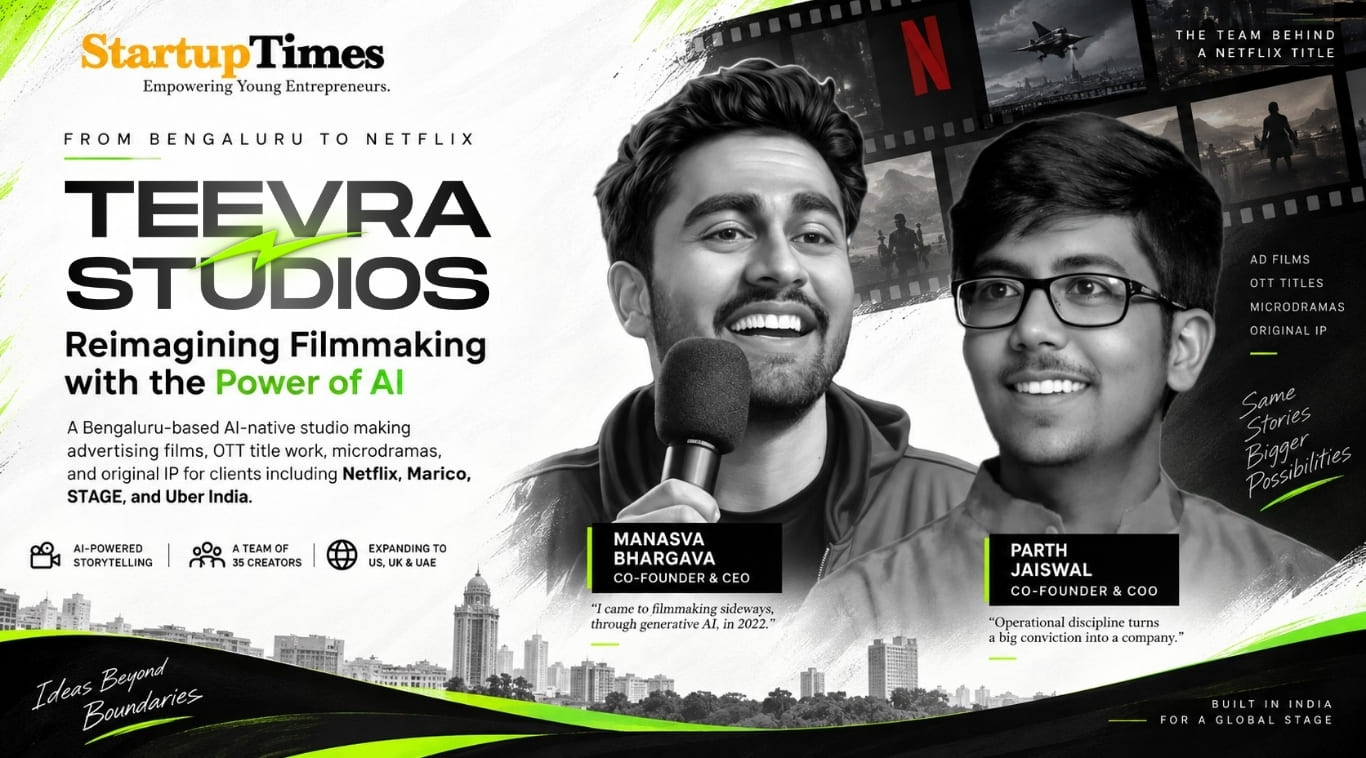
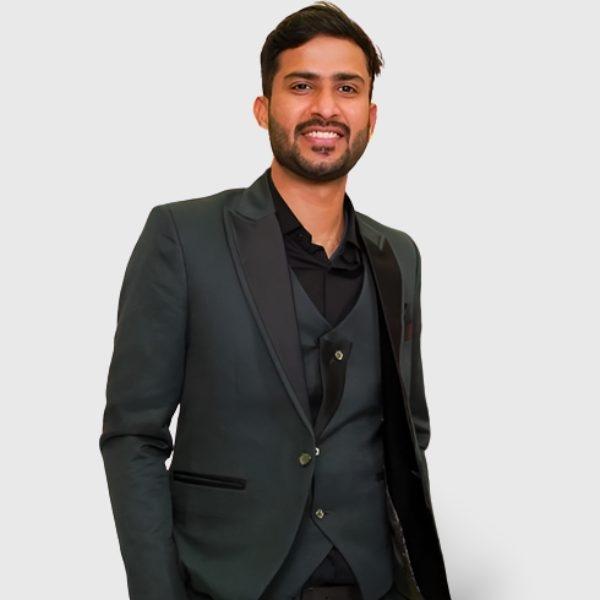
Manasva Bhargava, Co-Founder and CEO of Teevra Studios, comes from a product design background, entirely self-taught. "No design school, no film school, no family in the industry," he says. "I came to filmmaking sideways, through generative AI, in 2022." He was joined by Co-Founder Parth Jaiswal, whose own path ran through startup leadership and product strategy — most recently as a Senior Product Manager at Early Steps Academy — before the two built Teevra together on a shared conviction about where filmmaking was headed.
In 2022, Manasva started experimenting with the first generative video tools that actually worked. "Most people looked at them and saw a toy," he says. "What I saw was that the hardest part of making a film had quietly changed. It was never the idea that stopped you — it was the schedule, the location, the fifteen people who had to be in the same place on the same morning." Once that weight moved, the only limit left was imagination. Teevra launched in early 2024, with Manasva and Parth building it together — Manasva driving the creative and technical vision, Parth bringing the operational discipline that turned a conviction into a company.
Breaking the Arithmetic of Good Filmmaking
The gap the two founders identified was structural: good filmmaking was being rationed by budget. The biggest market got the beautiful film; everyone else — the regional launch, the smaller brand, the fourth ad in a campaign — got a cut-down version, not for lack of ideas but because a fifth version cost almost as much as the first. Teevra was built to break that arithmetic, so that making more doesn't mean costing proportionally more.
Today, the Bengaluru-based studio is a team of 35 making advertising films, OTT title work, microdramas, and original IP end-to-end for clients including Netflix, Marico, STAGE, and Uber India — alongside campaigns for Eureka Forbes, UltraTech Cement, and Storytel.
What Makes Teevra Different
Two things set Teevra apart, according to Manasva. First, the team is filmmakers before anything else — technology handles the logistics so people can spend their attention on story and craft. Second, Teevra has built a proprietary hybrid approach that places real actors inside AI-generated environments without needing an expensive virtual production stage, backed by an in-house pipeline that holds character consistency across an entire campaign or series — the part of AI-made content that usually breaks, and where most of Teevra's R&D goes.
Three Hard Calls That Built the Company
Building Teevra wasn't a straight line. In early 2025, after a difficult client engagement, Manasva closed the studio's design wing — a call that cost revenue but let the team focus on one thing done properly instead of two done adequately. Because the underlying AI tools changed capability every few weeks, the founders refused to build the business on any single vendor, choosing instead to keep the craft in-house — their own pipeline, their own methods, external platforms treated as replaceable suppliers. And because no one hands an unknown studio a national brand's TV commercial, Teevra earned that trust one film at a time, holding a price floor rather than taking on cheap work it couldn't stand behind.
The Netflix Moment
The turning point came in August 2026, when Netflix aired a completely AI-generated title sequence — the opening titles Teevra made for Operation Safed Sagar, a series on the Indian Air Force's 1999 Kargil War campaign, executive-produced by Manasva and Parth together. "Until then, every conversation we walked into started with someone quietly asking whether AI work could survive a real quality bar," Manasva says. "After that, it didn't."
What's Next
Teevra is expanding from a single services studio into three verticals: its current production studio, a dedicated AI and VFX studio, and a talent wing. Geographically, the company is moving into the US, UK, and UAE, starting with pilots rather than pitches, and going deep on microdrama — a format projected to grow from roughly $7 billion globally to $26 billion by 2030. The five-year goal, in Manasva's words: to be the company that made this craft legitimate in India, and trained most of the people practising it.
His advice to founders: cut things faster than feels comfortable — closing the design wing was the most painful decision of his career, and the reason everything after it worked. And don't treat not belonging as a handicap. Teevra is bootstrapped, has taken no outside capital, has grown roughly five times in two years, and has stayed profitable throughout — in part, Manasva says, because the founders never learned which corners they weren't allowed to cut.
About Teevra Studios: Co-Founded by Manasva Bhargava (CEO) and Parth Jaiswal. Website | LinkedIn | Instagram
This feature is brought to you by Startup Times.