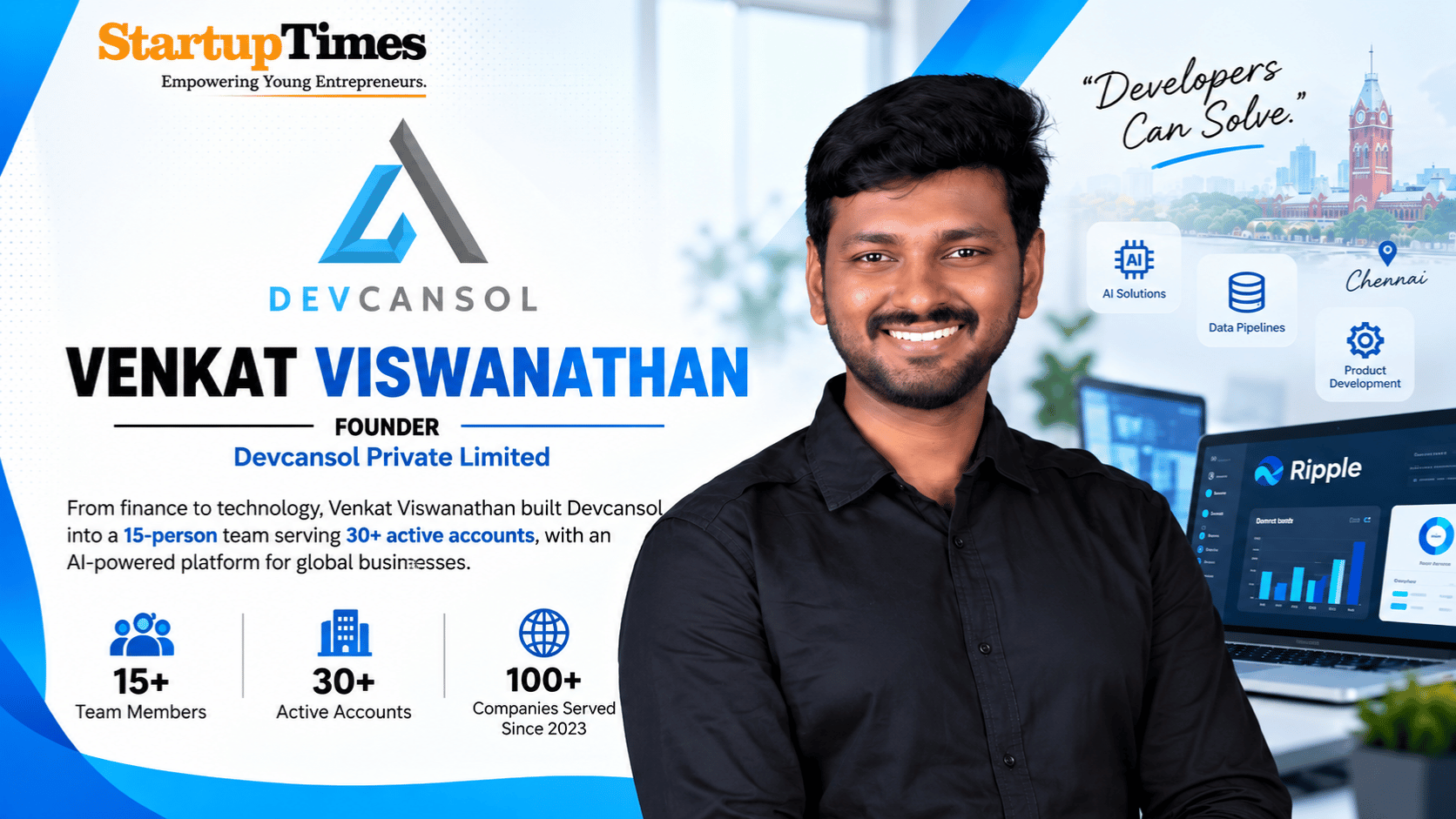
Every founder story has a moment that looks obvious only in hindsight. For Venkat Viswanathan, Founder of Devcansol Private Limited, that moment wasn't a garage-startup epiphany. It was years of writing SQL queries by hand for people who couldn't write their own.
A Finance Background That Led to Code
Venkat didn't start in technology. He began by tutoring college students, then spent years writing valuation reports and amortization schedules for the American commercial real estate sector from a desk in Chennai, before completing his articleship in Coimbatore. In March 2020, he joined a risk analysis team — timing that would soon prove memorable for reasons no one could have predicted.
The real shift happened at Verumex, where Venkat worked as an analyst translating financial reports and business requests into technical requirements for engineering teams.
"I was the person consuming the data, so I knew exactly where it hurt," he says.
His mentor at the time, Brittian Warner, noticed Venkat teaching himself Python and SQL on the side and moved him onto the technical track. Over the following years, Venkat built data pipelines that standardized feeds from more than 120 data providers across over 30 countries. Tasks that once required months of manual Excel consolidation were reduced to a few clicks.
Founding Devcansol: "Developers Can Solve"
In 2023, an opportunity arrived that Venkat couldn't turn down: a platform where a business user could ask a question in plain English and receive a table or chart, with AI writing the SQL underneath.
Having spent years writing those queries by hand, he understood exactly how much time such a solution could save. He left Verumex to build it. Within a month, the work outgrew one person, so he hired. What began as a single engagement gradually evolved into a company.
Developers can solve. Devcansol.
That belief became the foundation of the company's identity and its approach to solving business problems through technology.
Solving the Gaps Nobody Names
Devcansol's growth has been shaped by three market gaps Venkat identified through his own experience.
- The Translation Gap: Business teams often sit on enormous amounts of data but cannot get straightforward answers without waiting for an analyst.
- The Integration Gap: Growing companies frequently use separate tools for their websites, customer relationship management (CRM), and project management. When these systems don't communicate, employees are left manually transferring information between platforms.
- The Clarity Gap: Many companies want to adopt artificial intelligence but struggle to articulate what they actually need AI to accomplish.
Devcansol works to close these gaps through two complementary approaches:
- Offshore technical extension: Supporting software companies, largely based in the United States, with engineering capabilities.
- Technology partnership: Helping non-technical business owners turn product ideas into working software without having to build an engineering team from scratch.
Ripple: One Connected System Instead of Six Tools
Alongside its services business, Devcansol builds and operates Ripple, a platform designed to bring multiple business tools together behind a client's website.
Ripple combines several capabilities in one connected environment:
- Customer Relationship Management (CRM): Managing leads and customer information.
- Referral Management: Organizing referral-related workflows.
- Productivity Tools: Supporting tasks and attendance.
- Content Management System (CMS): Managing website content.
- AI Assistant: Answering questions from website visitors and providing internal teams with role-based information about leads, tasks, and people.
For US real estate clients, Ripple also powers rent and home-value estimators that use comparable properties and adjustable variables for closing costs. According to Venkat, a new client can be onboarded in approximately one week.
The broader idea is to simplify the technology stack businesses need to operate while reducing the friction caused by managing multiple disconnected tools.
The Year That Nearly Broke the Company
In 2025, Devcansol faced one of the most challenging periods in its journey. Most of the company's revenue was concentrated in two high-value client engagements. Within a short period, it lost both.
One project had reached its natural conclusion. In the other case, the founders fell out of alignment and wound the business down. Venkat was left with a full team but no work to sustain it.
Turning a Crisis into an Opportunity
The solution came through an unconventional proposal. Rather than allowing the departing founders to walk away from client relationships they had spent years building, Venkat offered to take over continuity of service for those clients, with the founders earning a commission.
- Clients continued receiving the services they depended on.
- The departing founders earned compensation from client relationships that might otherwise have been lost.
- Devcansol secured the cash flow needed to retain its team and continue operating.
That client portfolio became the foundation of the Ripple brand. The crisis also forced a fundamental rethink of how Devcansol would grow. Instead of equating growth with more clients and more employees, the company began converting repeatable work into reusable platforms, workflows, and white-labelled services.
The goal was to build systems that could be deployed for new clients without requiring a proportional increase in headcount.
Today, Devcansol has a 15-person team serving around 30 active accounts, having worked with well over 100 companies since 2023.
What's Next: Services Delivered as Software
Venkat believes the market is moving towards a model that goes beyond traditional Infrastructure-as-a-Service (IaaS), Platform-as-a-Service (PaaS), and Software-as-a-Service (SaaS).
He describes this emerging direction as services delivered as software.
In this model, configuration, integration, and implementation work that consultants once billed for by the hour can increasingly be handled by the software itself.
Over the next five years, Venkat wants Devcansol's products to drive most of the company's growth, supported by the engineering and service capabilities needed to build them effectively.
This represents a shift from a conventional services-led business towards a model where software can deliver more value without requiring a matching increase in people or operational costs.
Venkat Viswanathan's Advice to First-Time Founders
Beyond technology and business strategy, Venkat's experience has shaped how he thinks about risk, resilience, and relationships.
Prepare for Uncertainty
"Caution is better than cure — keep a reserve for a rainy day; it isn't fear of failure, it's how you make sure something outside your control doesn't end the vision halfway through."
Build Relationships on Actions
"Intentions are never equal to action. Build relationships on what people do, not only on what they say."
Both lessons reflect the challenges Venkat faced while building Devcansol: preparing for uncertainty, learning from setbacks, and creating a business that can survive beyond individual client engagements.
Conclusion: Building for Scalable Growth
Venkat Viswanathan's journey demonstrates how experience in one field can become the foundation for innovation in another.
His understanding of finance and data helped him identify operational inefficiencies. His transition into engineering gave him the tools to solve them. Building Devcansol turned that experience into a business, while the challenges of 2025 pushed the company towards a more scalable, product-led future.
With Ripple and its services-as-software vision, Devcansol is working towards a model in which businesses can access integrated technology and engineering capabilities without the complexity traditionally associated with building and maintaining them.
For Venkat, the principle remains straightforward:
Developers can solve. The challenge is turning those solutions into systems that scale.
About Venkat Viswanathan
Venkat Viswanathan is the Founder of Devcansol Private Limited, a technology company building AI-powered platforms and software solutions for businesses worldwide.
- Website:www.devcansol.com
- LinkedIn:Venkat Viswanathan
- Instagram:@venkatasubramanian_v
This feature is brought to you by Startup Times, empowering young entrepreneurs.