No Studio, No Camera Crew: Victor Riparbelli’s Bet on Synthesia
Explore Victor Riparbelli’s Synthesia journey: building AI video software for business training, collaboration, localization, and responsible use.
An internal training video is rarely the most glamorous item on a company’s to-do list. It can still be expensive to produce, difficult to update, and awkward to translate for a distributed workforce. Victor Riparbelli helped build Synthesia around that gap between how useful video can be and how much work it traditionally takes to create. The London company’s story is about turning a striking AI capability into a repeatable business workflow.
Founded in 2017, Synthesia brought entrepreneurs and researchers together to make video production more accessible through software. Its founder journey offers lessons for anyone building with advanced technology: choose a specific customer problem, make the output editable and usable, and account for the trust questions the capability creates. The commercial challenge is not simply to generate a convincing demonstration. It is to help an organization communicate something accurately, maintain it, and use it responsibly.
A founding team spanning research and entrepreneurship
Synthesia’s official history identifies Riparbelli, Steffen Tjerrild, Professor Matthias Niessner, and Professor Lourdes Agapito as its founders. The company describes roots across academic research and entrepreneurship, with connections to institutions including UCL, Stanford, Cambridge, and the Technical University of Munich. That mix matters because synthetic video requires both technical development and judgment about where the capability belongs in everyday work.
The founders did not face only a research problem. A prospective customer also needed a clear reason to change an existing production process. The business had to connect scientific capability with scripts, editing, collaboration, and delivery. This is a recurring challenge for research-led startups: a breakthrough can make a product possible, while the surrounding workflow determines whether a customer can adopt it without taking on an unreasonable amount of additional work.
Choosing the business communication problem
Synthesia’s product positioning focuses on business video, including training, onboarding, and knowledge sharing. That focus provides a useful way to understand the company’s market. A company may have a substantial amount of information to communicate repeatedly, yet lack the resources to film a new presenter whenever a process or policy changes.
The opportunity is therefore partly about maintenance. An impressive video that quickly becomes outdated can be less useful than a simpler asset that a team can keep accurate. Founders should examine the entire life of a customer’s output: creation, approval, publication, revision, and retirement. A product that improves only the first step may leave much of the burden untouched. Synthesia’s category makes the value of an editable production process easier to see.
Why the script becomes the center of the workflow
In a conventional shoot, changing a sentence can require coordinating people, equipment, and another recording session. In a software-based video workflow, the script can become an editable source for the output. That changes the practical relationship between content and production. It can make some kinds of revision easier, while increasing the importance of reviewing the words before and after generation.
This is a general product insight rather than a claim that every generated video is ready for publication. A customer still has to verify names, instructions, pronunciation, visual choices, and context. The technology can remove portions of the production effort without taking responsibility for the truth of the message. For founders, the valuable distinction is between automating the expression of content and establishing that the content is correct and appropriate for its audience.
Building for people who are not video specialists
The potential user of an internal video tool may be a learning manager, operations colleague, or subject expert. That person understands the material but may not know professional editing software. A successful product needs to make the important decisions manageable without requiring specialist training for every task. The interface becomes a bridge between domain knowledge and a usable video.
This creates a familiar design tension. Too many controls can overwhelm an occasional user; too few can prevent a team from producing work that fits its needs. Defaults, templates, and clear editing steps can help, but they need to preserve enough control for meaningful review. The founder’s challenge is to reduce unnecessary production complexity while keeping the customer able to judge and change the result. Ease of creation should support clarity, rather than conceal important choices.
The move toward collaborative software
In a 2023 founder announcement about Synthesia’s Series C, Riparbelli discussed a $90 million round led by Accel and described work on teams, workspaces, sharing, editing, and other collaborative features. The announcement said more than 50,000 businesses were using the platform at that time. Those are historical company-reported figures, useful as a marker of development rather than a statement of today’s scale.
The product details are particularly revealing. Once a tool is used inside an organization, creation becomes a coordinated process. Someone writes, someone reviews, someone approves, and another person may maintain the asset later. Collaboration features are not decorative additions to a generation engine. They help the software fit the way institutions actually produce and control information. For enterprise founders, this is often the difference between individual enthusiasm and organization-wide adoption.
Localization expands both the opportunity and the review burden
Video can be useful across a workforce that speaks several languages, but producing separate versions traditionally adds work. AI-enabled production offers a route to making more versions available. The commercial opportunity depends on whether the resulting communication is understandable and appropriate for the intended audience, rather than simply whether a translation can be generated.
This is where operational judgment remains important. Terminology, cultural context, and the consequences of an error vary between a product introduction and a safety instruction. A business needs a review process proportionate to the use case. Founders selling localization tools should therefore make it easier for customers to validate and manage versions. More output is valuable when it reduces barriers to understanding; volume alone is an incomplete measure of success.
Consent is part of the product, not a footnote
Synthetic presenters raise questions about permission and representation. Synthesia’s responsible AI materials describe consent requirements and moderation as parts of its approach. Its personal-avatar documentation explains a consent-recording step for creating a personal avatar. These details show that access to a powerful capability is accompanied by decisions about whose likeness may be used and under what conditions.
For a founder, the lesson is to design safeguards into the workflow rather than leave every question to an end-user disclaimer. That does not mean a safeguard eliminates all misuse. It means the company recognizes a foreseeable responsibility and provides processes intended to address it. In synthetic media, customer confidence depends partly on understanding those processes. The product must support legitimate communication without treating a person’s identity as an unrestricted raw material.
Enterprise buyers need more than realistic output
A demonstration may convince an audience that an avatar looks plausible. An enterprise buyer has additional questions: who can create content, who can approve it, how the organization manages access, and what happens when material needs to be withdrawn or corrected. The purchase decision therefore concerns an operating system for content production, not only visual quality.
That broadens the startup’s work. The team needs to understand procurement, administration, support, and the customer’s own governance. A capability that is exciting for a single user can be difficult to deploy if it creates unmanaged communication risks for a larger organization. Founders should distinguish between the evidence needed to earn interest and the evidence needed to support institutional use. Both are necessary, but they are not supplied by the same demo.
Funding supports execution; it does not replace it
Synthesia’s January 2026 company announcement reported a $200 million Series E at a $4 billion valuation. The company connected the investment to workplace learning and knowledge sharing. The date matters: it is a documented financing event, not an evergreen valuation label or a prediction about future performance.
For founders studying the journey, the operating question remains what the company does with additional resources. Research, infrastructure, customer support, and product development compete for attention. More funding can expand the available choices, but customers still assess the experience they receive. A software business becomes durable by continuing to solve a problem well enough that organizations want to keep using it, rather than by treating each financing round as proof that the product’s work is complete.
A founder lesson in choosing the useful application
Riparbelli’s story illustrates how an ambitious technology can find a practical market through an ordinary organizational need. Businesses already had information to communicate and videos to maintain. The opportunity was to change the production process so that more of that communication could be created and revised through software. The value came from connecting capability with a recurring job.
For other entrepreneurs, the lesson is to choose the application with care. Ask who owns the task, what makes the current process difficult, how the output will be reviewed, and what new responsibilities the automation creates. Synthesia’s journey shows why the answer extends beyond generation quality. A business customer needs a dependable workflow around the result. That is where a research achievement begins to become an operating product and, eventually, a company.
This profile is based on public company materials, founder announcements, and product documentation. Business-model interpretation is Startup Times analysis, not an exclusive interview. Read more startup founder stories.
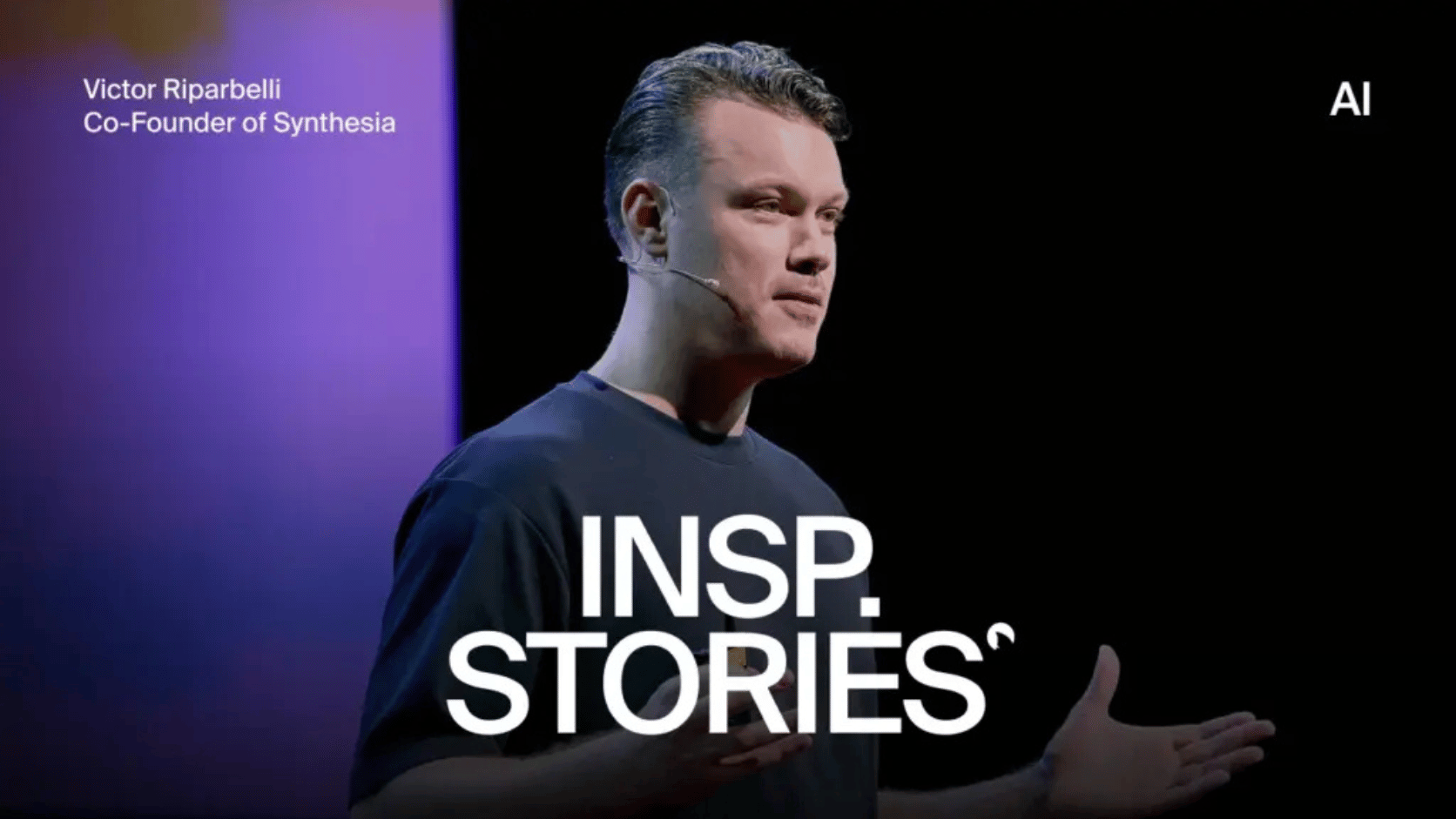
Image credit: Synthesia. Victor Riparbelli, co-founder of Synthesia.
Leave a comment
Your email address will not be published. Required fields are marked *
Add a newsletter to your widget area.
Top Stories