avaan: How a Bad Airport Bill Became a Bootstrapped Shipping Brand
Meera Singh, Founder & CEO of avaan India, on building a bootstrapped excess baggage, shipping and global delivery brand out of one airport counter bill.
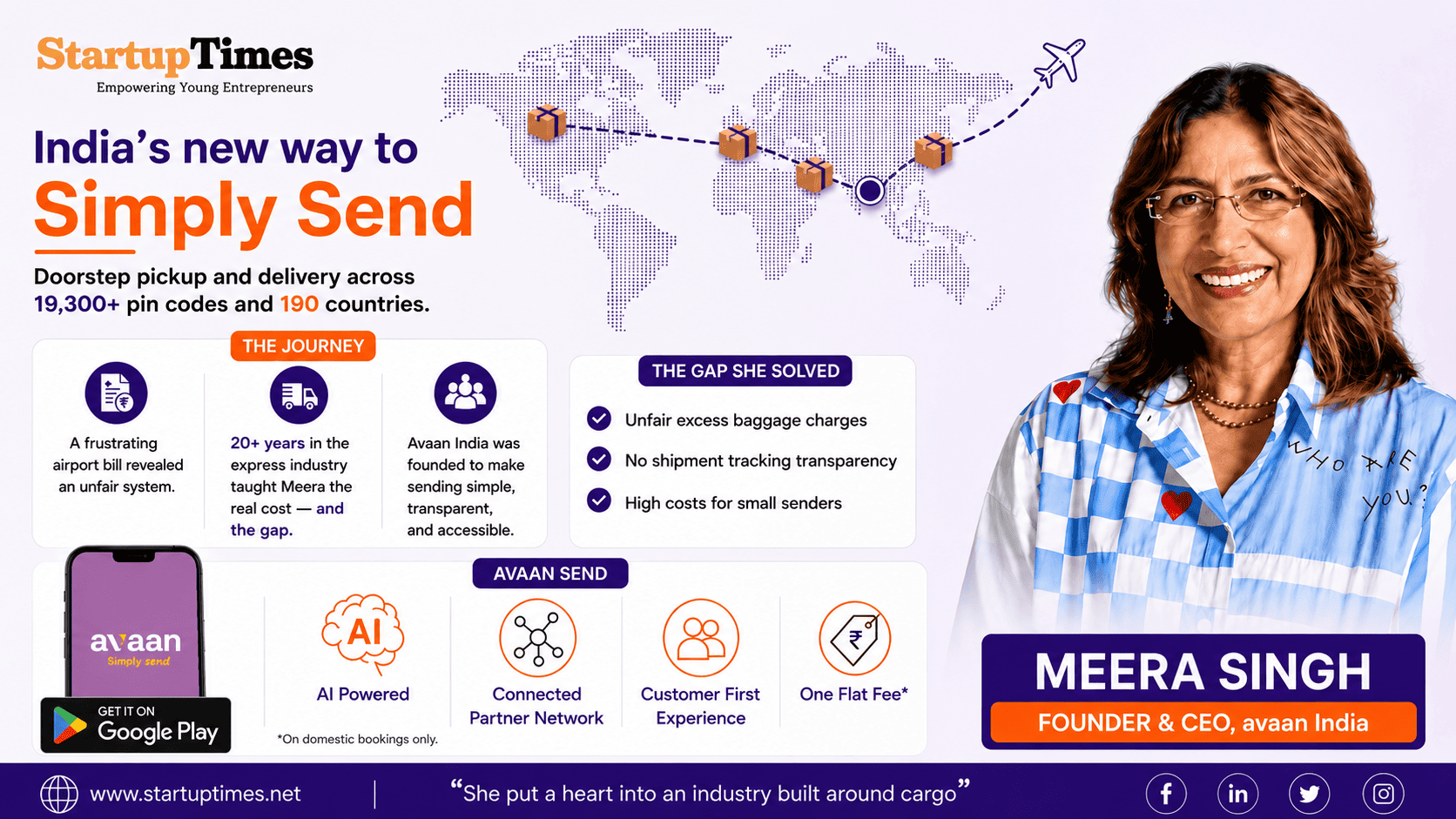
Meera started avaan after a bad airport bill convinced her that nobody was building shipping services for individual customers, only for businesses shipping in bulk. Her company is trying to close that gap.
Before avaan
Meera trained at the Institute of Hotel Management in Pusa, New Delhi, then started her career with The Oberoi, where she learned a lesson that has stayed with her since: service is not a department, it is a habit.
From hospitality, she moved into express cargo, spending close to two decades with Gati, one of India's most recognised cargo companies. It was there she learned, almost to the rupee, what it actually costs to move a kilogram of anything, anywhere in the country, knowledge she would later use to build avaan India.
Between Gati and avaan, she ran a hydroelectric project in Sikkim, where, in her own words, nothing arrives unless you have planned for it three times over. She successfully commissioned a 110 MW private hydropower project in the region. avaan applies the same discipline to individual customers that Meera spent two decades applying to large accounts.
The Bill That Started avaan
Meera was at an airport check-in counter, a few kilos over her baggage allowance, and was handed a bill for the excess. She had just spent two decades in cargo, and knew almost to the rupee what it should have cost. The bill had nothing to do with the real cost of moving that weight, and everything to do with her having no other option.
She paid it. And then she couldn't stop thinking about it.
There was no grand vision in that moment. There was a bill she was angry about, and enough industry knowledge that the anger didn't fade the way it does for most travellers. She realised she wasn't the only one, and nobody had built anything for people in that position.
The Gap Nobody Had Priced For
As Meera describes it, India's shipping industry had organised itself around two kinds of customers: businesses shipping in bulk, who could negotiate rates and choose between providers, and everyone else, the individual with a couple of extra bags, or the small business owner shipping their own orders because they weren't big enough for an enterprise contract.
That second group is larger than most people assume: individual travellers, and small businesses moving anywhere from five to fifty parcels a week, all charged unpredictable rates, with little visibility into where their shipment actually was.
avaan was built directly around that gap.
Three Services, One Network
Today, avaan runs three services, all booked through avaan Send, the company's consumer app. The app carries avaan’s tagline, "Simply Send." Whatever is being shipped, the process is meant to feel the same: one booking, doorstep pickup, transparent pricing, and tracking through to delivery.
Excess Baggage is where the company started: travellers with more than their airline allowance, or who simply don't want to carry extra bags, can have avaan pick up and deliver their bags, priced from under ₹89 per kilogram domestically, well below what airlines charge at the counter.
avaan Ship is the domestic package delivery service, covering more than 19,300 pin codes. It's the one small businesses lean on most, getting the same pickup-and-tracking experience a large enterprise account would receive, without needing enterprise volumes to earn it.
avaan Global extends that same experience to more than 190 countries, for anyone sending packages, gifts, or personal shipments internationally.
avaan Send app connects to the rest of the network behind the scenes: avaan Hub, which runs sort and warehouse operations, and avaan Partner, used by delivery executives on the ground. The three systems talk in real time, so a booking is routed, sorted, and assigned before a person has to step in. avaan is using machine learning to keep improving pickup routing and delivery-window prediction, so the system gets sharper with every shipment.
Convincing an Industry That Knew Too Much
The first resistance didn't come from customers. It came from insiders. Meera recalls floating a version of this pricing model years earlier, inside a large cargo business, and being told by people who knew the industry well that it wouldn't work: you cannot run consumer volumes at consumer prices and make the economics hold.
The lesson she took from it:
Resistance came from industry insiders, not target customers. The breakthrough reframe: treat shipments as individual belongings needing commercial-grade transparency, not plain freight. Shifting focus from B2B to C2C immediately clarified pricing.
Two further challenges followed: getting into secured airport environments took a long approval process, and second, trust had to be earned from scratch, since avaan was asking people to hand over personal belongings to a brand they'd never heard of. Meera's answer was to be visible where customers already were, which is why airport and hotel partnerships have mattered more than paid advertising.
The Kiosk That Made It Real
For Meera, avaan stopped being an idea on paper the day the company piloted its first airport kiosk in Delhi. The kiosk put avaan directly in front of the people it was built for. Enough of them stopped.
A second moment mattered almost as much. Meera was speaking at a business forum when a stranger in the audience offered, unprompted, to invest in avaan. She didn't take it. But when someone who owes you nothing offers to back you after ten minutes of listening, she says, you stop wondering whether the idea is real.
Today, avaan airport kiosks operate across Delhi, Mumbai, Hyderabad, Goa and Navi Mumbai.
A Founder Who Solves What She's Paid For
Her advice to aspiring entrepreneurs comes straight from how avaan came to exist: solve a problem you've personally paid for, not observed, not researched, paid for. The company came out of one bill she was angry about, and that anger has stayed more useful than any market study.
Her second piece of advice: expect the loudest objections to come from people who know your industry best. Experience is valuable, but it tells you what has always been true, not what could be, so listen, then decide for yourself.
Her third: be honest about how you're funding the business. avaan was built bootstrapped, without outside capital, which meant growing more slowly, but every decision stayed hers to make. Know which trade-off you're choosing, and choose it on purpose.
Beyond avaan
Outside avaan, Meera runs Affordable Art with a Heart, a charity supporting differently abled child artists, and has spoken from the TEDx stage in Mumbai (TEDxParel), in a talk titled "Disrupting Comfort Zones." She is also the author of An Ode to Sikkim and Mystique Shangrila; her book on Sikkim was personally received by His Holiness the Dalai Lama at his residence in Dharamshala. She was recognised among the Times of India's "Successful & Inspiring Business Leaders of 2023" and received the ET Inspiring Women Leaders Award the same year.
Know more about avaan at avaanindia.com or download the avaan Send app from the Google Play Store.
To read more such stories visite Startup Times Success Stories.


Leave a comment
Your email address will not be published. Required fields are marked *
Add a newsletter to your widget area.
Top Stories