Faizan Kanth: How SSGServ Is Rewriting India's Global Capability Center (GCC) Playbook Beyond Bengaluru
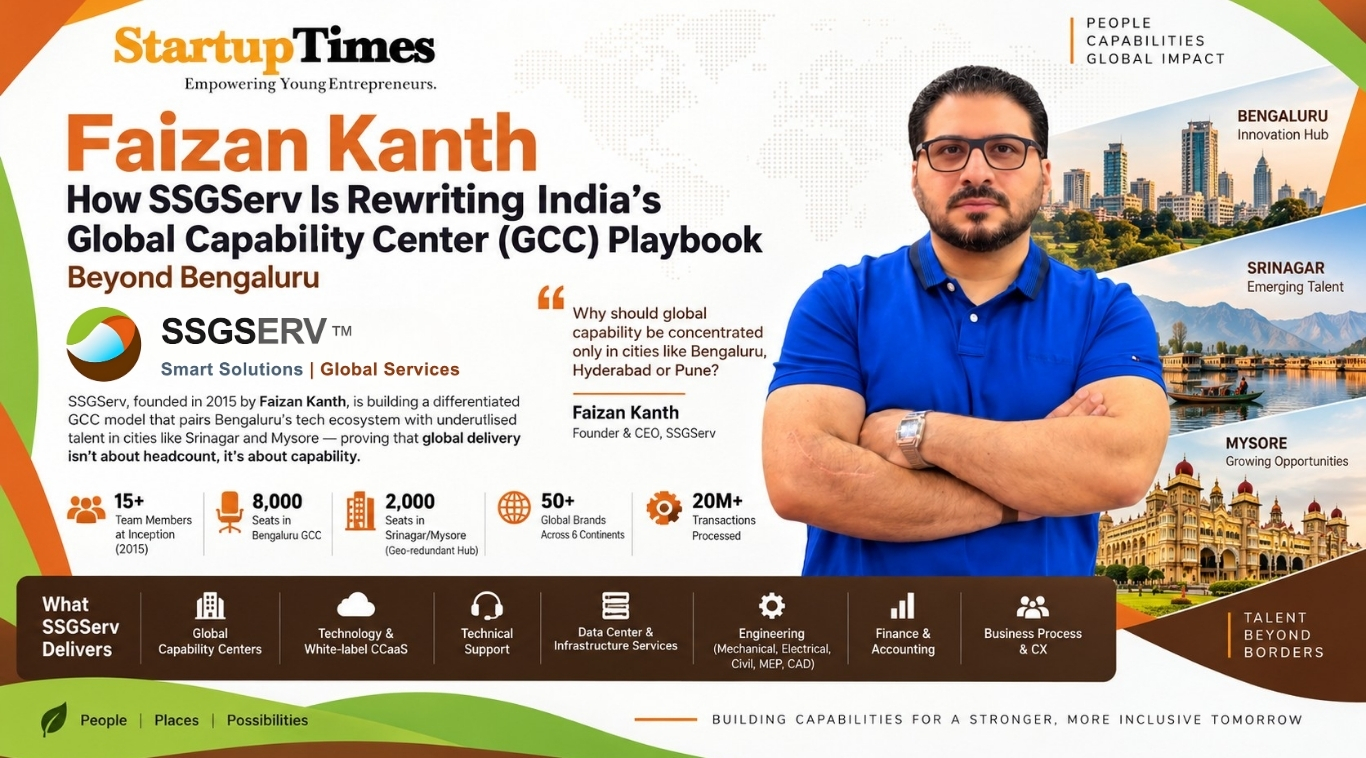
SSGServ Founder & CEO Faizan Kanth on building a Global Capability Center model that pairs Bengaluru's tech ecosystem with underutilised talent in cities like Srinagar and Mysore ,and why he believes the future of global delivery isn't about headcount, it's about capability.
For most of India's outsourcing industry, "scale" has meant one thing: more people, more seats, more cities on the traditional shortlist ,Bengaluru, Hyderabad, Pune. Faizan Kanth, Founder & CEO of SSGServ, built his company on a different bet: that the next phase of India's global delivery story runs through Tier-2 and Tier-3 cities most enterprises haven't considered yet.
A Career Built Across Operations, Not Just Strategy
Kanth's background spans frontline operations, strategy, people, technology, and international markets across EMEA, APAC, and North America ,a career path that gave him, in his own words, "a very practical understanding of what it takes to build and scale a business." An IIM Bangalore alumnus and Lean Six Sigma Black Belt, he founded SSGServ in 2015 with a 15-member team and a simple thesis: businesses don't just need people or vendors ,they need capabilities.
Why SSGServ Bets on Bengaluru Plus Srinagar and Mysore
The idea for SSGServ's differentiated model came from a pattern Kanth kept seeing repeat: companies expanding internationally consistently ran into the same questions ,where to find the right talent, how to build infrastructure, how to maintain governance, and how to scale without losing control. At the same time, he saw enormous, underutilised talent outside India's conventional technology hubs.
"Why should global capability be concentrated only in cities like Bengaluru, Hyderabad or Pune?" he asks. That question became the foundation of SSGServ's hybrid delivery model ,an 8,000-seat primary Global Capability Center in Bengaluru paired with a 2,000-seat geo-redundant hub in Srinagar/Mysore, giving clients access to Bengaluru's deep technology and leadership ecosystem alongside a highly capable, cost-efficient talent pool from emerging cities.
From BPO to GCC: Closing the Gap Between Outsourcing and Captive Centers
Kanth identified a specific market gap between two extremes: traditional outsourcing, which he says is largely about cost, headcount, and transactions, and building a fully captive operation, which demands significant time, capital, and management effort most companies can't spare. SSGServ positions itself in between ,helping companies build a dedicated capability, complete with its own standards, governance, culture, and processes, without constructing every piece of infrastructure from scratch.
"The GCC model changes the conversation from 'how many people can you provide?' to 'what capability can you help us build?'" Kanth explains. "That is a significant shift."
What SSGServ Actually Delivers
Today, SSGServ operates across Global Capability Centers, technology and white-label CCaaS, technical support, data center and infrastructure services, engineering (mechanical, electrical, civil, MEP, and CAD), finance and accounting, and business process and CX ,with over 20 million transactions processed across six continents for 50+ global brands. The company's Follow-the-Sun delivery model is designed to guarantee continuity across geographies and time zones, rather than concentrating risk in a single delivery location.
What differentiates SSGServ, Kanth says, isn't the individual services but how they connect: a client that comes in for customer experience or technical support often evolves that relationship into engineering, technology, finance, or a full GCC build-out over time.
Earning Trust Without Decades of Legacy
Competing against established players with decades of history and far larger teams meant SSGServ's biggest early hurdle was credibility ,clients weren't just trusting the company with a project, but with their customers, technology, data, and brand reputation. Kanth's answer was pure execution: delivering consistently, building long-term relationships, and proving that talent outside India's traditional tech hubs can support global-quality operations. "We shouldn't automatically equate geography with capability," he says.
The Turning Point: From Service Provider to Capability Partner
The inflection point for SSGServ, Kanth says, was when client conversations shifted from headcount, transactions, and SLAs to a fundamentally different question: can you help us build an engineering capability, establish a GCC, or create a specialised function under our own governance? That shift changed how SSGServ thought about its own business ,moving from "how many people can we deploy" to "what business capability can we create."
The Next Five Years
Kanth's five-year vision is for SSGServ to be recognised as a global capability partner rather than another outsourcing company, with continued investment in specialised GCCs, engineering, AI-enabled operations, and global CX. He sees Tier-2 and Tier-3 cities ,with Srinagar among them ,becoming meaningful contributors to India's global capability ecosystem, alongside a growing opportunity between India and the Gulf, where SSGServ has already worked on engineering GCC models for Saudi projects.
His advice for aspiring founders: don't start a business simply to be an entrepreneur ,start because you've identified a problem worth solving, stay close to your customers, don't be afraid to change your model when the market tells you to, and stay humble enough to learn from your mistakes quickly.
About Faizan Kanth:Founder & CEO, SSGServ. Website| LinkedIn| Company LinkedIn
This feature is brought to you by Startup Times.

Leave a comment
Your email address will not be published. Required fields are marked *
Add a newsletter to your widget area.
Top Stories