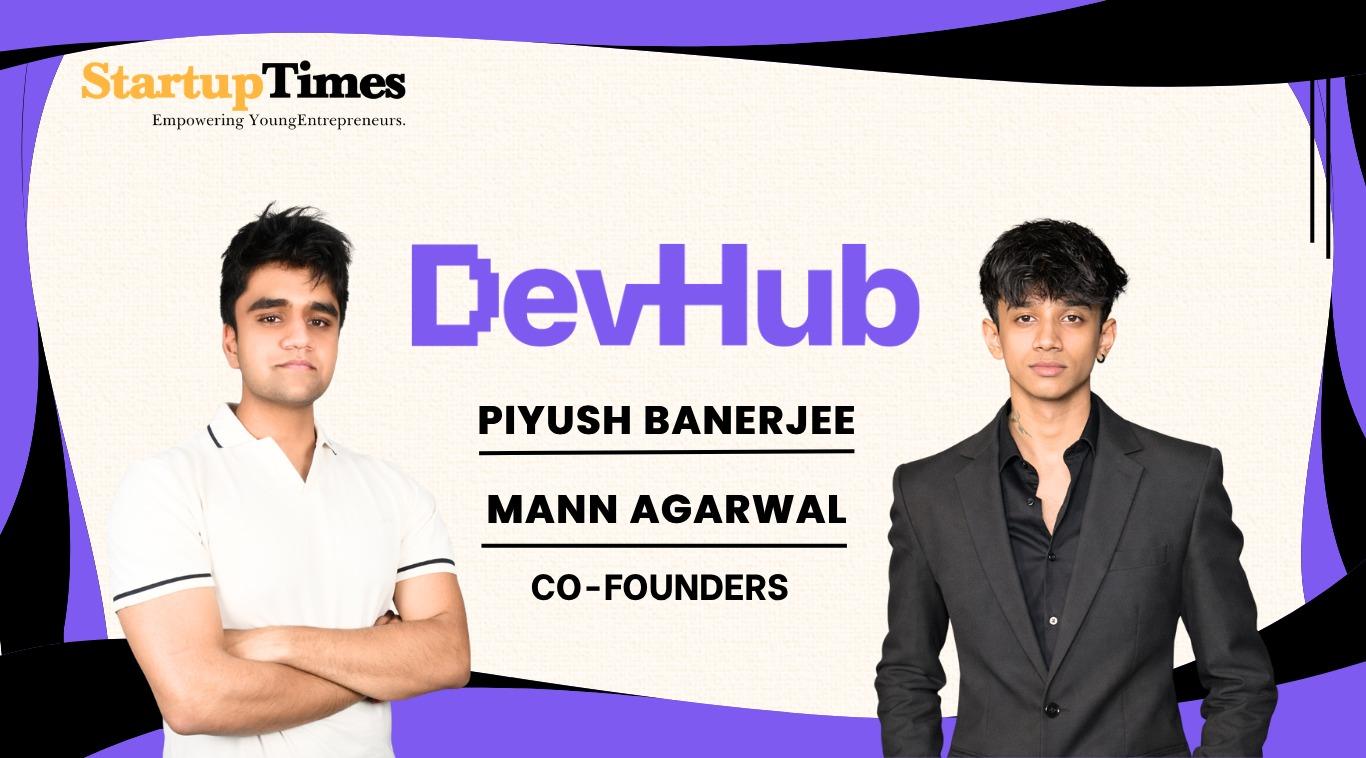
India’s startup ecosystem is evolving fast—not just because of founders building products, but because of communities shaping the next wave of innovators. At the center of this shift are Piyush Banerjee and Mann Agarwal, Co-founders of DevHub, who are building something that goes beyond a typical startup.
DevHub isn’t just another platform; it’s an attempt to rethink how developers grow, collaborate, and transition into real-world builders. What makes their journey interesting is that it didn’t start with a pitch deck or a “big idea.” It started with lived experiences, repeated frustrations, and a simple belief: learning tech should not feel disconnected from reality.
Early Foundations: Learning Beyond the Classroom
At 23, Piyush Banerjee’s journey doesn’t follow the usual script. A Computer Science graduate from MIT-WPU, he was never fully convinced that classrooms alone could prepare someone for the real world.
“I’ve always believed that you don’t really learn by sitting through lectures—you learn when something is on the line,” he says.
That mindset pushed him to take a year off during college—not out of necessity, but to explore building outside academics.
His first entrepreneurial step came at 17, when he co-founded Medamark Digital with friends. They pitched door-to-door to local businesses, often facing rejection, until one client agreed to pay ₹5,000 per month. It wasn’t a big deal financially—but it changed everything in terms of confidence and clarity.
Over time, Piyush explored product, branding, consulting, and startup operations. From working with a legal-tech startup to contributing to campaigns involving global artists like Russ and JID, his journey has been less about linear growth and more about constant experimentation.
The Technical Vision: Mann Agarwal’s Role in Building DevHub
If Piyush brings structure and business thinking, Mann’s path is driven by a deep focus on AI and research, combined with a strong instinct for leadership, strategy, and partnerships.
Currently pursuing a BTech in Artificial Intelligence from NMIMS, Mann has worked across multiple startups. He has consistently stood out among his peers for his performance and ability to take ownership early. Even during college and competitions, he gravitated toward leadership roles.
“I’ve always been less interested in just building the model and more interested in what happens after it works: who uses it, how it scales, and whether it actually matters,” Mann explains.
His work reflects that mindset—from building real-time AI systems to contributing to a research fellowship at Nanavati Max Super Speciality Hospital, where he worked on AI-driven healthcare solutions.
Alongside applied work, he has developed a strong research foundation, with multiple paper submissions and a published research paper in cryptocurrency forecasting accepted at an IEEE conference in Switzerland. This demonstrates his ability to combine advanced AI architectures with real-world systems.
At his core, Mann represents a new kind of founder—one who combines deep technical expertise with business instinct and sees AI not just as a field of study, but as a tool to build systems that matter.
The Moment DevHub Took Shape
DevHub didn’t start in a boardroom—it started with a DM.
Mann reached out to Piyush on Instagram with an idea around building a developer ecosystem. The idea clicked instantly, but both knew it needed to be bigger than just another student community.
As they brainstormed, they realized they had been observing the same problem from different angles.
Startups couldn’t find execution-ready developers when they needed them. Students, on the other hand, struggled to find meaningful opportunities despite having skills.
The gap was obvious. The solution wasn’t.
DevHub became that bridge.
Identifying the Market Gap
According to Mann, accessibility was one of the biggest issues.
“There’s talent everywhere—but very few structured pathways. People either feel lost or stuck,” he says.
DevHub was designed to make that pathway clearer. Beginners and experienced developers coexist in the same ecosystem, learning through collaboration instead of competition.
From Piyush’s perspective, the missing piece was structure.
“We don’t have a pipeline; we have scattered opportunities. DevHub is about bringing everything into one system,” he explains.
Inside DevHub: More Than a Community
Today, DevHub operates as a multi-vertical engineering ecosystem.
It builds AI systems, SaaS tools, and automation platforms—while also functioning as a community-driven execution layer that bridges the gap between education and industry. Developers don’t just learn—they work on real products.
A major initiative within DevHub is BuildVerse, where internal experiments are turned into market-ready products.
Another is 0to1, a six-month execution-first program where participants build startups from scratch.
Adding to this, the team is launching an independent applied AI research lab called CONCPT, focused on building practical, real-world AI systems rather than purely academic outputs.
The philosophy is simple:
Community drives execution. Execution builds products. Products create startups.
Challenges Along the Journey
For Mann, the hardest part early on was credibility.
“Convincing people to believe in something that doesn’t fully exist yet—that’s always the toughest phase,” he says.
Getting institutions, mentors, and developers to trust the vision required consistent delivery.
For Piyush, the struggle was more operational.
Cash flow issues, deals falling through, and managing multiple verticals with limited resources created constant pressure.
“There were phases where everything felt uncertain—but we kept going because the long-term vision made sense,” he shares.
The Breakthrough Moment
DevHub’s turning point came when multiple things aligned—academic collaborations, IIT-backed mentors, and a growing community of over 500 developers.
Around the same time, the team also received an investment opportunity from a notable entity.
They chose to decline it.
“We wanted to build this our way,” Piyush says. “Staying bootstrapped gave us control over the direction.”
Even today, DevHub continues to operate without external funding.
The Road Ahead
Looking ahead, the founders see DevHub evolving into a fully integrated tech ecosystem.
Piyush is focused on long-term impact.
“We’re not chasing short-term valuation. The goal is to build something that creates real value at scale.”
The ambition is clear—DevHub aims to grow into a billion-dollar ecosystem, driven by its startups, products, and AI systems.
Mann’s vision complements this:
“We want DevHub to become the go-to place for anyone who wants to build—not just learn,” he says.
Advice to Aspiring Entrepreneurs
Mann believes founders should focus on real problems.
“The best ideas come from things you’ve personally struggled with. Don’t chase trends—solve something real.”
Piyush adds:
“Start before you feel ready—but don’t ignore structure. Execution without direction doesn’t last.”
Building the Future, One Builder at a Time
DevHub represents a different kind of startup—one that focuses as much on people as it does on products.
Mann Agarwal and Piyush Banerjee are attempting something ambitious: reshaping how Indian developers learn, build, and scale ideas so they can compete confidently on a global stage.
If it works, DevHub won’t just create startups.
It will create builders.
Connect & Explore