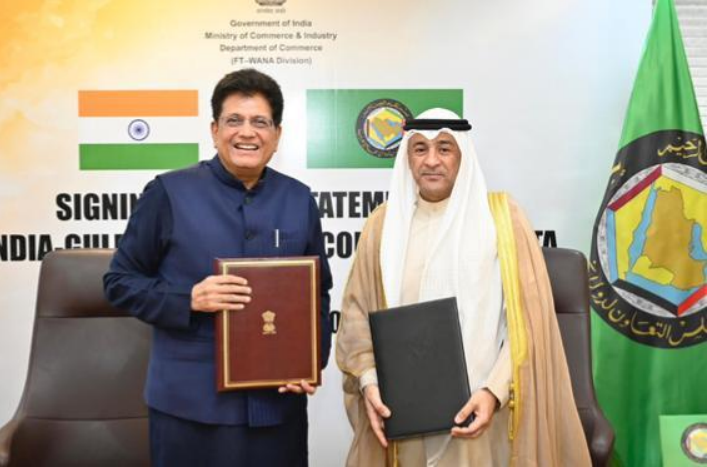
India and the Gulf Cooperation Council (GCC) formally initiated negotiations for a long-pending India–GCC Free Trade Agreement after a Joint Statement was signed in New Delhi on 24 February 2026. Commerce and Industry Minister Piyush Goyal and GCC Secretary-General Jasem Mohammad Al Budaiwi led the signing, describing the development as a “major step in deepening economic integration” between India and the six-nation Gulf bloc. The decision revives talks stalled since 2008, reflecting renewed urgency to expand trade, technology partnership and cross-border investment.
The FTA is expected to significantly reshape economic engagement between India and Saudi Arabia, UAE, Qatar, Kuwait, Oman and Bahrain, with both sides identifying opportunities in goods, services, digital trade, renewable energy and logistics. Senior officials highlighted that India–GCC trade has consistently remained above USD 155 billion, making the bloc India’s largest trading partner. The agreement, once completed, will be among India’s most consequential modern trade frameworks, strengthening its role in the West Asian economic architecture.
Revival of Negotiations After Nearly Two Decades
The resumption of FTA negotiations is the result of sustained diplomatic engagement between New Delhi and Gulf capitals over the past year. Minister Goyal emphasised that the revival reflects “a mutual recognition that India and the GCC are entering a new phase of economic partnership,” adding that the pact aims to address tariff barriers, regulatory bottlenecks and long-term investment frameworks. His remarks were supported by senior MEA officials who confirmed that the decision followed a series of strategic discussions with Saudi Arabia and the UAE, India’s closest economic partners in the region.
For the GCC, the move aligns with its larger diversification strategies such as Saudi Vision 2030, UAE’s economic transformation agenda, and Qatar National Vision 2030. Secretary-General Al Budaiwi stated that the GCC sees India as a “priority regional partner” and highlighted India’s expanding consumer market, manufacturing capabilities and digital infrastructure leadership. Analysts note that the launch of formal talks at this stage reflects geopolitical stability within the region and India’s rising influence in the Global South.
Strengthening Trade, Investment and Sectoral Growth
India–GCC bilateral trade has historically been anchored in energy, but the trade basket has diversified considerably. Indian exports now include engineering goods, machinery, electronics, pharmaceuticals, food products and gemstones. Officials predict that tariff reduction under the FTA could significantly raise India’s competitiveness in these sectors, particularly in Saudi, UAE and Oman markets. Industry bodies have already begun internal consultations to identify areas where tariff relaxation could accelerate supply-chain growth.
GCC nations have also emerged as major investors in India. Sovereign funds such as Abu Dhabi Investment Authority (ADIA), Qatar Investment Authority (QIA) and Saudi Arabia’s Public Investment Fund (PIF) collectively hold multi-billion-dollar positions across India’s renewable energy, logistics, digital services and infrastructure sectors. The FTA is expected to include mechanisms that streamline investment entry, reduce compliance hurdles and promote joint ventures in high-growth industries. Officials estimate that the pact could unlock an additional USD 25–30 billion in cross-border investment over the next few years.
A senior trade official familiar with the negotiations said that both sides are aligning their regulatory positions to ensure faster customs clearance, simplified standards cooperation and integrated logistics corridors. This includes examining opportunities for enhanced maritime routes between Indian ports and GCC coastal hubs.
Digital Trade, Technology and Financial Cooperation
One of the most anticipated areas of the FTA is digital and technological cooperation. India is pushing for frameworks that recognise digital public infrastructure, cross-border fintech services, cybersecurity standards and data-governance principles. The GCC, which is rapidly transitioning from traditional sectors to high-tech economies, has expressed interest in partnering with Indian firms across artificial intelligence, cloud computing, digital identity solutions and e-governance platforms.
The UAE and Saudi Arabia have already partnered with multiple Indian technology companies for smart-city projects, cloud infrastructure expansion and fintech regulations. The FTA is likely to formalise these partnerships under a broader regulatory understanding that enables interoperability, talent mobility and joint innovation projects. A senior GCC technology official stated that India’s experience in building population-scale digital platforms “offers a model that Gulf nations are keen to adapt in various civic and financial systems.”
Financial cooperation will also expand under the proposed agreement. Both sides are exploring smoother cross-border payment frameworks and fintech regulatory bridges, which could increase transparency and reduce transaction delays for millions of Indian expatriates living in the Gulf.
Energy Transition and Green Partnership at the Core
While hydrocarbons remain central to India–GCC ties with the Gulf supplying nearly one-third of India’s crude and over 40 percent of its LNG, the FTA is set to broaden collaboration in green and renewable energy. India is emerging as a global hub for solar module manufacturing, green hydrogen production and electrolyser innovation. GCC countries are positioning themselves as future leaders in hydrogen exports and large-scale renewable projects.
Negotiators confirmed that the agreement will include provisions for joint R&D, long-term green-hydrogen purchase arrangements and carbon-reduction technologies. Saudi Arabia and the UAE already have partnerships with Indian firms for hydrogen pilot projects. The FTA is expected to institutionalise these efforts by establishing predictable investment environments and permitting easier transfer of clean-energy technologies between the two regions.
Energy analysts note that the India–GCC partnership is transitioning from a buyer-supplier relationship to a technology-driven clean-energy alliance. The FTA could help India secure stable energy routes while supporting the Gulf’s ambition to diversify away from oil and gas.
Labour Mobility, Regulatory Alignment and Long-Term Outlook
The GCC hosts nearly nine million Indian workers, making labour mobility a central component of bilateral cooperation. Negotiators indicate that the FTA discussions will include frameworks for skill recognition, workforce mobility, safety standards and faster processing of employment documentation. India has been advocating for more transparent recruitment systems and improved worker protections under existing labour laws in the Gulf.
Regulatory alignment is also expected to play a significant role in accelerating trade efficiency. Both sides are evaluating harmonisation in customs procedures, product standards, dispute-settlement frameworks and intellectual-property protection. Officials believe these steps will reduce transaction delays, foster business confidence and create a predictable environment for exporters and investors.
Economists project that once concluded, the India–GCC FTA could raise bilateral trade to USD 250–280 billion within the first five years. The agreement is positioned to become one of the most impactful trade pacts of the decade, connecting India’s manufacturing strength with the Gulf’s capital, energy infrastructure and strategic geography.