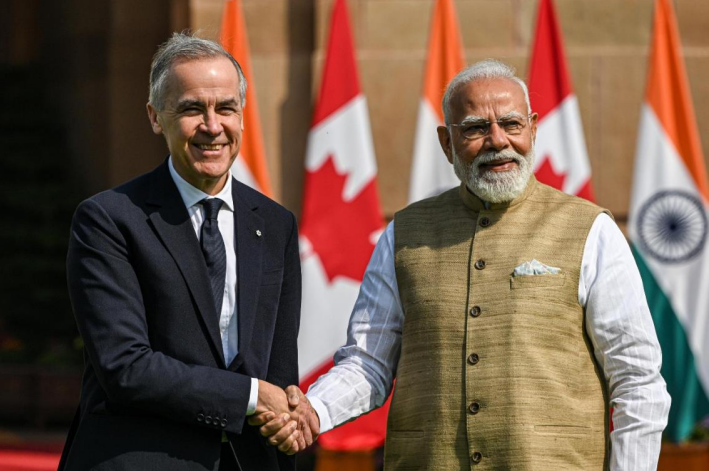
India and Canada finalised a landmark $2.6-billion uranium supply agreement in New Delhi after Prime Minister Narendra Modi and Canadian Prime Minister Mark Carney jointly endorsed a renewed Strategic Energy Partnership. The deal grants India Canada Uranium Deal long-term access to nuclear fuel from Canadian major Cameco, marking one of the biggest civil-nuclear supply commitments between the two countries in more than a decade. Officials confirmed that the contract covers deliveries of nearly 22 million pounds of uranium concentrate scheduled between 2027 and 2035, aligned with India’s nuclear-power expansion plans.
Alongside the uranium pact, both governments agreed to accelerate negotiations on a Comprehensive Economic Partnership Agreement (CEPA), broaden cooperation in critical minerals, LNG, and technology, and set a renewed diplomatic tone after years of strained relations. The announcements collectively signal a deliberate reboot of India–Canada ties at a time when both countries are seeking secure energy partnerships, diversified supply chains and strengthened Indo-Pacific coordination.
India Locks Long-Term Uranium Supply for Expanding Nuclear Fleet
The agreement with Cameco ensures steady uranium supply for India’s growing civilian reactor network, a priority for New Delhi’s long-term energy strategy. Officials stated that the volumes and delivery schedule were designed to match India’s reactor commissioning timeline, especially as the government pursues additional nuclear capacity to reduce dependence on fossil fuels. The deal is structured as a long-term commercial contract with market-linked pricing and staged annual shipments.
For India, which plans to significantly increase nuclear generation by 2040, guaranteed access to uranium is vital for uninterrupted operations of existing reactors and for upcoming units currently under construction. Energy ministry sources noted that the arrangement reduces India’s historical procurement volatility by locking in predictable volumes from a globally established supplier. The pact strengthens India’s civil-nuclear ecosystem just as the country’s electricity demand is projected to rise sharply over the next decade.
CEPA Framework Revived as Leaders Push for Stronger Economic Integration
The signing ceremony also included a bilateral decision to fast-track CEPA negotiations, an agenda stalled for several years. The new terms of reference formally revive the process and commit both sides to an accelerated schedule. Indian and Canadian officials indicated that the refreshed CEPA framework will cover trade in goods and services, investment, digital commerce, mobility, and regulatory coordination.
The renewed push comes amid growing recognition that India Canada Uranium Deal possess complementary strengths, India as a high-growth consumer and manufacturing hub, and Canada as a resource-rich technology and energy economy. A successful CEPA is expected to unlock greater market access, reduce tariff barriers and enable deeper participation of Canadian firms in India’s clean-energy and critical-minerals sectors, areas where Ottawa is keen to diversify partnerships. Both governments signalled political intent to make CEPA a cornerstone of future ties.
Strategic Energy Collaboration Extends Beyond Uranium
While uranium supply is the most high-profile element, the Strategic Energy Partnership announced by the two leaders extends into multiple clean-energy domains. India Canada Uranium Deal committed to exploring cooperation in LNG, hydrogen, solar technology manufacturing, and joint research in low-carbon solutions. The partnership reflects a shared view that energy security and decarbonisation pathways must be pursued concurrently.
India, which is rapidly scaling renewable capacity, sees Canada as a dependable supplier of LNG and advanced materials essential for solar and battery manufacturing. Canada, meanwhile, is seeking long-term buyers for its LNG output and looking to position itself as a stable partner in global energy transition supply chains. Officials from both sides described the energy package as “pragmatic, future-focused and commercially grounded,” underscoring its relevance for joint climate goals.
Diplomatic Reset After Years of Strain
The joint announcements mark a clear diplomatic thaw after a challenging period in India–Canada relations. The meeting between Modi and Carney took place under an explicitly cooperative tone, with both leaders highlighting shared democratic values and mutual economic interests. The uranium agreement is viewed within diplomatic circles as a strong signal of restored trust.
High-level officials accompanying the delegation emphasised that both countries intend to rebuild ties on a practical, forward-looking foundation. The revitalised engagements across energy, trade, education and technology were presented as evidence of political willingness to move beyond past tensions. Analysts noted that the nature and scale of the agreements indicate a substantive reset rather than symbolic goodwill.
Outlook
The next phase of India–Canada cooperation will be defined by execution operationalising the uranium supply chain, advancing CEPA negotiations, and deepening joint initiatives in critical minerals and technology. Implementation teams on both sides are already preparing follow-up meetings to map timelines, regulatory requirements and industry participation.
Strategically, the agreements position India Canada Uranium Deal as partners in key 21st-century domains: clean energy, nuclear security, mineral supply chains and digital transformation. If CEPA progresses as planned, bilateral trade could rise substantially in the coming decade, supported by increased investment flows, technology collaboration and smoother mobility frameworks. The uranium pact, meanwhile, anchors the long-term energy pillar of the partnership, reinforcing India’s path toward a more secure and diversified energy future.