
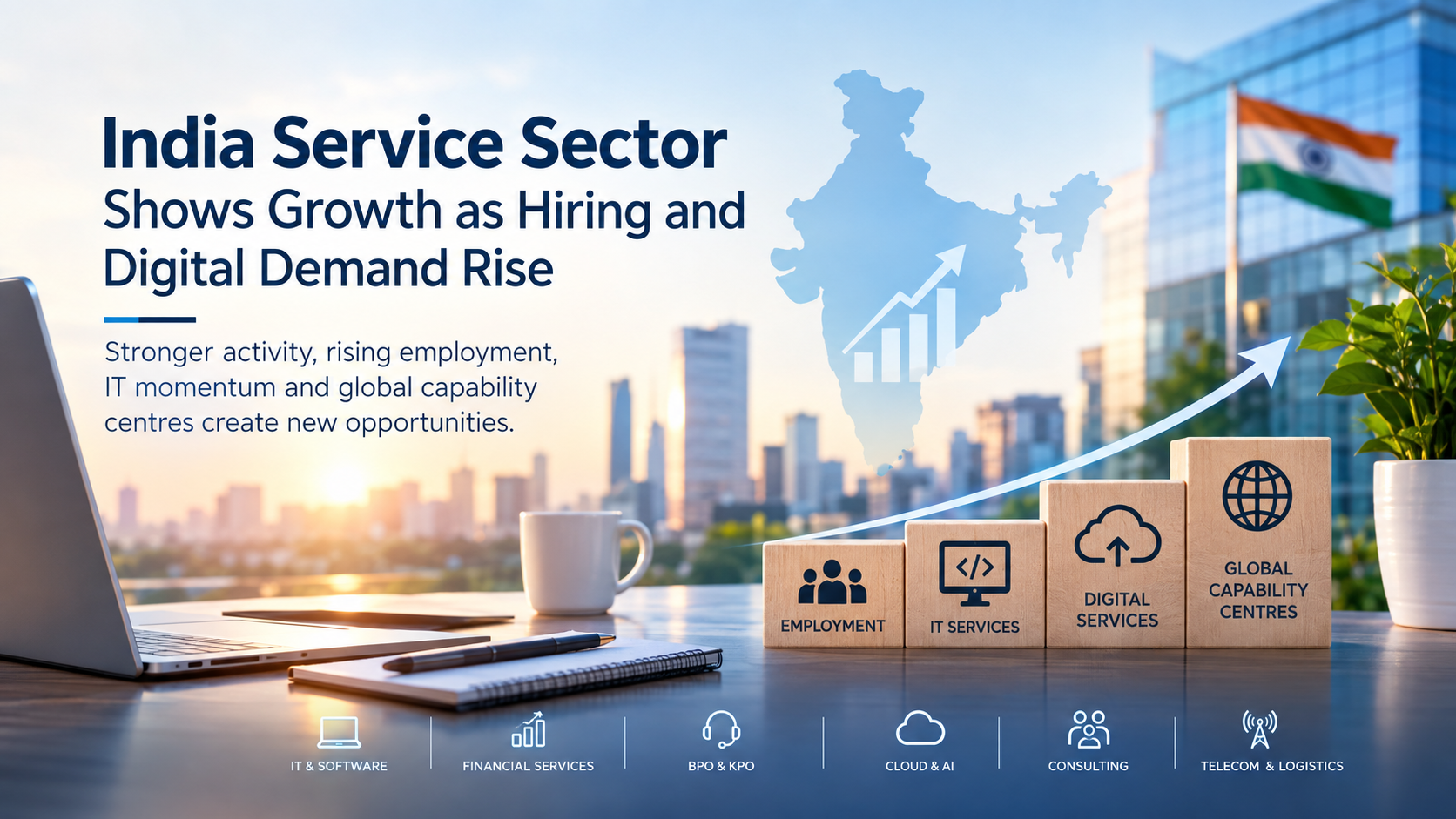
India Service Sector Shows Growth as Hiring and Digital Demand Rise
India service sector activity improved in August 2026, while hiring, IT services and GCC expansion create new growth opportunities.
India service sector activity showed signs of resilience in August 2026, with business activity expanding faster than in the previous month and employment growth reaching a 15-month high. The latest HSBC India Services PMI indicated that the sector continues to play an important role in supporting business activity, employment and digital transformation across the Indian economy.
The seasonally adjusted HSBC India Services PMI Business Activity Index increased to 54.1 in August from 53.3 in July. A reading above 50 indicates expansion. However, the August reading remained among the weaker growth rates recorded in recent years, highlighting a mixed environment in which service providers continue to experience demand while facing cost and business-confidence pressures.
Service Sector Growth Improves in August
The improvement in India's services activity was supported by stronger business activity and new orders. Service companies continued to report demand for their offerings, although the pace of new-business growth remained relatively subdued compared with stronger periods.
According to the latest PMI data, international demand also provided support, with new export orders continuing to increase. At the same time, companies remained cautious about future market conditions, suggesting that businesses are balancing growth opportunities with uncertainty around costs and demand.
For India's broader economy, the performance of the service sector remains significant because services cover a wide range of activities, including information technology, financial services, professional services, telecommunications, retail, hospitality, logistics and business-process operations.
Hiring Becomes an Important Positive Signal
One of the notable developments in the latest data was the improvement in employment. Services companies increased staffing at the fastest rate in 15 months, indicating that some businesses are expanding their workforce to meet operational requirements and customer demand.
The employment increase is particularly relevant for India's large pool of young professionals and skilled workers. Demand for employees is increasingly connected with areas such as customer service, sales, technology, digital operations and specialised business services.
The trend also highlights how India's service economy is evolving beyond traditional outsourcing. Companies are increasingly looking for employees with technology, analytics, artificial intelligence, communication and problem-solving skills.
IT Services Hiring Shows Fresh Momentum
The information technology segment is also showing signs of improved hiring demand. Recent industry data reported by Business Standard indicated that active talent demand in India's IT services sector reached around 57,000 roles in September 2026, representing the highest level in approximately 18 months.
This development reflects the continuing importance of technology-driven services in India's employment market. Companies are increasingly investing in digital transformation, cloud technology, artificial intelligence, cybersecurity, software development and enterprise technology.
For businesses, the shift means that technology is becoming a core part of service delivery rather than simply a support function.
Global Capability Centres Strengthen India's Service Economy
Another major development is the continued expansion of Global Capability Centres (GCCs) in India.
On September 21, 2026, Starbucks announced an agreement to establish a Global Capability Centre in Chennai and plans to hire approximately 800 technology professionals. The centre is expected to support functions including finance, software development and research and development.
The development reflects the broader transformation of India's GCC ecosystem. According to the 2026 Nasscom-Zinnov figures cited by Reuters, India has more than 2,100 GCCs employing around 2.36 million people and generating nearly $100 billion in revenue annually.
GCCs are increasingly moving beyond traditional back-office functions and taking responsibility for higher-value activities such as technology development, finance, analytics and research.
Digital Services Continue to Create Opportunities
The expansion of digital infrastructure is creating opportunities across several parts of the service economy. Artificial intelligence, cloud computing, enterprise software, data centres and digital platforms are increasing demand for specialised services.
Government discussions with global business leaders have also highlighted India's opportunities in digital infrastructure and financial services. Recent discussions in New York focused on areas including AI, cloud computing, digital services, data centres and financial technology.
This trend could create opportunities for technology companies, consulting firms, financial service providers, digital agencies and startups offering specialised business solutions.
Challenges Facing the Service Sector
Despite the positive hiring and activity indicators, the service sector is not without challenges.
The August PMI data showed that new-business growth remained relatively subdued and business confidence was below its long-run average for the second consecutive month. Input costs also increased, while businesses raised prices to reflect higher operating expenses.
Service businesses therefore need to focus not only on acquiring customers but also on improving productivity, controlling operating costs and maintaining service quality.
Technology can play an important role in this process. Automation, AI-powered customer support, CRM systems, data analytics and cloud-based platforms can help service companies improve efficiency while managing growing customer expectations.
What the Latest Developments Mean for Businesses
The latest developments point towards a service economy that is becoming increasingly technology-driven and skill-intensive.
For startups and established companies, opportunities are emerging in areas such as:
- Artificial intelligence and automation
- IT and software services
- Financial technology
- Digital marketing
- Business consulting
- Cybersecurity
- Cloud computing
- Customer experience
- Data analytics
- Global Capability Centres
- Professional and knowledge-based services
Companies operating in these segments can benefit from India's large talent pool and growing digital ecosystem, while businesses across other service industries can use technology to improve their operations and customer experience.
Future Outlook for India's Service Sector
The India service sector continues to remain an important part of the country's economic growth story. August data showed continued expansion, while the acceleration in employment and renewed demand for IT professionals provided additional signs of activity in selected segments.
At the same time, slower new-business growth, cost pressures and cautious business confidence indicate that growth is not uniform across every service segment. Companies will increasingly need to combine technology adoption with workforce development, customer-centric strategies and operational efficiency.
The expansion of IT services hiring and GCCs also demonstrates the changing nature of India's service economy. As global companies increasingly use India for technology, finance, research and other high-value functions, the country's service sector is becoming more closely connected with global business operations.
For businesses and professionals, the emerging opportunity lies in developing capabilities that match this transformation. Companies that invest in digital infrastructure, skilled talent, automation and high-value services will be operating in an environment where technology and services are becoming increasingly interconnected.
Overall, recent developments suggest that India's service sector remains active, but its next phase of growth will increasingly depend on digital transformation, skilled employment, global demand and productivity-led business models.
To read more such news visit Startup Times

Leave a comment
Your email address will not be published. Required fields are marked *
Add a newsletter to your widget area.
Top Stories