
India’s Dark Pattern Problem: How Digital Platforms Influence What We Buy
From hidden charges to pre-selected options, dark patterns are changing how Indians shop online. What happens when convenience starts influencing consumer choice?
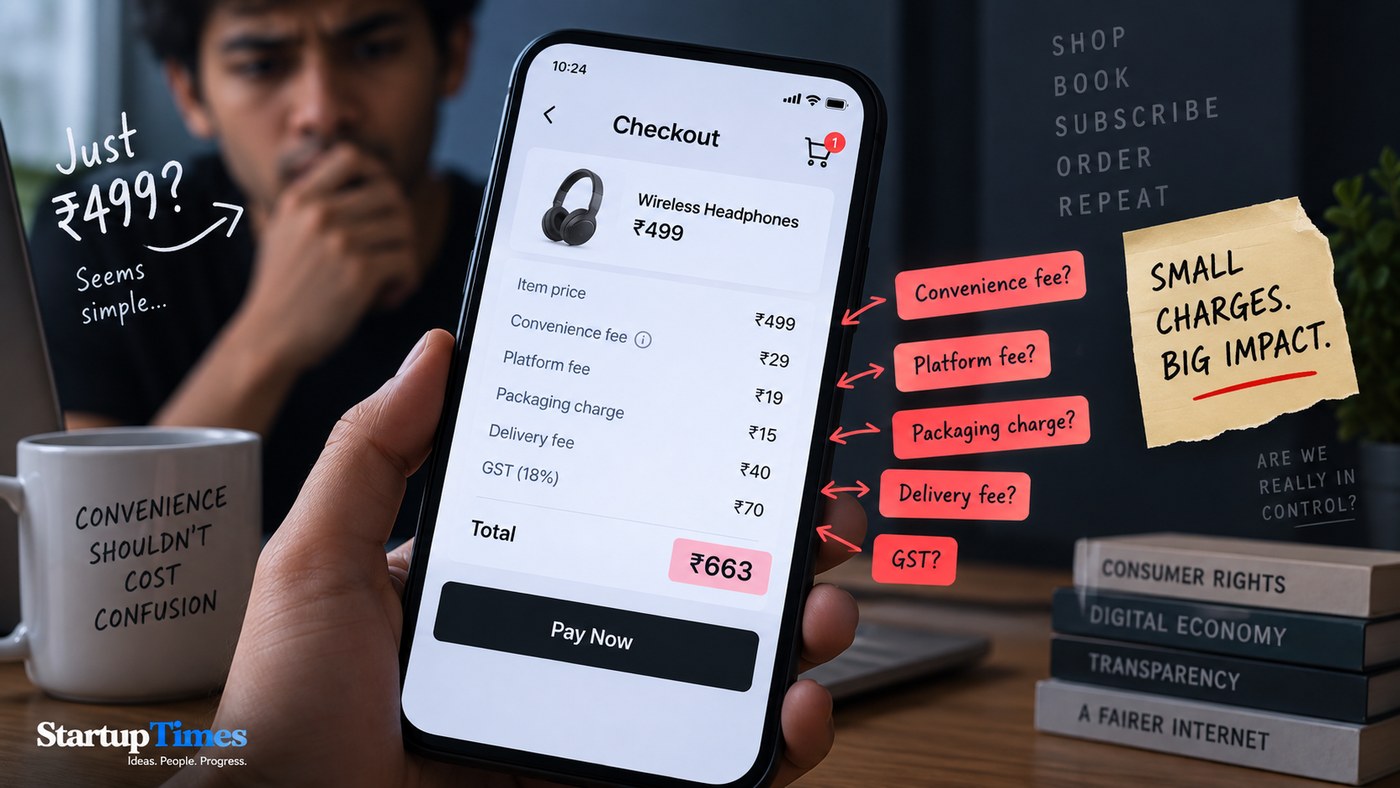
You open an app to buy something for ₹500.
By the time you reach the payment screen, the number is different.
Maybe an additional charge has appeared. Maybe an add-on was already selected. Maybe a “free” service requires you to hand over your phone number and email address. Or perhaps the screen makes one option look obviously safer than the other.
None of these experiences are accidental when they are deliberately designed to influence what you choose.
They are part of a growing digital business problem known as dark patterns.
And in India, the issue is no longer just about annoying pop-ups or confusing websites. It has become a consumer-protection issue that regulators are actively investigating.
The price you see may not be the price you pay
Digital businesses have spent years making transactions faster and easier.
One click can order dinner. A few taps can book a flight. A subscription can be activated without speaking to anyone.
But the same convenience can also make it easier for consumers to overlook what is happening during the transaction.
A 2026 study by Datum Intelligence estimated that Indian consumers lose between ₹25,000 crore and ₹28,000 crore every year because of dark patterns across online marketplaces.
The study, based on a survey of 2,590 consumers across 50 cities, estimated that 88% of India's 304 million online buyers lose around ₹78–₹87 per month through practices including hidden charges, forced add-ons, drip pricing, false urgency and subscription traps.
The number is striking not because every individual transaction involves a large amount of money.
It is because small amounts multiplied across millions of transactions become a very large business.
The real power of a dark pattern is not the ₹20 or ₹50 it may add to one transaction. It is the scale at which the same design can influence millions of consumers.
So, what exactly is a dark pattern?
A dark pattern is essentially a design choice that pushes a user towards something they may not have intended to do.
India's Central Consumer Protection Authority (CCPA) defines dark patterns as deceptive design practices using user-interface or user-experience interactions that mislead or trick users into doing something they originally did not intend or want to do.
India's 2023 Guidelines for Prevention and Regulation of Dark Patterns identify 13 types, including:
| Dark pattern | What it can look like |
|---|---|
| Basket Sneaking | An additional product or service is added to your basket |
| Confirm Shaming | The user is made to feel guilty for rejecting an option |
| Forced Action | You must take an action you didn't originally want to take |
| Drip Pricing | Additional costs appear during the buying process |
| Subscription Trap | A subscription becomes difficult to cancel or renew |
| Interface Interference | The design gives one choice greater prominence |
| False Urgency | The interface creates pressure to act immediately |
The government lists 13 such practices as deceptive or unfair digital practices.
The important distinction is that not every fee, discount or persuasive advertisement is automatically a dark pattern.
A business is allowed to charge for delivery.
A subscription is allowed to renew according to its terms.
A company is allowed to market its product.
The problem begins when the interface is deliberately designed to hide, distort or manipulate the consumer's ability to make an informed choice.
The regulator is no longer just warning consumers
India notified its dark-pattern guidelines in 2023.
In June 2025, the CCPA went a step further and advised e-commerce platforms to conduct self-audits to identify dark patterns and remove them. The authority also formed a Joint Working Group involving government bodies, regulators, consumer organisations and National Law Universities to examine and address violations.
But the issue did not disappear.
In June 2026, the CCPA took action against PhysicsWallah and McAfee.
PhysicsWallah was fined ₹5 lakh after the CCPA found, among other things, that a ₹10 donation was automatically selected during checkout and that some courses advertised as “free” required users to provide personal information. The authority identified practices including basket sneaking, confirm shaming and forced action.
McAfee was fined ₹1 lakh over its subscription-renewal interface.
According to the CCPA, users were presented with “Renew Now” and “Accept Risk”, making the decision not to renew appear associated with accepting a security risk. The authority identified confirm shaming, interface interference, trick wording and forced action.
Then came another case.
In July 2026, the CCPA imposed a ₹1 lakh penalty on SpiceJet after finding that consumers could be automatically enrolled in its SpiceClub loyalty programme through a pre-ticked checkbox. The regulator also found that promotional communication consent could be pre-selected.
SpiceJet said the issue was caused by a technical error and was asked to provide an undertaking confirming corrective action.
The important point is not the size of the individual penalties.
It is the message behind them:
Consumer consent cannot simply be assumed because a checkbox was already selected.
The uncomfortable business question
For a digital company, the objective of a product page or checkout screen is usually simple:
Convert the user.
More completed purchases can mean more revenue.
More subscriptions can mean higher recurring revenue.
More users sharing their contact information can mean more opportunities for engagement.
That creates a natural tension.
A product team may ask:
“How can we make more people complete this transaction?”
A consumer-protection framework asks a different question:
“Did the consumer freely and clearly choose to complete this transaction?”
Those questions can sometimes lead to very different designs.
A large “Continue” button and a small “No, thanks” option might improve conversion.
A pre-selected add-on might increase average order value.
A countdown timer might create urgency.
But when these techniques cross the line into deception or manipulation, conversion optimisation becomes a consumer-rights issue.
Why small charges matter
There is another reason this issue deserves attention.
Consumers often ignore small additional charges.
₹10 here.
₹20 there.
₹49 somewhere else.
The individual amount may not be enough to make someone abandon a purchase.
But digital platforms operate at enormous scale.
The 2026 Datum Intelligence study estimated that 63% of online payment users experienced hidden charges or drip pricing, compared with 52% in 2024. It also reported that 73% of the platforms it assessed used forced-action mechanisms.
This means the debate isn't simply about whether one customer lost ₹20.
It is about whether digital businesses can systematically earn more by making consumers less aware of what they are agreeing to.
That is a much bigger question.
Awareness doesn't necessarily solve the problem
Perhaps the most interesting finding from the 2026 study is what it calls an “awareness paradox.”
According to the report, 81% of respondents said they were aware of dark patterns, yet 85% still reported being misled by them. At the same time, 74% said they would be willing to pay more for platforms that committed to fair and transparent design.
This tells us something important about digital behaviour.
Knowing that manipulation exists does not necessarily make people immune to it.
When someone is booking a train, ordering dinner, buying a product or trying to cancel a subscription, they are usually not studying the interface.
They simply want to finish the task.
And that is precisely where interface design becomes powerful.
The cost of trust
There is also a business risk here.
If consumers repeatedly discover that the price changes at checkout, that an unwanted service was added automatically, or that cancelling a subscription is much harder than signing up, they may eventually stop trusting the platform.
The 2026 Datum Intelligence study estimated that more than ₹55,000 crore in e-commerce gross merchandise value could be at risk as consumers reduce spending, compare platforms more aggressively or switch services because of these practices.
That creates an interesting paradox.
A dark pattern might help a company generate one additional transaction today.
But repeated manipulation can make a customer less likely to trust the platform tomorrow.
Short-term conversion and long-term trust are not always the same thing.
What should a fair digital experience look like?
The answer isn't to make every website boring.
Businesses need to sell.
Platforms need revenue.
Subscriptions need customers.
And good interface design should make digital transactions easier.
But the consumer should be able to understand:
What am I buying?
How much will I pay?
What am I agreeing to?
Can I say no?
Can I cancel later?
Is the choice presented to me genuinely neutral?
These questions are becoming increasingly important as more of India's commerce moves online.
The CCPA's own guidance is clear on one fundamental principle: consent should be explicit, affirmative and freely given, rather than automatically assumed through pre-ticked options or deceptive design.
The future of digital commerce may depend on trust
India's digital economy is still expanding.
More consumers are shopping online, ordering through apps, booking travel digitally and paying for subscriptions.
That creates enormous opportunities for startups and established companies.
But growth also means that the design decisions made by a product team can affect millions of people.
The next generation of successful digital businesses may therefore have to optimise for something beyond clicks and conversions:
trust.
A consumer should not have to become a detective before clicking “Pay Now”.
Convenience was supposed to make digital commerce simpler.
The challenge for India's digital businesses is making sure that simplicity does not come at the cost of informed choice.
Because ultimately, the strongest digital platform may not be the one that gets the most people to click.
It may be the one that people trust enough to click again.


Leave a comment
Your email address will not be published. Required fields are marked *
Add a newsletter to your widget area.
Top Stories