India’s Drone Startups Are Moving Beyond Deliveries: The New Business of Industrial Drones
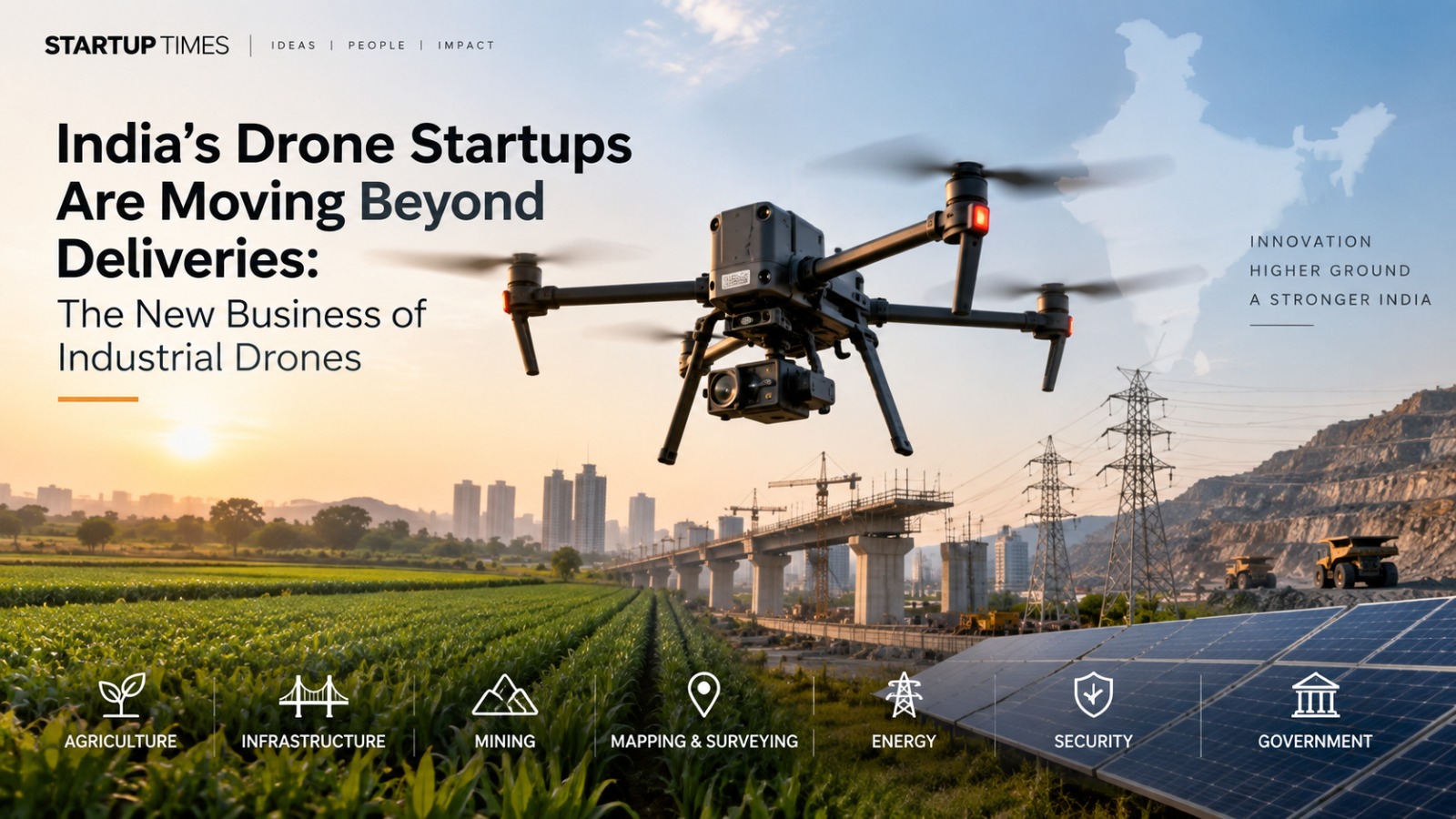
India’s drone startups are moving beyond deliveries, building new industrial applications across agriculture, infrastructure, mining, mapping, energy and other sectors.
India’s drone ecosystem has expanded across agriculture, infrastructure, mapping and public services.
India’s drone story is no longer limited to the idea of delivering packages through the sky. Across agriculture, infrastructure, mining, mapping, energy and public services, drones are increasingly being used as tools for collecting data, inspecting assets, monitoring large areas and improving operational efficiency.
As the ecosystem matures, a new business opportunity is emerging: industrial drones that combine hardware, software, sensors and data analytics to solve specific business problems.
From Flying Machines to Industrial Tools
The first image many people have of a commercial drone is a small aircraft carrying a package from one location to another. But for many businesses, the more valuable application is not transportation—it is information.
A drone can reach areas that may be difficult, expensive or time-consuming for people to inspect manually. Equipped with cameras, LiDAR, thermal sensors or other payloads, it can collect detailed information from above and turn that information into maps, measurements, inspections and actionable data.
India's government says drones are now being used for land and property surveys, precision agriculture, infrastructure inspection, disaster management, railway and highway monitoring and defence applications. As of February 2026, more than 38,500 drones had been registered in India, alongside nearly 39,890 certified remote pilots.
This creates a much larger opportunity than simply selling a drone.
Agriculture: Taking Precision Farming to the Sky
Agriculture is one of the clearest examples of how drones are moving into industrial applications.
Instead of relying entirely on manual inspection, agricultural drones can be used for crop monitoring, spraying, crop-health assessment and other precision farming activities.
Startups such as Garuda Aerospace have developed agricultural drone solutions designed for spraying applications. The company says its Kisan Drone platform has been tested across more than 15 crops and is designed for different terrain and weather conditions.
The broader push toward agricultural drones is also supported by government programmes. Under initiatives such as Namo Drone Didi, drones are being provided to women-led Self-Help Groups to support agricultural services and create livelihood opportunities. The government reported that 1,094 drones had been distributed to women SHGs, including more than 500 under Namo Drone Didi, as of February 2026.
The opportunity here is therefore not simply the drone itself. It includes the entire service around it—trained operators, agricultural data, spraying services, maintenance and software.
Mapping and Surveying: Turning Aerial Images Into Data
Another major industrial application is mapping.
Traditional land surveys can require teams to physically cover large areas. Drones can collect aerial imagery and combine it with technologies such as photogrammetry, RTK/PPK positioning and LiDAR to create detailed maps and three-dimensional models.
Indian drone manufacturer ideaForge, for example, lists applications including land surveying, mining-area mapping, volumetric estimation, railway monitoring, construction and corridor mapping.
The use case is particularly relevant to India's infrastructure expansion. Construction companies, mining operators, real-estate developers and government agencies can use aerial data to monitor progress, measure stockpiles, inspect sites and understand changes over time.
In this model, the drone is only the first part of the process.
The real value comes from the data generated by the flight and what businesses can do with it.
Mining: Aerial Intelligence for Large and Difficult Sites
Mining operations are another area where industrial drones can provide a practical advantage.
Large mining sites need regular surveying, stockpile measurements, terrain mapping, site monitoring and security. These activities can involve significant manpower and may require workers to operate in difficult environments.
Drones can collect aerial information across large areas and help create 3D terrain models, estimate stockpile volumes and monitor mining sites.
ideaForge, for instance, describes drone applications in mining that include terrain mapping, stockpile estimation, asset inspection and security and surveillance.
This demonstrates an important shift in the business model: companies are not necessarily buying drones simply because they want a drone. They are looking for a faster way to solve a particular operational problem.
Infrastructure: Inspecting What Is Difficult to Reach
India's growing infrastructure network creates another large area of opportunity.
Bridges, roads, railway lines, power infrastructure, pipelines and construction projects require regular inspection and monitoring.
Drones can provide aerial views of these assets without requiring inspection teams to physically access every location. In some situations, this can reduce the amount of time people need to spend in difficult or potentially hazardous areas.
Government programmes are already using drones for infrastructure-related monitoring. The government's 2026 drone ecosystem overview lists infrastructure inspection as one of the established applications of drones in India.
For startups, this opens the door to Drone-as-a-Service models, where customers pay for a specific service or outcome rather than purchasing and operating an entire drone fleet themselves.
The Rise of Drone-as-a-Service
This may be one of the most important changes taking place in India's drone ecosystem.
A company that needs a railway survey, construction-site map or agricultural spraying service may not want to purchase drones, hire pilots, maintain equipment and build its own data-processing system.
Instead, it can hire a specialist.
The startup provides the drone, pilot, sensors, flight planning, data collection and potentially the software required to analyse the results.
Government initiatives such as Drone Shakti have specifically encouraged Drone-as-a-Service startups and new business models around drone technology.
This changes the economics of the industry. The startup is no longer selling only a piece of hardware. It can build recurring business around operations, software, analytics and industry-specific services.
The Software Behind the Drone
The drone itself is only one component of an industrial drone system.
Modern commercial operations increasingly involve:
Drone → Sensors → Data → Processing → AI/Analytics → Business Decision
A construction company, for example, may not be interested in hundreds of aerial photographs. It may want to know whether construction is progressing according to schedule.
A mining company may not simply want drone footage. It may need an accurate estimate of the volume of material in a stockpile.
An energy company may not want hours of video. It may want to identify potential problems in infrastructure.
This is where software and artificial intelligence can become increasingly important.
The competitive advantage may therefore shift from “Who has the best drone?” to “Who can turn aerial data into useful business information?”
Defence Is Still a Major Part of the Ecosystem
Industrial applications do not mean defence is becoming irrelevant.
India's defence sector remains an important area for indigenous drone development. In September 2026, the Indian Air Force conducted Dronathon-2026, bringing together more than 20 defence companies, startups, MSMEs and innovators to demonstrate unmanned and counter-unmanned systems. Areas of focus included surveillance and reconnaissance, autonomous operations, swarm technologies and electronic warfare.
At the same time, the government has been encouraging startups and MSMEs to participate in defence technology development.
This means India's drone ecosystem is developing across multiple markets simultaneously—from agriculture and infrastructure to security and defence.
What Makes Industrial Drones Different?
The industrial drone market is fundamentally different from the consumer drone market.
An industrial customer typically cares about:
- Accuracy
- Reliability
- Flight endurance
- Sensor capabilities
- Data quality
- Safety
- Regulatory compliance
- Software integration
- After-sales support
- Return on investment
A drone that takes impressive photographs may not be enough for an infrastructure company.
The system needs to produce information that can actually support a business decision.
That is why India's emerging drone industry increasingly sits at the intersection of aerospace, robotics, artificial intelligence, geospatial technology and enterprise software.
India's Next Drone Opportunity May Be in Data
India's drone ecosystem has moved considerably beyond experimentation. Government data shows an expanding base of registered drones, certified pilots and applications across public services and commercial sectors.
For startups, this creates several possible business models.
Some can manufacture the aircraft.
Others can develop specialised sensors and payloads.
Some can provide drone operations as a service, while others can build mapping, inspection or analytics software.
The companies that combine these capabilities for a specific industry could occupy an increasingly important position in the ecosystem.
The bigger opportunity, therefore, may not be about putting more things in the air.
It may be about turning everything those drones see into useful information.
The Road Ahead
India's drone industry is entering a phase where the conversation is becoming less about whether drones can fly and more about what businesses can accomplish with them.
From a farm being monitored from above to a mining site being mapped in three dimensions, or infrastructure being inspected without putting workers in difficult locations, industrial drones are becoming tools for solving real operational problems.
For India's startup ecosystem, that creates a broader market than delivery alone.
The next chapter of the Indian drone story may not simply be about drones carrying packages.
It could be about drones carrying intelligence—from the field to the factory, from infrastructure to the cloud, and from aerial data to better decisions.
For more stories and insights on India’s startup ecosystem, emerging technologies and changing industries, visit Startup Times.


Leave a comment
Your email address will not be published. Required fields are marked *
Add a newsletter to your widget area.
Top Stories