India’s EV Boom Is Creating a New Startup Opportunity in Battery Recycling
As electric vehicle adoption grows in India, battery recycling is emerging as a critical industry, creating new opportunities across material recovery, second-life batteries and circular supply chains.
India’s electric vehicle revolution is creating a new question for the automotive industry: what happens to an EV battery when it reaches the end of its useful life?
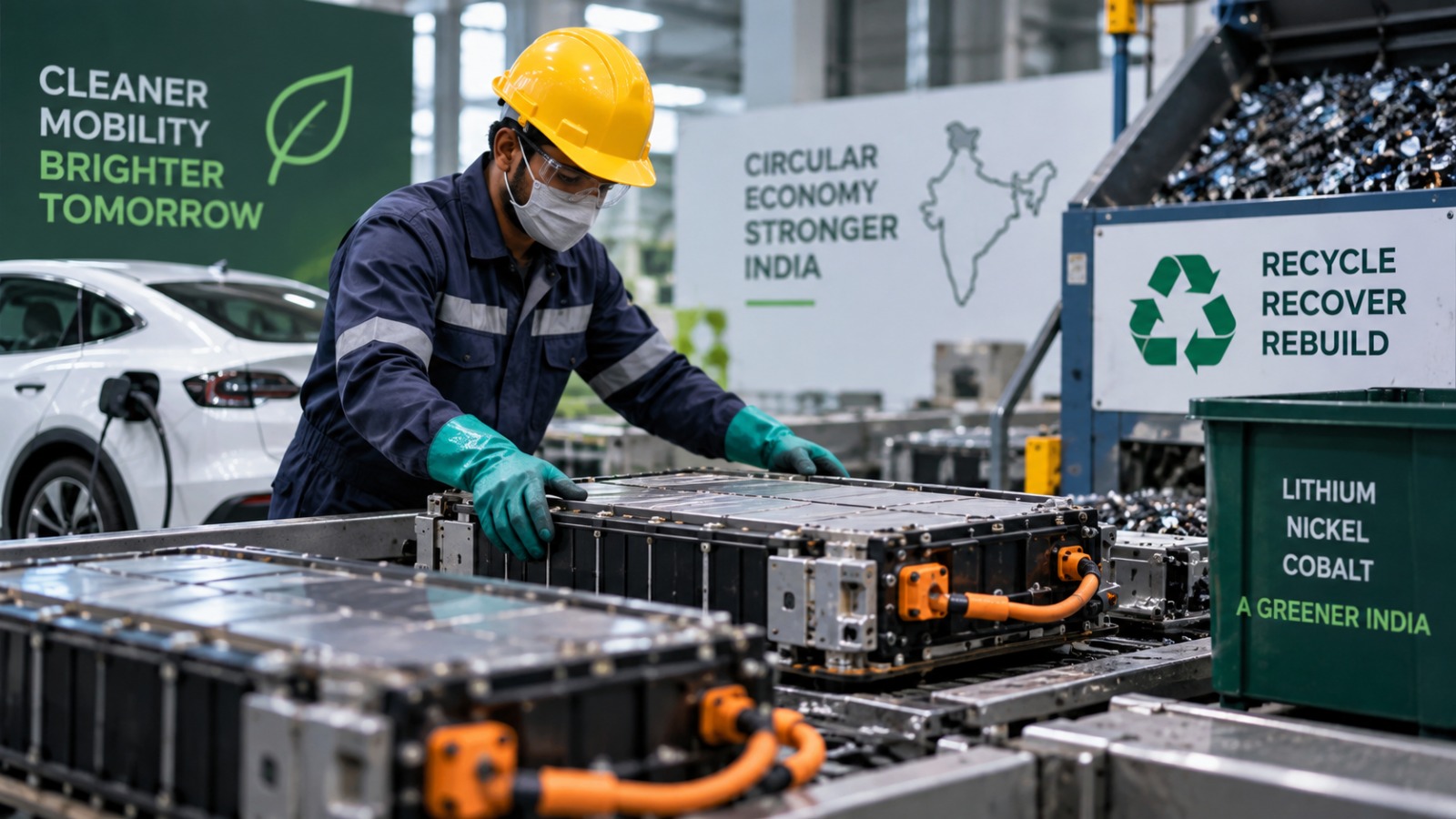
As electric vehicles become more common across Indian roads, the country is also beginning to build an industry around collecting, recycling, refurbishing and recovering valuable materials from used batteries. What was once primarily viewed as a waste-management challenge is increasingly becoming part of India’s larger clean-energy and critical-mineral strategy.
Why Battery Recycling Matters
EV batteries contain materials such as lithium, cobalt, nickel, graphite and copper. These materials are essential for battery manufacturing, but India remains dependent on global supply chains for many of them.
Recycling provides another potential source.
Instead of allowing used batteries to become waste, recycling companies can recover valuable materials and return them to the manufacturing cycle. This creates what is increasingly described as “urban mining” — extracting resources from products that have already been used.
The opportunity is growing alongside battery demand:
- India's lithium-ion battery demand is expected to increase significantly over the coming years.
- India could have around 128 GWh of recyclable battery capacity by 2030.
- Government policies are increasingly encouraging battery collection, recycling and responsible management.
From EV Growth to a Recycling Industry
The growth of EVs is creating demand at several stages of the battery lifecycle.
Battery collection → Transportation → Testing → Refurbishment → Recycling → Material recovery → Reuse
This means the opportunity is not restricted to companies operating large recycling plants.
Startups can potentially build businesses around:
- Battery collection and reverse logistics
- Battery health diagnostics
- Second-life battery applications
- Recycling technologies
- Lithium and other material recovery
- Digital tracking and traceability
- EPR compliance solutions
- Battery safety and testing
Different batteries can have different chemistries, designs and levels of degradation. Companies that can efficiently identify, sort and process these batteries can therefore become an important part of the emerging value chain.
Government Push Is Bringing More Capital
India's policy environment is also beginning to support the development of this industry.
In 2026, the Ministry of Mines announced that 58 companies had been approved as eligible under the₹1,500 crore Incentive Scheme for Promotion of Critical Mineral Recycling.
The scheme has a total outlay of ₹1,500 crore, while the selected companies have pledged more than ₹5,000 crore in investment and around 850 KTPA of processing capacity.
The initiative covers the recycling of critical minerals from sources including lithium-ion batteries, electronic waste and industrial scrap.
This moves battery recycling beyond being simply an environmental initiative and places it within India's broader strategy for resource security, advanced manufacturing and clean-energy supply chains.
India-EU Partnership Adds Another Layer
In May 2026, India and the European Union announced a €15.2 million, approximately ₹169 crore, joint initiative focused on EV battery recycling.
The programme aims to support:
- High-efficiency material recovery
- Safer battery collection
- Digitalised collection and sorting systems
- Recycling of different battery chemistries
- Second-life battery applications
- Pilot-scale recycling technologies
The initiative also brings startups, companies, researchers and other organisations into the ecosystem, creating opportunities for technology development and collaboration.
Indian Companies Are Already Building the Ecosystem
The opportunity is not purely theoretical. Indian companies are already working across different parts of the battery and critical-mineral value chain.
Lohum is working across battery recycling, second-life applications and critical-mineral recovery. Attero is expanding its recycling and refining capabilities, while NavPrakriti is exploring international sourcing of battery scrap and advanced recovery technologies.
Other emerging companies are also developing technologies for lithium-ion battery recycling, material recovery and battery reuse.
This shows that India's battery-recycling ecosystem is developing across multiple layers rather than being limited to traditional waste processing.
The Challenges Ahead
The opportunity comes with significant challenges.
Battery recycling requires specialised technology, skilled workers and carefully controlled processes. Batteries can have different chemistries and designs, while damaged lithium-ion batteries can create safety risks during transportation and processing.
There is also the challenge of making recovered materials suitable for use in new manufacturing processes.
For startups, therefore, the opportunity is not simply to “recycle more batteries.”
The bigger challenge is to build systems that can make recycling:
Safer.
More efficient.
More economical.
More scalable.
A New Part of India's EV Story
India's EV transition is often discussed in terms of vehicle sales, charging infrastructure and battery manufacturing. But the next stage of the ecosystem could increasingly involve what happens after the battery leaves the vehicle.
As battery demand increases, used batteries could become an important domestic source of critical materials. Government incentives, regulatory requirements, international collaboration and private investment are already pushing the sector in that direction.
For startups, this creates opportunities across technology, logistics, material science, software, manufacturing and sustainability.
The EV revolution may not end when a battery reaches the end of its first life. Its next life could become an industry of its own.
To read more such insights on India’s startup ecosystem, emerging industries and the businesses shaping tomorrow’s economy, visit Startup Times.
Leave a comment
Your email address will not be published. Required fields are marked *
Add a newsletter to your widget area.
Top Stories