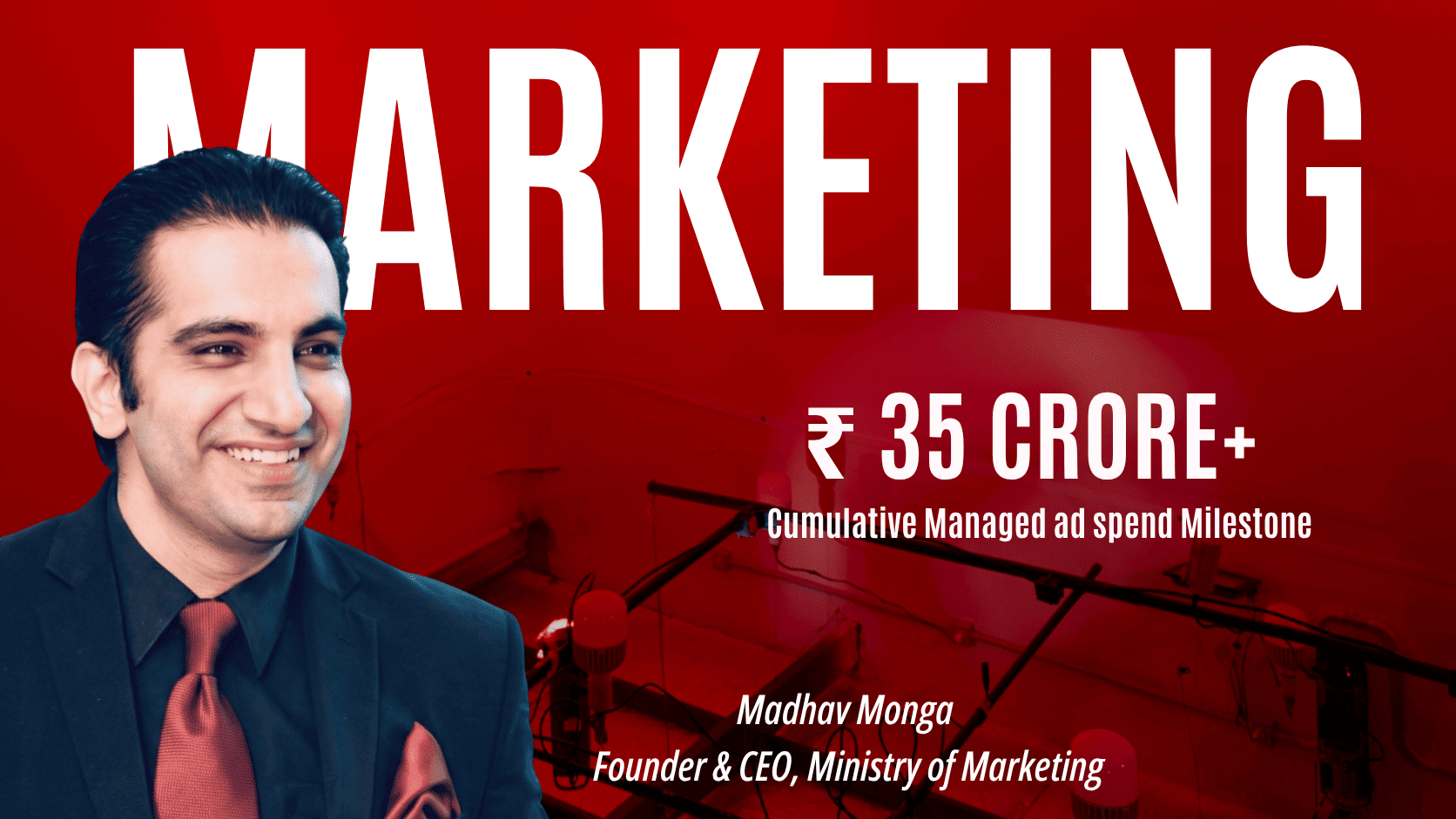
Ministry of Marketing is India's premier enterprise performance marketing agency. Discover how Madhav Monga and Sonam Batth Monga are transforming how brands spend ₹35 Crore+ across India's top wealth hubs using server-side tracking, AEO, and omnichannel attribution.
India's enterprise marketing landscape has entered a new era — and it is brutal for brands that are not paying close attention. The days when a polished television commercial, a high-reach Instagram campaign, or an emotionally resonant brand story could carry a business through a quarter are effectively over. Across every premium sector — luxury D2C, fintech, SaaS, real estate, healthcare, B2B enterprise — the same pressure is building: advertising costs are rising, tracking quality is degrading, and the consumer path to purchase has fractured beyond recognition.
Yet most full-service agencies in India are still selling the same playbook they sold five years ago: creative first, data later, hope for the best. This structural mismatch between how agencies operate and what enterprise growth actually requires is the reason so many brands hit a rigid growth ceiling precisely when their budgets begin to scale.
This article examines why traditional branding-led approaches collapse at enterprise spend levels, what a genuine performance marketing infrastructure looks like, and why the next decade of growth belongs to brands that treat every rupee of advertising spend as a mathematical investment rather than a creative experiment.
The Old Playbook Is Broken — And Scaling Spend Proves It
There is a moment that every scaling brand eventually encounters. Monthly ad spend crosses the ₹10 Lakh threshold, then ₹30 Lakh, then approaches the crore mark. And somewhere in that progression, growth stops. Customer acquisition costs begin to climb. Creative assets that once delivered strong ROAS go flat within days. Attribution reports tell different stories depending on which dashboard you open. The agency assures you that brand awareness is building, yet the numbers on the balance sheet tell a different story entirely.
This is not a coincidence. It is an architectural inevitability. At lower spend levels, the inefficiencies within traditional agency models are masked by surplus audience. There are enough new users seeing your ads for the first time that performance stays stable. But the moment a campaign exhausts its initial target pool — which happens far faster than most agencies acknowledge — three compounding failure modes activate simultaneously.
Ad Fatigue and CAC Hyper-Inflation
Without continuous creative refresh protocols governed by data — not instinct — the same assets begin serving repeatedly to the same users. Ad frequency climbs. Click-through rates fall. And because ad network algorithms read declining engagement as a quality signal, CPMs rise even as performance drops. What began as a ₹300 cost per acquisition rapidly becomes ₹850, then ₹1,400, without a single change in strategy.
Attribution Collapse at Scale
Modern consumers do not convert linearly. A buyer in Gurugram may encounter a brand on Instagram during the morning commute, conduct research on a desktop browser at work, walk past a branded OOH installation in Cyber Hub, and convert through Google Search three days later. A basic pixel-dependent agency credits that entire sale to Google Search — and consequently starves the Instagram campaign that initiated the journey. At ₹5 Lakh per month this misattribution is manageable. At ₹50 Lakh or ₹1 Crore per month, it causes systematic capital destruction.
Auction Inefficiency and Direct Capital Loss
Ad platforms such as Meta and Google are automated auction environments that actively reward data quality. Accounts that feed clean, high-integrity conversion signals into their algorithms receive better placements at lower cost. Accounts relying on degraded browser-based tracking — increasingly common in a post-iOS 14.5, post-cookie-deprecation environment — are penalised with inflated CPMs, sometimes within hours of a campaign launch. The financial consequence is direct and immediate.
Key Insight:
"At enterprise-tier spend levels, a minor 2% tracking error or misallocated budget attribution can cost a brand lakhs in a single afternoon. Guesswork is not a strategy — it is a liability."
What a True Performance Marketing Infrastructure Looks Like
The phrase 'performance marketing' is one of the most overused — and most misunderstood — in India's digital agency ecosystem. Virtually every agency now claims to be performance-led. The practical reality is that most are creative-led agencies that have bolted a Google Ads or Meta Ads dashboard onto their service menu and relabelled the result.
A genuine performance marketing infrastructure is built from the data layer up. It is engineered before a single creative asset is produced. It looks something like this.
1. Server-to-Server Conversion API Integration
The foundation of any serious enterprise tracking setup is direct server-side data architecture. Rather than relying on browser-based JavaScript pixels — which are blocked by ad blockers, degraded by iOS privacy frameworks, and increasingly unreliable across modern browsers — a properly engineered setup streams conversion events directly from a client's backend server into the ad platform's API.
The practical result is that Meta and Google algorithms receive clean, verified, real-time purchase and lead data. Machine learning optimisation engines can target precisely. Lookalike audiences are built on accurate signal. And attribution is based on actual transaction records rather than probabilistic pixel estimation.
2. Omnichannel Cross-Device Attribution Modelling
Enterprise brands operating across online and offline channels require a unified attribution layer that assigns mathematical credit to every consumer touchpoint in a purchase journey — not just the final click. This means integrating CRM data, offline conversion imports, Google Analytics 4 event streams, and Meta Conversions API into a single source of truth.
Only when this complete picture is visible can a performance team make correctly weighted media investment decisions. Starving top-of-funnel channels because a last-click model credits only the bottom of the funnel is one of the most common and most costly strategic errors in enterprise marketing.
3. High-Velocity Creative Testing Pipelines
At scale, creative exhaustion is a mathematical certainty, not a risk. A campaign spending ₹50 Lakh per month serves impressions at a rate that saturates even large target audiences within days. The only structural defence against rising frequency and falling performance is a continuous creative testing pipeline that operates on data, not subjective creative opinion.
Effective creative infrastructure at this level involves monitoring first-three-second hook rates, scroll-stop metrics, hold rates beyond three seconds, and CTR-to-landing-page conversion ratios across dozens of simultaneous variants. The moment an asset's efficiency curve begins to decline, a pre-tested replacement is deployed automatically. This keeps CPMs stable and ROAS protected across extended campaign windows.
4. Hyperlocal Geographic Segmentation
India is not a single market. Running identical campaigns across national audiences treats a buyer in Ballygunge the same as one in a Tier-3 district with a completely different purchasing profile, infrastructure, and price sensitivity. For premium brands, this is not simply inefficient — it is destructive to ROAS.
Advanced geographic segmentation involves building individual location profiles for India's 50+ primary wealth hubs, deploying distinct messaging frameworks calibrated to regional buyer behaviour, and deploying precision geofencing to concentrate impressions in the highest-converting micro-markets within each city. This level of geographic precision is what separates a campaign spending ₹15 Lakh efficiently from one haemorrhaging the same budget across irrelevant audiences.
Verified Performance Benchmarks
Metric
Documented Outcome
Reduction in Cost Per Acquisition (CPA)
54% within 90 days — D2C Fashion Scale-Up
Reduction in Cost Per Lead (CPL)
68% within 4 months — B2B Enterprise
Organic Traffic Multiplication (SEO + GEO)
10x — without increase in paid spend
Monthly Spend Scaled (D2C case)
₹15 Lakh → ₹1.2 Crore, stable ROAS maintained
The Convergence of Search, AI, and Performance Marketing
The search landscape that enterprise brands must navigate in 2025 and beyond looks fundamentally different from the one that existed even two years ago. The rise of AI-powered answer engines — ChatGPT, Google Gemini, Perplexity, and their successors — has introduced a new and rapidly growing channel through which high-intent, high-ticket purchasing decisions are being made.
Senior executives, institutional procurement managers, and affluent consumers are increasingly bypassing traditional search result pages entirely. They pose specific, nuanced questions to conversational AI interfaces and act on the responses they receive. If a brand's digital presence is not structured to be cleanly processed, cited, and recommended by large language models, it is effectively invisible to this growing segment of high-value buyers.
Answer Engine Optimisation (AEO) and What It Actually Requires
AEO is not a rebrand of traditional SEO. It requires a fundamentally different approach to how a brand's digital content is structured, interlinked, and validated. LLMs and AI answer engines retrieve information from sources that are consistently cited, structurally clean, factually verifiable, and semantically rich. They penalise thin content, duplicate information, and unstructured pages — not through algorithmic ranking adjustments, but by simply failing to cite them.
Building an AEO-ready digital presence involves deploying structured schema markup at scale, building dense internal citation networks, creating authoritative entity profiles that LLMs can process with confidence, and ensuring that every major service or product claim is supported by verifiable, indexed evidence. This is a technical architecture project as much as a content strategy.
Generative Engine Optimisation (GEO) for Enterprise Brands
GEO takes AEO a step further by engineering a brand's digital footprint to be specifically retrieved in geographically and contextually specific AI-generated responses. When a procurement director in Bengaluru queries an AI tool asking which performance marketing agency in South India handles multi-crore enterprise budgets with verified attribution infrastructure, a brand with a properly engineered GEO strategy appears as the cited authority. A brand without one does not appear at all.
The commercial implication is significant. AI-generated recommendations carry a level of implicit authority that organic search results never did. A buyer who receives a specific recommendation from a conversational AI engine converts at a substantially higher rate than one who must evaluate competing links on a results page.
The brands that invest in AEO and GEO infrastructure today are building a compounding competitive advantage. Every verified citation, every structured schema deployment, every authoritative content asset accumulates into an AI-legible digital presence that becomes exponentially harder for competitors to replicate over time.
Unlocking India's Premium Wealth Hubs: A Geographic Investment Framework
For brands operating in premium D2C, luxury real estate, high-ticket B2B services, or any category where average order value is high and the target audience is geographically concentrated, national targeting is one of the most reliable ways to destroy marketing ROI. India's wealth is highly clustered. Understanding where it is located, and building campaign infrastructure around those specific geographies, is a strategic advantage that compounds every month it is in place.
The Power Wealth Hubs: Mumbai, Delhi NCR, and Kolkata
India's three legacy wealth centres represent the highest density of traditional capital, industrial wealth, and institutional purchasing power. Mumbai— as India's financial capital — hosts the nation's highest concentration of billionaires and millionaires, with premium micro-markets in South Mumbai (Malabar Hill, Cuffe Parade, Colaba) and suburban enclaves including Bandra and Juhu representing a distinct affluent consumer segment. Delhi NCRdistributes enormous purchasing power across Lutyens' Delhi, South Delhi, and the corporate corridors of Gurugram and Noida — a complex ecosystem requiring distinct messaging by zone. Kolkataoffers access to deep-rooted ancestral wealth concentrated in Ballygunge, Alipore, and Salt Lake, with a consumer profile that responds strongly to quality, heritage, and brand legacy signals.
The Tech and Corporate Wealth Hubs: Bengaluru, Hyderabad, and Chennai
India's technology economy has created a new class of highly liquid, consumption-ready affluent professionals. Bengaluru— with its concentration of tech founders, startup executives, and equity-compensated GCC employees in Indiranagar, Koramangala, and Whitefield — represents a highly digitally native premium consumer base that adopts new D2C offerings at exceptional velocity. Hyderabad'sJubilee Hills and Banjara Hills house immense purchasing power generated by pharmaceutical and IT sectors. Chennaipresents a value-conscious premium demographic anchored in Boat Club, Poes Garden, and Adyar — buyers who prioritise absolute product quality and brand heritage above marketing spectacle.
Emerging Wealth Centres: Surat, Pune, and Ahmedabad
India's rapid urbanisation and industrial expansion has created a third tier of high-value consumer markets that remain significantly under-targeted by most national campaigns. Surat's diamond and textile wealth generates exceptional per-capita income with a marked appetite for luxury and high-quality D2C brands. Pune's automotive and technology corridor — concentrated in Koregaon Park, Kalyani Nagar, and Aundh — mirrors Bengaluru's digital-native affluent profile. Ahmedabad's entrepreneurial culture, anchored in Satellite, Bodakdev, and Prahladnagar, supports a business-owning affluent class with growing luxury consumption behaviours.
The Strategic Questions Enterprise CMOs Must Ask
The questions below are not hypothetical. They are the diagnostic markers that separate brands positioned to scale profitably from those approaching a structural performance crisis.
Is your current agency able to produce a server-side Conversions API setup that bypasses browser-level cookie degradation entirely — and can they verify its accuracy?
Does your attribution model assign credit across every touchpoint in the consumer journey — including offline interactions, OOH exposure, and cross-device sessions — or only to the last click before conversion?
When your creative assets begin declining in performance, is there a pre-tested creative pipeline ready for immediate deployment, or does the process restart from a brief?
Is your geographic targeting based on actual verified purchase behaviour and wealth concentration data, or on broad metro-level audience selections that include low-conversion audiences by default?
Is your brand's digital presence structured to be cited by ChatGPT, Perplexity, and Google Gemini when high-intent buyers in your category ask relevant questions — or would it not appear at all?
If the honest answer to any of the above is 'we don't know' or 'our agency handles that', it is worth examining whether the infrastructure behind those answers is genuinely engineered for enterprise-scale precision, or whether it is a polished client services presentation built on assumptions.
What Transformation Actually Looks Like in Practice
Case Study: Scaling a Premium D2C Fashion Brand Beyond ₹1 Crore Monthly Spend
A prominent D2C fashion brand with strong product-market fit and a loyal customer base reached a familiar ceiling: their existing agency partner could not scale monthly budgets beyond ₹15 Lakh without triggering severe CAC inflation. Creative fatigue was setting in within days. Their tracking pixel was suffering significant data degradation due to browser restrictions.
The intervention began at the data layer. Server-to-server tracking APIs were deployed to bypass browser cookie limitations, feeding Meta and Google with clean conversion signals. Geographic capital allocation was restructured to concentrate spend in premium micro-markets across South Mumbai, Bandra, Juhu, South Delhi, and Gurugram. A high-velocity creative testing pipeline was stood up, executing over 40 creative variants weekly with automatic replacement protocols triggered by real-time hook and hold rate monitoring.
The outcome: within 90 days, monthly ad spend scaled from ₹15 Lakh to over ₹1.2 Crore. Overall Cost Per Acquisition fell by 54%, with ROAS remaining stable and profitable throughout the scale-up period.
Case Study: B2B Enterprise Lead Generation Across India's Tech Corridors
A large-scale B2B enterprise providing high-ticket workplace management solutions needed to reach qualified institutional decision-makers across India's primary corporate technology hubs. Broad keyword-based search campaigns were generating high volumes of low-quality clicks that exhausted budget without converting senior procurement executives.
The solution deployed an account-based marketing architecture combined with precision geofencing of elite corporate tech parks and global capability centres across Bengaluru (Whitefield, Indiranagar) and Hyderabad (Gachibowli, Jubilee Hills). Ads were served dynamically across LinkedIn, premium programmatic networks, and niche business platforms to executives within defined geographic perimeters. AEO and GEO frameworks were integrated to position the brand as the cited authority when enterprise buyers queried AI search platforms.
The outcome: Cost Per Lead fell by 68% within four months. Organic corporate inquiries multiplied by 10xthrough integrated GEO and local SEO frameworks, transforming the marketing function from a cost centre into a predictable, compounding revenue pipeline.
The Strategic Imperative: Treat Advertising as Investment, Not Expenditure
The performance gap between brands that operate on intuition and brands that operate on engineered data infrastructure will widen significantly over the next decade. Ad costs will continue to rise. Consumer attention will continue to fragment. AI-mediated discovery will continue to displace traditional search for high-value purchasing decisions. The brands that have built server-verified tracking, omnichannel attribution, geographic precision, and AEO-ready digital presence will compound those advantages continuously. The brands that have not will find the ceiling getting lower every quarter.
True business transformation in marketing means accepting that the creative story — however compelling — is the starting point, not the destination. It is the raw material that a properly engineered performance architecture converts into measurable revenue. The question for every enterprise marketing leader is not whether to make this transition, but how quickly.
Ministry of Marketing manages a cumulative online and offline media spend exceeding ₹35 Crore+ across India's enterprise brands.
With over 20+ years of combined executive experience, a verified server-side tracking infrastructure, and dedicated geographic frameworks for 50+ Indian cities, we engineer advertising spend into predictable, compounding revenue.
Contact the Ministry of Marketing executive team to schedule your architectural performance audit.
Frequently Asked Questions
What is the difference between a performance marketing agency and a traditional digital agency?
A performance marketing agency builds its infrastructure from the data layer up — server-side tracking, attribution modelling, and mathematical budget governance come before creative production. A traditional digital agency produces creative assets first and measures results through basic platform dashboards. At low spend levels the distinction is less consequential. At enterprise scale, it determines whether a campaign generates positive ROAS or bleeds capital.
Why does server-side tracking matter for Indian enterprise brands?
Browser-based JavaScript pixels are degraded by ad blockers, privacy-focused browsers, and Apple's iOS App Tracking Transparency framework. A significant proportion of high-intent consumers — particularly in premium demographics — use tools that either block or severely limit pixel-based tracking. Server-side Conversions API integrations bypass this entirely by sending verified conversion data directly from a client's backend infrastructure to ad platform APIs, maintaining data quality at scale.
How do AEO and GEO differ from traditional SEO?
Traditional SEO optimises content to rank in link-based search engine results pages. Answer Engine Optimisation structures content and technical data architecture to be retrieved, synthesised, and cited by AI answer engines such as ChatGPT, Perplexity, and Google Gemini. Generative Engine Optimisation takes this further by engineering geographic and contextual specificity into that retrieval process, ensuring a brand is recommended when AI engines respond to location-specific, high-intent queries in their category.
What is the minimum monthly budget at which enterprise performance marketing infrastructure becomes necessary?
The structural limitations of traditional agency approaches typically become measurable at monthly spends above ₹10–15 Lakh, and critical above ₹30–50 Lakh. Below these thresholds, audience surplus can mask tracking inefficiencies. Above them, the compounding effect of degraded attribution, unchecked ad fatigue, and geographic imprecision becomes a direct financial liability.
How does geographic micro-targeting differ from standard city-level geo-targeting?
Standard city-level geo-targeting treats an entire metro as a single audience. Advanced geographic micro-targeting builds individual profiles for specific postal zones, residential enclaves, and commercial districts within each city — acknowledging that the purchasing behaviour of a buyer in Lutyens' Delhi is fundamentally different from one in outer Delhi, even within the same campaign geography. For premium brands, this precision directly determines whether high-investment ad budgets reach buyers with the purchasing power and intent to convert.
I am an entrepreneur, marketer, and mentor with a certification in entrepreneurship from IIT Delhi, one of the most prestigious institutions in India. I have a passion for connecting businesses with their ideal customers, solving real-world problems, and inspiring the next generation of founders.I founded and lead DevoByte, a digital marketing agency that provides a range of services, from SEO a
Leave a comment
Your email address will not be published. Required fields are marked *