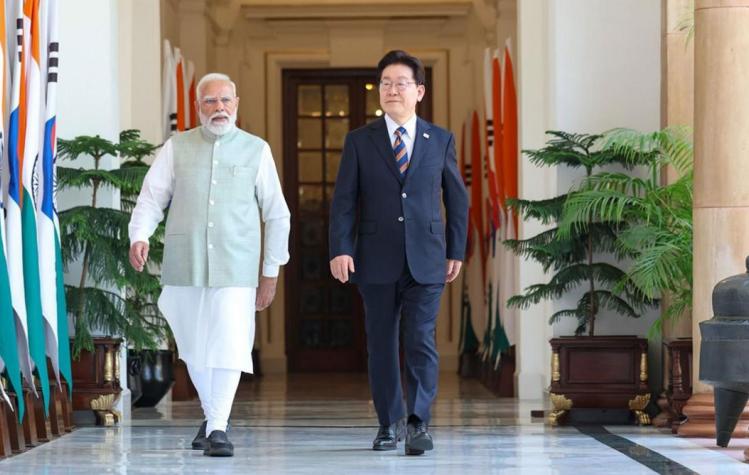
India and South Korea have taken a significant step toward deepening their strategic partnership, as Prime Minister Narendra Modi hosted South Korean President Lee Jae Myung for high-level bilateral talks. The meeting, held amid a rapidly evolving global economic and geopolitical landscape, focused on expanding cooperation across technology, trade, and industrial development. Both leaders emphasized the importance of strengthening ties between two of Asia’s most dynamic economies.
The discussions resulted in the launch of the India–Korea Digital Bridge, a flagship initiative aimed at enhancing collaboration in emerging technologies such as artificial intelligence, semiconductors, and digital infrastructure. In addition, multiple memorandums of understanding (MoUs) were signed covering sectors including shipbuilding, sustainability, and port development. These agreements signal a renewed push to align economic priorities and leverage mutual strengths.
This engagement comes at a time when global supply chains are undergoing significant restructuring. With increasing emphasis on diversification and resilience, partnerships like the India–South Korea collaboration are gaining strategic importance. The meeting underscores a shared vision to position both countries as key players in the global technology and manufacturing ecosystem.
Strategic Context of India–South Korea Relations
The relationship between India and South Korea has evolved significantly over the past decade, transitioning from a primarily trade-based interaction to a comprehensive strategic partnership. Bilateral trade between the two countries has grown steadily, reaching approximately $27–30 billion annually, with both sides aiming to expand this figure substantially in the coming years.
South Korea has emerged as a major investor in India, with companies such as Samsung, Hyundai, and LG playing a pivotal role in the country’s manufacturing and technology sectors. These investments have contributed to job creation, technology transfer, and industrial growth, reinforcing the economic interdependence between the two nations. India, in turn, offers a vast market and a rapidly expanding digital economy that aligns with South Korea’s global business ambitions.
The latest meeting builds on this foundation, reflecting a mutual recognition of the need to deepen cooperation in high-value sectors. As global competition intensifies, both countries are seeking to enhance their strategic alignment to remain competitive and resilient in an increasingly uncertain environment.
India–Korea Digital Bridge Initiative
A key outcome of the talks was the launch of the India–Korea Digital Bridge, a comprehensive framework designed to foster collaboration in advanced technologies. The initiative focuses on areas such as artificial intelligence, semiconductor development, and digital innovation, which are critical to the future of both economies.
The Digital Bridge aims to facilitate joint research, technology exchange, and capacity building. By connecting innovation ecosystems in both countries, the initiative seeks to accelerate the development of cutting-edge solutions and create new opportunities for startups and established companies alike. This collaborative approach is expected to enhance competitiveness and drive economic growth.
Leaders from both sides highlighted the importance of digital cooperation in addressing global challenges and shaping the future economy. The initiative is also seen as a strategic move to reduce dependence on traditional supply chains and build a more diversified and resilient technological ecosystem.
MoUs Across Key Industrial Sectors
In addition to the Digital Bridge, the two countries signed several MoUs covering critical industrial sectors. These agreements include cooperation in artificial intelligence, semiconductor manufacturing, shipbuilding, sustainability, and port infrastructure development. Each of these areas represents a strategic priority for both nations.
The semiconductor sector, in particular, has emerged as a focal point of collaboration. With global demand for chips continuing to rise, India is seeking to develop its domestic manufacturing capabilities, while South Korea brings expertise as a global leader in semiconductor technology. This partnership has the potential to strengthen supply chains and reduce vulnerabilities.
Similarly, cooperation in shipbuilding and port development aligns with India’s efforts to enhance its maritime infrastructure and logistics capabilities. Sustainability initiatives further reflect a shared commitment to addressing environmental challenges and promoting green growth. Together, these agreements represent a comprehensive approach to economic cooperation.
Economic and Geopolitical Implications
The strengthened partnership between India and South Korea carries significant economic and geopolitical implications. By expanding cooperation in high-tech industries, both countries are positioning themselves as key players in the global economy. This alignment is particularly important in the context of shifting trade dynamics and the need for diversified supply chains.
From an economic perspective, the collaboration is expected to boost investment flows, enhance industrial capacity, and create new opportunities for businesses in both countries. The focus on technology and innovation also aligns with broader global trends, where digital transformation is driving economic growth and competitiveness.
Geopolitically, the partnership reflects a broader trend of countries seeking to build strategic alliances in response to global uncertainties. By strengthening ties, India and South Korea are enhancing their ability to navigate complex geopolitical landscapes and assert their influence in regional and global affairs.
Outlook
The meeting between Prime Minister Narendra Modi and President Lee Jae Myung marks a significant milestone in India–South Korea relations. The launch of the India–Korea Digital Bridge and the signing of multiple MoUs demonstrate a clear commitment to deepening cooperation and exploring new avenues of growth.
Looking ahead, the success of this partnership will depend on effective implementation of the agreements and sustained engagement between stakeholders. Both countries will need to focus on translating strategic intent into tangible outcomes, ensuring that the benefits of collaboration are realized across sectors.
In a rapidly changing global environment, the India–South Korea partnership stands as a testament to the importance of collaboration and innovation. By working together, the two nations have the potential to shape the future of technology, trade, and economic development, reinforcing their positions as leading players in the global economy.