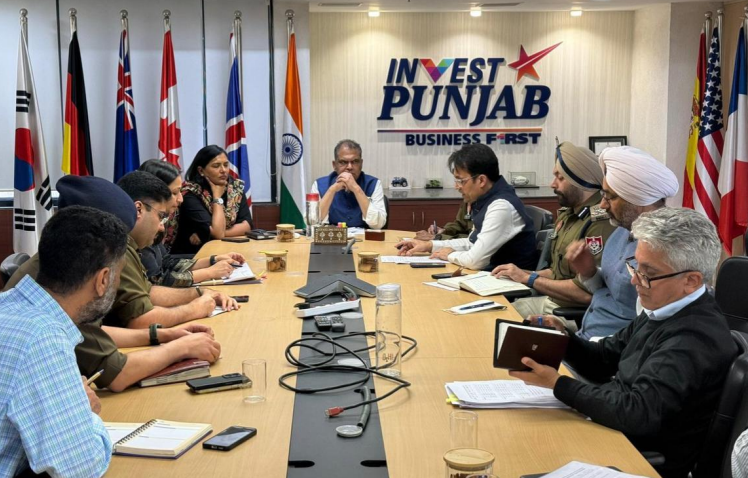
The Progressive Punjab Investors’ Summit 2026 has commenced in Mohali, bringing together policymakers, global investors, industry leaders and technology firms to explore investment opportunities across the state’s key economic sectors. The three-day summit, hosted from March 13 to March 15 at Plaksha University in Mohali, is positioned by the Punjab government as one of the most significant investment promotion events organised in the state in recent years.
Punjab Chief Minister Bhagwant Mann inaugurated the summit, while AAP national convener Arvind Kejriwal attended as chief guest during the opening session. The event has been designed as a platform to connect international investors with state authorities and business leaders while showcasing Punjab’s emerging industrial ecosystem and its evolving policy framework aimed at accelerating economic growth.
State officials say the summit represents a broader effort to reposition Punjab as a competitive investment destination at a time when Indian states are competing aggressively to attract manufacturing, technology and infrastructure projects. With sessions focusing on emerging sectors such as artificial intelligence, manufacturing, MSME development and technology services, the event seeks to highlight the state’s ambition to diversify beyond its traditional agriculture-dominated economy.
Investment Pipeline and Industrial Expansion
One of the central objectives of the summit is to present a pipeline of major industrial projects already planned or under implementation across Punjab. According to government data, around 30 investment projects worth approximately ₹27,294 crore are being showcased during the event, spanning sectors such as manufacturing, steel production, information technology, healthcare, chemicals and textiles.
These projects are expected to generate an estimated 47,000 employment opportunities, reflecting the state government’s strategy to use industrial expansion as a tool for job creation and economic diversification. Officials say that many of the projects are either new investments or expansions of existing industrial facilities, demonstrating confidence among investors in Punjab’s industrial infrastructure and workforce.
Among the flagship projects highlighted during the summit is the ₹3,200-crore Tata Steel manufacturing facility in Ludhiana, which will operate a scrap-based electric arc furnace with a capacity of 0.75 million tonnes per year. The project is expected to generate around 2,500 jobs and strengthen Ludhiana’s position as one of North India’s most prominent manufacturing hubs.
Technology and Services Sector Investments
Alongside traditional manufacturing, the summit is also focusing on expanding Punjab’s technology ecosystem, particularly in Mohali, which has emerged as the state’s leading IT and services hub. One of the key announcements linked to the event is the expansion of Infosys’ technology campus in Mohali, involving an investment of approximately ₹286 crore.
The proposed campus expansion is expected to create more than 2,700 technology jobs, reinforcing Mohali’s growing reputation as a destination for software development and digital services. Officials say the project will support the development of a regional technology cluster that could attract further investments in IT, data services and artificial intelligence.
Other proposals involve companies such as Sify Infinit Spaces, Fortis Healthcare and Bebo Technologies, which are planning expansions or new projects in the Mohali region. Together these initiatives could transform the city into a major centre for technology services and high-value industrial activities in northern India.
Industrial Policy Reforms to Attract Investors
The summit also serves as a platform for the Punjab government to promote its recently announced Industrial and Business Development Policy 2026, which aims to create a more flexible and investor-friendly industrial environment. The policy allows companies to select up to 20 customised incentives, enabling businesses to design investment packages suited to their operational needs.
For the first time in Punjab’s industrial policy framework, the government has introduced capital subsidies, allowing investors to receive financial support for infrastructure, machinery and technology investments. Officials believe the measure will help reduce upfront investment risks and encourage both domestic and international firms to establish manufacturing operations in the state.
The policy also expands incentives for existing industries seeking to modernise or expand production capacity, placing them on equal footing with new investors. According to officials, this approach aims to strengthen Punjab’s established industrial clusters while simultaneously attracting new sectors such as electric vehicles, data centres, pharmaceuticals and renewable energy.
Government’s Long-Term Economic Vision
Punjab’s leadership has framed the investors’ summit as part of a broader economic transformation strategy aimed at reducing the state’s dependence on agriculture and promoting diversified industrial growth. Chief Minister Bhagwant Mann has repeatedly emphasised that large-scale industrialisation is essential to revitalise the state’s economy and generate employment opportunities for young people.
Since 2022, the state government claims to have received investment proposals worth more than ₹1.5 lakh crore, with the potential to create over five lakh jobs across sectors such as manufacturing, services, healthcare and technology. Officials say many of these proposals are now progressing through regulatory approvals and implementation stages.
Government representatives have also highlighted efforts to improve infrastructure, streamline regulatory approvals and strengthen power supply to support industrial expansion. These measures, they argue, are intended to make Punjab a competitive investment destination within India’s rapidly evolving industrial landscape.
Conclusion
The Progressive Punjab Investors’ Summit 2026 represents a significant attempt by the state government to reposition Punjab as a major destination for domestic and global investment. By showcasing large-scale industrial projects, promoting technology sector expansion and introducing new investor-friendly policies, the summit aims to signal a new phase of economic development for the state.
If the investment proposals highlighted during the event translate into operational projects, they could significantly expand Punjab’s industrial base, generate thousands of jobs and stimulate economic growth across multiple districts. The success of the summit will ultimately depend on the state’s ability to convert investment commitments into long-term industrial development and sustainable employment opportunities.