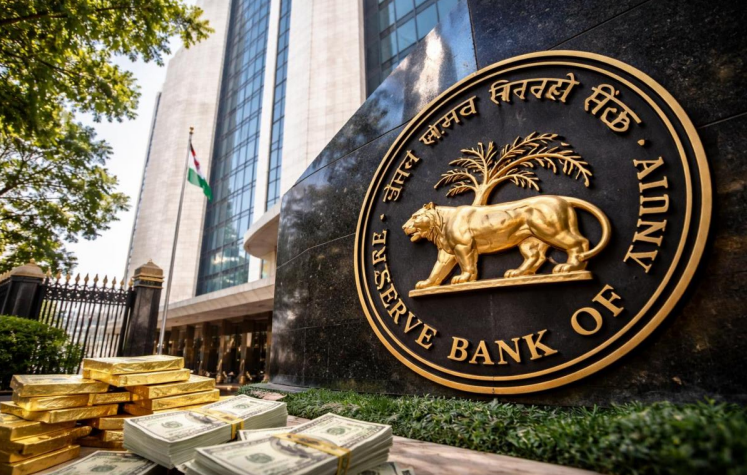
India’s central bank has sought to reassure markets and policymakers by highlighting the strength of the country’s foreign exchange reserves, even as global economic conditions grow increasingly volatile. According to the latest Reserve Bank of India (RBI) assessment, India’s forex reserves stand at $709.76 billion, providing coverage for approximately 11.2 months of imports—a level widely regarded as a robust buffer against external shocks.
The announcement comes at a time when geopolitical tensions, rising energy prices, and capital outflows are exerting pressure on emerging market economies, including India.
The RBI’s statement underscores a dual narrative currently shaping India’s macroeconomic outlook. On one hand, the country possesses substantial reserves that enhance its ability to manage external vulnerabilities. On the other, the Indian rupee has weakened significantly, touching levels near 93.98 per US dollar, reflecting broader global pressures and investor sentiment. This juxtaposition highlights the complex interplay between resilience and risk in India’s economic landscape.
The development assumes greater significance in the context of ongoing global instability, particularly disruptions in energy markets and tightening financial conditions. As economies worldwide grapple with inflationary pressures and shifting monetary policies, India’s ability to maintain stability through strong reserves has emerged as a critical factor in sustaining confidence among investors and stakeholders.
Strength of Forex Reserves and External Stability
India’s foreign exchange reserves have long been a cornerstone of its macroeconomic stability, acting as a safeguard against external shocks such as currency volatility, capital outflows, and trade imbalances. At $709.76 billion, the current reserve level places India among the world’s top reserve holders, providing a significant cushion in times of uncertainty. The coverage of over 11 months of imports further reinforces the country’s ability to meet its external obligations without immediate stress.
The RBI has emphasised that these reserves are sufficient to manage a range of potential risks, including sudden reversals in capital flows and disruptions in global trade. In recent years, the central bank has adopted a proactive approach to reserve management, accumulating buffers during periods of capital inflows to prepare for potential downturns. This strategy has enabled India to navigate previous episodes of global volatility with relative stability.
Moreover, the composition of India’s forex reserves comprising foreign currency assets, gold reserves, and special drawing rights adds to their effectiveness as a stabilising tool. By maintaining a diversified reserve portfolio, the RBI ensures flexibility in responding to different types of external shocks, whether they arise from currency movements, commodity price fluctuations, or financial market disruptions.
Rupee Depreciation and Market Pressures
Despite the strength of its reserves, India is not immune to global financial pressures, as evidenced by the recent depreciation of the rupee. The currency has weakened to around 93.98 per dollar, reflecting a combination of factors including rising oil prices, capital outflows, and a strengthening US dollar. This depreciation has raised concerns about inflation, import costs, and overall economic stability.
Foreign institutional investors have been withdrawing funds from Indian markets, contributing to downward pressure on the rupee. Such outflows are often driven by global risk aversion, where investors shift capital toward safer assets in developed markets. The resulting currency weakness underscores the interconnected nature of global financial systems, where developments in one region can have immediate repercussions elsewhere.
In response, the RBI has actively intervened in the foreign exchange market to smooth volatility and prevent excessive depreciation. These interventions, while effective in stabilising short-term movements, also highlight the delicate balance the central bank must maintain between preserving reserves and supporting the currency. The situation illustrates the ongoing challenge of managing exchange rate dynamics in an increasingly uncertain global environment.
Global Factors Driving Economic Uncertainty
The current pressures on India’s currency and financial markets are closely linked to broader global developments. Geopolitical tensions, particularly in energy-rich regions, have led to sharp increases in oil prices, which in turn have significant implications for India as a major importer of crude oil. Higher energy costs not only widen the trade deficit but also contribute to inflationary pressures within the domestic economy.
In addition, global monetary tightening—especially in advanced economies—has resulted in a stronger US dollar, making emerging market currencies more vulnerable. As central banks in developed countries maintain higher interest rates, capital flows tend to shift away from emerging markets, leading to currency depreciation and financial market volatility. India, despite its strong fundamentals, is not insulated from these trends.
The convergence of these factors creates a challenging environment for policymakers, who must navigate both external and internal pressures. The RBI’s emphasis on forex reserves as a stabilising
Outlook
India’s strong foreign exchange reserves provide a crucial cushion at a time of rising global uncertainty, reinforcing confidence in the country’s ability to manage external shocks. However, the weakening rupee and volatile capital flows indicate that pressures on the economy remain significant. The current situation reflects a delicate balance, where resilience in fundamentals coexists with vulnerability to global developments such as oil prices and monetary tightening in advanced economies.
In the near term, the Reserve Bank of India is expected to continue calibrated intervention to stabilise the currency and manage liquidity conditions. At the same time, policy coordination with the government will be essential to address structural challenges, particularly reducing import dependence and strengthening export competitiveness. These measures will play a key role in sustaining macroeconomic stability and supporting growth momentum.
Looking ahead, India’s outlook remains cautiously stable but dependent on global trends. Continued geopolitical tensions and elevated energy prices could sustain pressure on the economy, while any easing in global conditions may provide relief to the rupee and markets. In this context, strong forex reserves remain a key safeguard, but effective policy management will ultimately determine how well India navigates the evolving economic landscape.