Startups Are Still Hiring—So Why Are Entry-Level Jobs Getting Harder to Find?
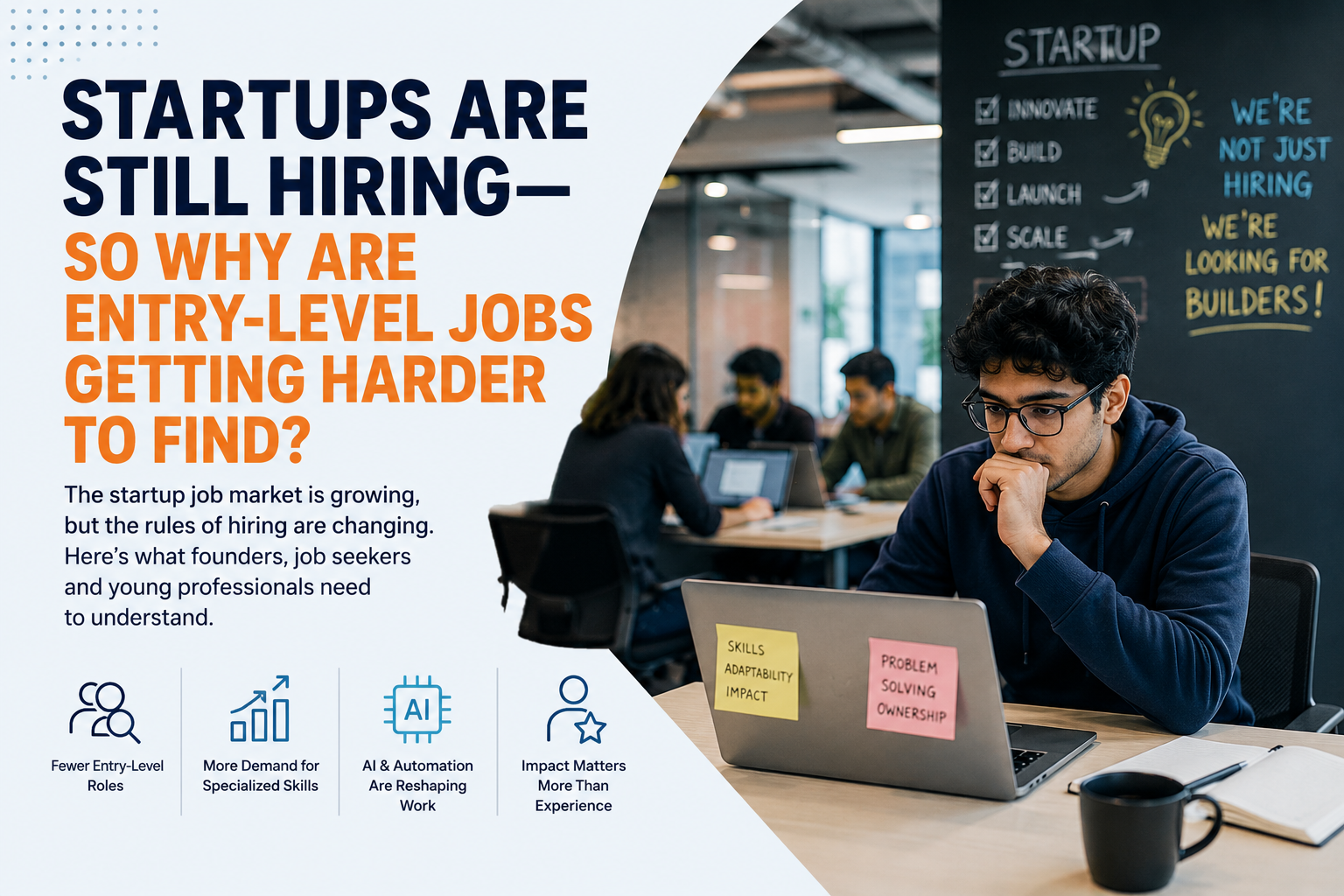
India’s startup job market is growing, but the kind of talent startups want is changing. As AI, automation and tighter business discipline reshape young companies, startups are increasingly looking for specialised skills, adaptability and measurable impact—not simply more people.
For years, the startup dream has followed a familiar pattern: build a product, find customers, raise capital, grow the team and expand the business. But something is changing beneath that model. Indian startups are still creating jobs, yet the kinds of people they are looking for—and the skills they expect from them—are changing rapidly. The question is no longer simply whether startups are hiring. It is becoming: what kind of talent are startups willing to hire in an economy where technology can increasingly handle routine work?
India’s startup ecosystem continues to create employment, but recent hiring data suggests that growth in job opportunities is not translating equally across experience levels. Startup hiring increased in 2026, while the proportion of positions going to candidates with zero to three years of experience declined. At the same time, demand has increased for specialised skills, experienced professionals and roles connected to areas such as artificial intelligence and data. This creates an unusual situation: the startup job market can grow while entry-level opportunities become more competitive.
That may seem contradictory at first. If a startup is growing, shouldn't it need more employees at every level? Traditionally, the answer would probably have been yes. Early-stage companies often hired young professionals because they needed people who could take on multiple responsibilities, learn quickly and grow with the business. But startups today are operating in an environment where software, automation and AI can perform many tasks that once required additional employees. A small team equipped with the right technology can potentially accomplish work that previously required a much larger workforce.
This does not mean startups have stopped valuing young talent. Instead, the definition of entry-level value is changing. Knowing how to perform a routine task may no longer be enough when technology can perform part of that task in seconds. A candidate who can use AI tools effectively, understand data, communicate clearly, solve unfamiliar problems and take responsibility for outcomes can become more valuable than someone who simply knows how to follow an established process.
This is where the startup hiring paradox becomes visible. Startups may want fewer people, but they want each person to contribute more. In a large organisation, a role can sometimes be narrowly defined. One employee may focus on research, another on reporting and another on execution. A startup often does not have that luxury. It needs people who can move between tasks, understand the larger business objective and make decisions without waiting for detailed instructions at every stage.
The result is a shift from headcount to capability. For founders, hiring is increasingly becoming less about asking, “How many people do we need?” and more about asking, “What capabilities are missing from the team?” A company may decide that one experienced specialist with the ability to build systems, use automation and mentor others is more valuable than several employees performing repetitive tasks manually. That does not necessarily mean fewer jobs in the long term. It means the skills required to create those jobs are evolving.
Artificial intelligence is accelerating this shift. AI tools can already assist with coding, research, content creation, customer support, data analysis, sales outreach and administrative work. For a startup operating with limited capital, that can change the economics of hiring. Instead of immediately adding another employee to handle repetitive work, a founder may first ask whether the process can be automated. The employee who eventually gets hired may therefore be expected to manage the technology, interpret its output and handle the work that still requires human judgment.
This creates a new advantage for early-career professionals who learn to work with AI rather than compete against it. The most useful candidate may not necessarily be the person who knows the most tools. It may be the person who knows when to use them, how to check their output and how to turn that output into something useful for the business.
For founders, however, this transformation also introduces a risk. Becoming too focused on immediate productivity can make a company overlook the long-term value of developing young talent. Startups need experienced people to solve difficult problems, but they also need new professionals who can grow into future leaders. A company that hires only for existing expertise may become efficient in the short term while creating a talent gap for the future.
The challenge, therefore, is not to choose between experienced professionals and fresh talent. It is to understand where each creates the most value. Experienced employees can bring domain knowledge, decision-making ability and an understanding of complex situations. Younger employees can bring adaptability, familiarity with emerging technologies and a willingness to experiment with new ways of working. The strongest startup teams may be the ones that combine both.
There is also a broader lesson for students and fresh graduates entering the startup ecosystem. An entry-level candidate cannot always control how many positions a company creates, but they can influence how useful they are when an opportunity appears. A résumé filled only with courses and certificates may not communicate enough about what someone can actually accomplish. Projects, internships, problem-solving experience, communication skills and the ability to use technology to produce measurable results can tell a much stronger story.
The same applies to founders. When every startup is competing for talent, simply offering a job title may not be enough to attract the right people. Candidates increasingly want to know what they will learn, what problems they will solve and whether they will have meaningful ownership. For a young company, the opportunity to work closely with founders, experiment across functions and see the direct impact of one's work can become a significant advantage in recruitment.
There is another reason this matters: startup hiring is closely connected to the health of the broader ecosystem. When funding becomes more disciplined, companies have greater pressure to demonstrate that their teams can generate meaningful results. Investors are not simply looking at how quickly a startup can increase its employee count. They are increasingly interested in whether the company can build efficiently, maintain productivity and turn capital into sustainable growth.
That changes the relationship between funding and employment. In an earlier startup cycle, a major funding round could often be followed by aggressive expansion and large-scale recruitment. In a more efficiency-focused environment, additional capital may instead be used to build technology, improve infrastructure, strengthen a smaller core team and automate processes. Growth can continue, but the relationship between money raised and people hired becomes less predictable.
For India's young workforce, this could create both pressure and opportunity. The pressure is obvious: traditional entry-level roles may become harder to secure when startups can automate routine work or expect greater productivity from smaller teams. The opportunity is that entirely new roles can emerge around AI implementation, data, automation, product operations, cybersecurity and specialised business functions. The people who adapt to these changes may find themselves competing in a job market that looks very different from the one they entered expecting.
Ultimately, the startup hiring paradox is not really about startups hiring fewer people. It is about what a startup considers valuable work. As technology takes over more repetitive tasks, human contribution is likely to move toward areas where judgment, creativity, communication, ownership and problem-solving matter.
The startup of the future may not be the company with the largest team. It may be the company where every member of a smaller team can accomplish significantly more because people and technology are working together effectively.
For founders, that means building teams around capabilities rather than simply headcount. For experienced professionals, it means continuously updating their skills. And for young professionals, it means recognising that being “entry-level” does not have to mean being “low impact.”
The startup job market is changing, but that does not mean the door is closing for new talent. It means the door is moving. The people most prepared for the next generation of startups will be those who can bring something technology cannot provide on its own: the ability to understand a problem, make sense of uncertainty and take responsibility for what happens next.

Leave a comment
Your email address will not be published. Required fields are marked *
Add a newsletter to your widget area.
Top Stories