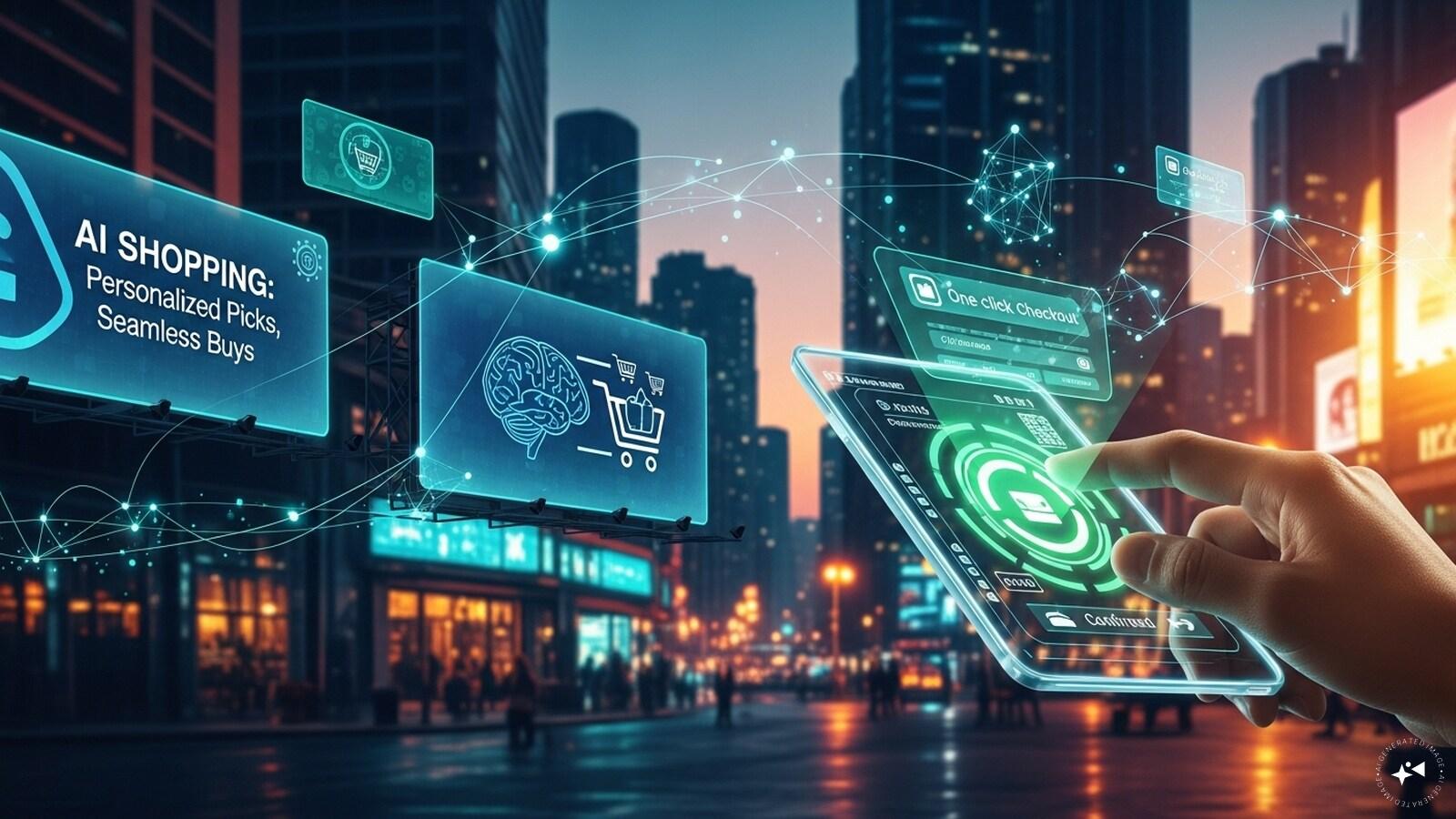
The Checkout Is Disappearing: How AI Agents Could Rebuild India’s Digital Commerce Stack
As AI evolves from answering questions to taking actions, India is entering a new phase of digital commerce. The rise of agentic payments could create an entirely new startup opportunity around trust, permissions, identity, data protection and transaction infrastructure.
Imagine telling your AI assistant, “Book me a cab to the airport tomorrow morning. Keep it under ₹800.” Instead of opening a ride-booking app, comparing options, entering details and completing the payment yourself, an AI agent could eventually handle the entire process within the limits you have approved.
That may sound like a small change in how we use technology. In reality, it could represent a major shift in digital commerce. For years, online businesses have been designed around humans clicking, searching, comparing, selecting and paying. The next phase could be built around software agents that perform many of these actions on behalf of users.
India is particularly interesting in this transition because it already has large-scale digital infrastructure for identity, payments and online transactions. UPI has transformed everyday payments, while the ecosystem is increasingly experimenting with AI-powered assistance and automated transaction experiences.
The bigger question now is: What happens when AI does not just explain a payment, but initiates one?
From “Search and Click” to “Ask and Approve”
Traditional e-commerce assumes that the customer is the operator. Even when algorithms recommend products, the final sequence of actions generally remains human-controlled.
Agentic commerce changes that relationship.
Instead of navigating several applications, a consumer could give an AI agent a goal:
“Find me a train to Pune tomorrow evening under ₹2,000 and book the best option.”
Or:
“Order the groceries I usually buy, but don't spend more than ₹3,000.”
Or:
“Pay this monthly bill if the amount is within my normal range.”
The consumer is no longer interacting with every individual service. The AI becomes the interface between the consumer and the marketplace.
But that creates a challenge that is much bigger than artificial intelligence itself: trust.
The Biggest Opportunity May Not Be Another AI Chatbot
If AI agents eventually perform financial and commercial actions for millions of people, businesses will need infrastructure to answer questions that ordinary chatbots never had to solve.
Who gave the agent permission to spend money?
How much is it allowed to spend?
Can it make one payment or unlimited payments?
What happens if it chooses the wrong product?
Who is responsible if an automated transaction goes wrong?
Can users understand why an agent made a particular decision?
Can the user stop it immediately?
These questions point toward a potentially important startup opportunity.
Instead of building another consumer-facing AI application, entrepreneurs could build the trust layer underneath AI applications.
That could include spending limits, transaction approvals, identity verification, fraud detection, consent management, audit trails, agent authentication and automated dispute systems.
The valuable product may not always be the AI agent itself. It could be the infrastructure that makes the agent safe enough to use.
India’s Digital Infrastructure Could Become an Advantage
India has spent years developing infrastructure that allows financial and digital services to operate at enormous scale. UPI is one of the clearest examples.
The next challenge could be moving from digital infrastructure designed primarily for humans to infrastructure that can safely support intelligent software acting on behalf of humans.
Recent developments indicate that this transition is becoming a serious business and policy conversation.
A proposed framework for agentic payments could enable authorised AI agents to make certain low-value, routine UPI transactions without requiring a person to approve every individual payment. Such a system would need controls around spending limits, identity, consent and responsibility.
That distinction matters.
An AI agent being permitted to make a ₹100 routine purchase is very different from an agent being allowed to spend ₹1 lakh without supervision.
The technology may be similar, but the trust architecture is completely different.
The New Startup Layer: Permission Infrastructure
One of the most interesting opportunities could be what we might call permission infrastructure.
Today, an application generally knows what it can do because a user directly interacts with it. In an agent-driven economy, permission could become something that is programmable.
Imagine giving an AI agent a rule such as:
“You can spend up to ₹2,000 per transaction and ₹5,000 per week, but never purchase financial products without asking me.”
A technology company could provide the infrastructure that converts these instructions into enforceable rules.
The same concept could apply to businesses.
A company might allow an AI purchasing agent to order office supplies automatically while restricting expensive equipment purchases. A travel company could permit an agent to make bookings within a specific budget. A financial platform could require additional authentication before higher-risk transactions.
This creates an important distinction between AI that can act and AI that can act safely.
The second problem could become the larger market.
Data Protection Becomes Part of the Product
Agentic systems could also create a significant data challenge.
An AI assistant managing purchases may know what a person buys, where they travel, which subscriptions they maintain, what services they use and potentially how they spend money.
Data protection therefore becomes a central part of the future of agentic commerce.
For startups, privacy may no longer be something treated only as a legal requirement.
Privacy could become a product feature.
A successful agentic-commerce company may need to convince users that its technology knows enough to be useful without collecting more information than necessary.
The question will not simply be whether an AI can access data.
It will be whether the user understands why the AI needs that data and what it is allowed to do with it.
The Marketplace May Become Less Important Than the Agent
There is another consequence that deserves attention.
For years, companies have invested heavily in becoming the place where consumers begin their shopping journey. Search engines wanted to own discovery. Marketplaces wanted to own transactions. Apps wanted to become the destination.
But what happens if the consumer starts with an AI agent instead?
The user may no longer care whether a product comes from Marketplace A or Marketplace B. The agent could compare available options based on price, delivery time, quality, previous preferences and other rules.
That could make access to AI agents a new competitive battleground.
Businesses may need to make their products understandable not only to humans, but also to machines.
Product information, pricing, availability, policies and transaction rules could increasingly need to be structured in ways that software agents can interpret.
In other words, the next generation of digital commerce may need machine-readable businesses.
A New Question for Indian Founders
The obvious question for an entrepreneur today is:
“What AI application should I build?”
A more interesting question could be:
“What infrastructure will every AI application need once it starts acting in the real world?”
That question opens a completely different startup map.
There could be companies building secure agent wallets, agent identity systems, programmable spending controls, AI transaction monitoring, agent-to-business communication standards, automated dispute resolution, consent infrastructure and systems that record why an AI made a particular transaction.
Some of these businesses may never become household names.
That does not make them less important.
Cloud infrastructure companies are rarely the product consumers talk about. Payment infrastructure is often invisible when it works. Identity systems operate quietly in the background.
The same could happen with agent infrastructure.
The biggest companies in the agentic economy may be the ones consumers never directly see.
Giving AI Agency Without Giving It Unlimited Power
There is obvious excitement around autonomous AI, but autonomy without boundaries creates equally obvious risks.
An AI agent can misunderstand instructions. It can make an incorrect recommendation. It can encounter fraudulent information. It can be manipulated by malicious content. And when an agent is connected to financial systems, a mistake can become a real transaction.
That is why the next stage of AI adoption may not be about removing humans completely.
It may be about designing human-controlled autonomy.
The best systems could allow users to define the boundaries within which an AI is trusted to operate rather than asking users to approve every single action.
Think of it as a digital power of attorney with programmable limits.
Where the Startup Opportunity Lies
India’s startup ecosystem has already demonstrated that large opportunities can emerge from infrastructure that ordinary consumers rarely notice.
Agentic commerce could become another such opportunity.
The winners will not necessarily be startups with the most impressive AI demonstrations.
They could be the companies that solve the less glamorous but more difficult questions:
Who is allowed to act?
What are they allowed to do?
How much are they allowed to spend?
What data can they access?
How can every action be verified?
And who takes responsibility when something goes wrong?
These are not flashy questions.
But they are the questions that determine whether autonomous technology can move from an interesting demonstration into everyday life.
The Next Interface May Not Be an App
The smartphone changed the way people interacted with businesses. Apps became the dominant interface for ordering food, booking travel, moving money and buying products.
AI agents could introduce another transition.
Instead of manually completing a sequence of actions, consumers may increasingly express an outcome:
“I need this.”
“Find me the best option.”
“Keep it within this budget.”
“Pay this.”
“Don't do anything outside these rules.”
The interface becomes conversational.
The infrastructure underneath becomes considerably more complicated.
For India’s startup ecosystem, that complexity could represent an opportunity.
The next generation of founders may not compete only to build the app that gets opened first.
They may build the infrastructure that allows AI to safely act after the app is no longer the first place the customer goes.
And if that happens, the future of digital commerce may not be about removing the checkout button.
It may be about making the checkout button unnecessary.


Leave a comment
Your email address will not be published. Required fields are marked *
Add a newsletter to your widget area.
Top Stories