The Cold Chain Challenge: Why India's Food Supply Needs Better Logistics
India's food supply depends on more than farming. Explore how cold storage, refrigerated transport, and smarter logistics can reduce food waste, support farmers, and improve the movement of perishable goods from farm to market.
Introduction: The Journey from Farm to Market
India is one of the world's major agricultural producers, supplying a wide variety of fruits, vegetables, dairy products, fish, meat, and other perishable goods. However, growing these products is only one part of the food supply chain. Ensuring that they reach markets, retailers, food-processing companies, and consumers while maintaining their quality is an equally important challenge.
After harvesting, many food products begin to lose freshness and quality if they are exposed to unsuitable temperatures, poor handling, or delays during transportation. A shortage of timely storage or an unreliable delivery system can turn a successful harvest into a financial loss. This is where cold chain logistics becomes essential.
A cold chain is a temperature-controlled system that helps preserve perishable products throughout their journey, from the farm to the final consumer. It combines suitable storage facilities, refrigerated transportation, careful packaging, temperature monitoring, and efficient distribution. For India, strengthening this system is not just a matter of improving transportation; it is an opportunity to reduce food losses, support farmers, improve supply-chain efficiency, and create new business opportunities.
Understanding the Cold Chain and How It Works
Cold chain logistics involves maintaining appropriate temperature and handling conditions at different stages of a product's journey. Unlike ordinary transportation, where goods can often be stored and moved without specialised temperature controls, perishable products may require carefully managed environments to maintain their quality and safety.
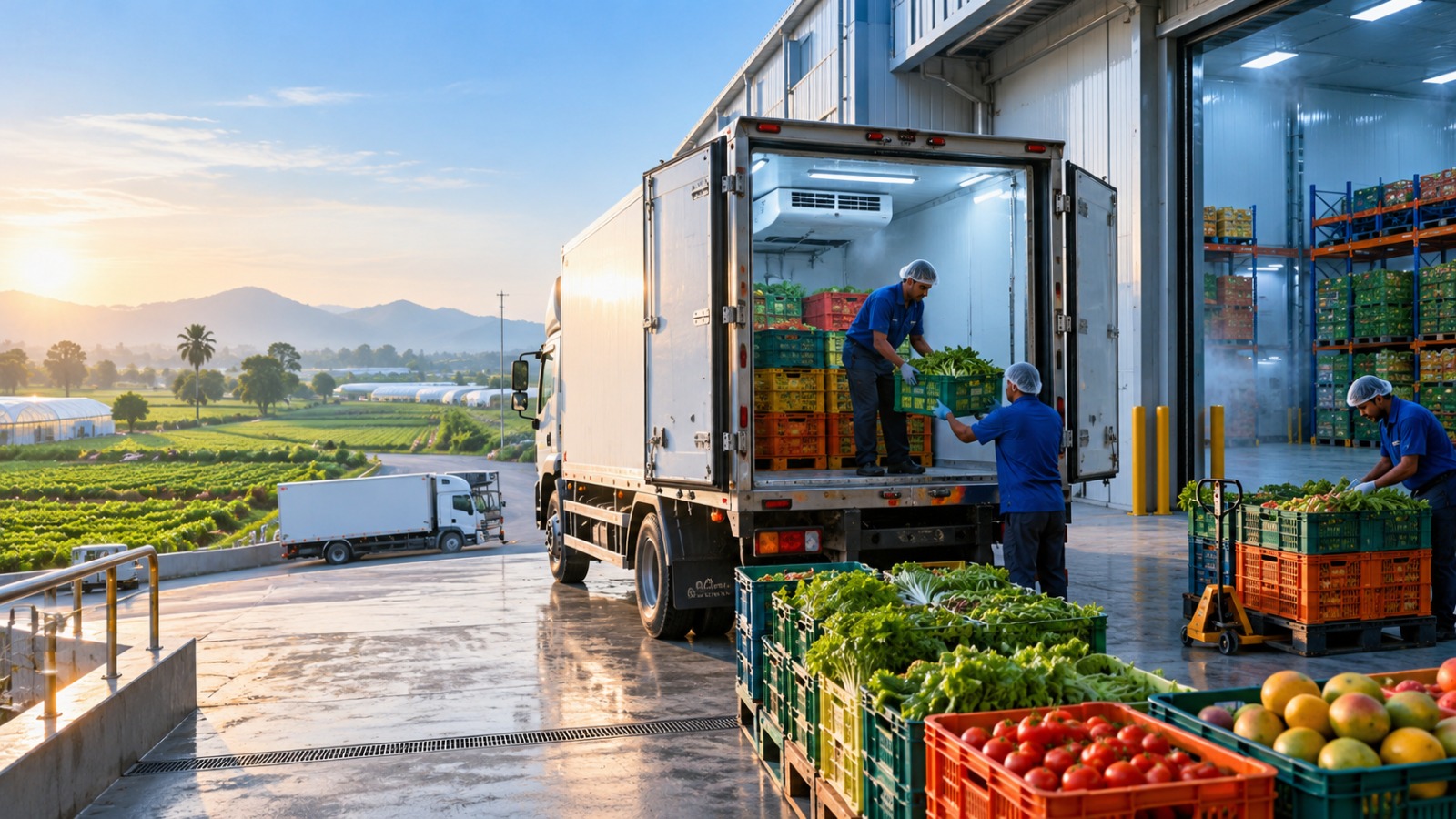
The process often begins shortly after harvesting. Fresh produce may need pre-cooling to remove field heat before it is packed and transported. It can then be sorted, graded, packed, and moved to a suitable cold-storage facility. Depending on the product, it may later travel in a refrigerated vehicle to a wholesale market, processing centre, distribution hub, supermarket, or food retailer.
Each stage must work in coordination with the others. A modern cold-storage warehouse cannot fully protect produce if it spends several hours in unsuitable conditions before arriving there. Similarly, a refrigerated truck cannot prevent losses if the product was already damaged during harvesting or packaging.
This makes cold chain logistics a connected system rather than a single piece of infrastructure. Its effectiveness depends on how well storage, transportation, handling, monitoring, and distribution work together.
Why Food Losses Remain a Serious Concern
Food loss is an important economic challenge because agricultural products require resources such as land, water, labour, energy, and investment to produce. When products deteriorate before reaching consumers, much of that effort and value is lost.
A study commissioned by India's Ministry of Food Processing Industriesand conducted by NABARD Consultancy Services assessed post-harvest losses across selected agricultural commodities using data for 2020–22. The findings reported estimated losses of approximately 7.36 million metric tonnes of fruits and 11.97 million metric tonnes of vegetables. These figures illustrate the scale of the post-harvest challenge and the importance of improving storage, handling, and distribution systems.
However, cold chain infrastructure is not the only factor involved. Losses can occur during harvesting, collection, sorting, grading, packaging, transportation, and storage. Poor roads, inadequate packaging, delays at markets, and limited access to processing facilities can also contribute to the problem.
The objective, therefore, should be to improve the entire supply chain. Better cold storage and refrigerated transport can make a significant contribution, but their benefits are greatest when combined with efficient handling practices, appropriate infrastructure, and reliable coordination between everyone involved.
The Challenges Facing India's Cold Chain Network
1. High Infrastructure and Operating Costs
Building and operating a cold-storage facility requires significant investment in refrigeration equipment, insulated structures, temperature-control systems, backup power, and maintenance. Refrigerated vehicles also cost more to purchase and operate than conventional transport vehicles.
For small farmers, cooperatives, and local traders, these costs can make access to professional cold chain services difficult. A facility may be technically available in a region but still remain financially out of reach for smaller businesses.
Operating expenses create another challenge. Refrigeration systems consume energy, and facilities need trained workers to monitor equipment, maintain the correct conditions, and manage inventory. Businesses must balance these expenses against the value of the products they handle.
2. Gaps Between Storage and Transportation
Cold storage and refrigerated transport need to operate as parts of one connected system. If a farmer has access to a storage facility but no suitable vehicle to transport the produce, the benefits of storage may be limited.
The same problem can occur when refrigerated vehicles are available but loading areas, collection centres, or distribution facilities are not equipped to maintain appropriate conditions. Delays during loading and unloading can expose goods to unsuitable temperatures and increase the risk of deterioration.
Improving coordination between farms, collection centres, warehouses, transport operators, wholesalers, and retailers is therefore essential. The goal should be to maintain suitable conditions throughout the journey instead of focusing on individual facilities in isolation.
3. Uneven Access for Small Farmers
Large agricultural businesses and organised food companies may have greater resources to invest in storage and transportation. Small farmers, however, may produce quantities that are too limited to justify hiring an entire refrigerated vehicle or maintaining their own cold-storage facility.
This creates a need for shared infrastructure and flexible services. Farmer Producer Organisations, cooperatives, aggregation centres, and shared logistics platforms can help multiple producers combine their requirements and access services at a more manageable cost.
Local collection centres can also help bring produce together before it is transported to larger markets. Such arrangements can make cold chain services more practical for smaller producers, particularly when they are supported by reliable transport connections and transparent pricing.
4. Unreliable Power Supply and Energy Consumption
Cold-storage facilities depend on a consistent power supply to maintain the required temperatures. Power interruptions, equipment failures, or poorly maintained refrigeration systems can compromise the quality of stored products.
Energy consumption is also a major operating consideration. Facilities that rely on inefficient equipment may face higher electricity bills, making services more expensive for farmers and businesses.
Energy-efficient refrigeration, improved insulation, solar power where suitable, and reliable backup systems can help address these challenges. Temperature alarms and remote monitoring can also alert operators to equipment problems before they result in significant losses.
5. Limited Visibility Across the Supply Chain
Businesses need accurate information about where products are located, how long they have been in storage, and whether the required temperature conditions have been maintained. Without reliable records, it becomes harder to identify problems, plan deliveries, and manage inventory.
Digital tools can help address this gap. Temperature sensors, GPS tracking, inventory management systems, and connected monitoring devices can provide useful information throughout transportation and storage.
However, technology alone cannot solve every problem. It must be affordable, easy to use, and supported by people who understand how to respond to the information it provides.
How Better Cold Chain Logistics Can Benefit Farmers and Consumers
A stronger cold chain can create benefits across the agricultural economy. For farmers, suitable storage and reliable transportation may provide more flexibility in deciding when and where to sell their produce. Instead of being forced to sell immediately because of limited storage options, farmers with access to appropriate facilities may be better positioned to plan their sales, depending on market prices, product shelf life, and storage costs.
For food processors and retailers, improved temperature control can support more consistent product quality, better inventory management, and more predictable deliveries. Businesses may also be able to reduce avoidable spoilage and the costs associated with damaged or unsellable goods.
Consumers can benefit when products retain their quality for longer and distribution becomes more reliable. A better-organised supply chain can help connect production centres with urban and regional markets, including areas that depend on goods transported over longer distances.
Nevertheless, lower food losses do not automatically guarantee lower retail prices. Prices are also influenced by demand, fuel costs, weather, market conditions, labour, and the margins charged by different participants. Better cold chain logistics can improve supply efficiency, but the extent to which consumers benefit depends on how the entire market operates.
The Role of Technology in Modern Cold Chain Management
Technology is increasingly useful for monitoring and coordinating temperature-controlled supply chains. Rather than relying entirely on manual checks, businesses can use sensors and connected devices to collect information about temperature, humidity, location, and equipment performance.
Internet of Things (IoT) sensors, for example, can monitor conditions inside a refrigerated vehicle or storage room. If the temperature moves outside the required range, the system can send an alert to the operator, allowing the issue to be investigated before the product is affected.
GPS tracking can improve visibility into vehicle movements and help logistics managers estimate arrival times. Digital inventory systems can record when goods enter and leave a facility, while data analytics can help businesses identify recurring delays, forecast demand, and plan storage capacity more effectively.
Artificial intelligence may also assist with demand forecasting, route planning, and equipment maintenance when reliable data is available. These applications can help businesses make better decisions, although their effectiveness depends on data quality, implementation costs, and operational discipline.
For smaller businesses, the most useful solutions may not be the most complex ones. Affordable temperature monitors, mobile-based booking systems, shared inventory platforms, and simple digital records can provide meaningful improvements without requiring a large technology budget.
Government Initiatives Supporting Cold Chain Development
Recognising the importance of post-harvest infrastructure, the Government of India has introduced initiatives to strengthen food processing, preservation, and supply-chain facilities.
The Ministry of Food Processing Industries implements the Integrated Cold Chain and Value Addition Infrastructure scheme under the Pradhan Mantri Kisan SAMPADA Yojana. The scheme aims to establish integrated cold chain facilities connecting production areas with processing centres and markets. Its components can include pre-cooling, cold storage, packing facilities, refrigerated vehicles, and other infrastructure required to preserve products during distribution.
The objective is to reduce post-harvest losses and improve the movement of agricultural and other perishable products through a more coordinated supply chain. The scheme also provides a framework for eligible businesses and organisations to develop integrated cold chain projects, subject to the applicable guidelines and eligibility conditions.
Government support can encourage investment, but the long-term effectiveness of these initiatives depends on how well the infrastructure is planned, operated, and connected to local agricultural needs. Facilities must be suitable for the products being handled, accessible to the intended users, and economically viable over time.
Official information is available through the Ministry of Food Processing Industries' Integrated Cold Chain scheme.
Emerging Business Opportunities for Startups
The challenges within India's cold chain network also create opportunities for entrepreneurs. Startups do not necessarily need to build large warehouses or purchase entire fleets of refrigerated trucks to contribute to this sector. They can focus on specific problems that make existing supply chains less efficient.
One opportunity is the development of shared cold-storage services. A startup could connect farmers, traders, and food businesses with available storage facilities, allowing users to find suitable capacity based on location, product type, quantity, and duration. Such a model could help smaller producers access infrastructure without having to invest in their own facilities.
Another opportunity lies in technology-enabled logistics coordination. Digital platforms could connect farmers and agricultural collection centres with refrigerated transport operators, helping businesses organise deliveries and improve vehicle utilisation. Better coordination may also reduce unnecessary trips and the costs associated with transporting small quantities independently.
Affordable monitoring solutions present another area for innovation. Startups can develop temperature sensors, alert systems, and mobile dashboards that help small warehouses and transport operators monitor their operations. The value of these solutions lies in making useful information accessible without adding excessive complexity or expense.
Energy-efficient refrigeration is another promising direction. Businesses that develop efficient cooling equipment, improved insulation, solar-assisted systems, or better energy-management solutions may help operators reduce long-term operating costs. The suitability of each technology will depend on the location, facility size, energy requirements, and products being stored.
There are also opportunities in specialised services such as packaging, product traceability, inventory management, and supply-chain analytics. By solving specific operational problems, startups can help improve the performance of existing infrastructure rather than relying entirely on the construction of new facilities.
For entrepreneurs, the key is to identify a genuine problem faced by farmers, logistics operators, or food businesses and develop a solution that is affordable, practical, and commercially sustainable.
Building a More Sustainable Cold Chain
Cold chain development must balance efficiency with environmental responsibility. Refrigeration is essential for preserving many perishable products, but it also requires energy and equipment that must be managed carefully.
Improving energy efficiency is one way to make cold chain operations more sustainable. Modern refrigeration systems, well-insulated storage rooms, regular equipment maintenance, and effective temperature management can help reduce unnecessary energy consumption.
Renewable energy can also play a role where local conditions and project economics make it practical. Solar power combined with suitable storage or backup arrangements may help some facilities manage electricity costs and improve reliability, particularly in areas where power supply is inconsistent.
Better route planning and vehicle utilisation can contribute as well. When deliveries are coordinated effectively, transport operators may be able to reduce empty journeys and avoid unnecessary fuel consumption. These improvements can support both operational efficiency and environmental goals.
Sustainability also means preventing avoidable food waste. When more produce reaches consumers in good condition, the resources used to grow, harvest, and transport it are less likely to be wasted. However, these benefits should be assessed carefully rather than assuming that every cold-storage project automatically reduces emissions. Refrigeration technology, energy sources, transport distances, and operating practices all influence the overall impact.
A sustainable cold chain should therefore focus on three connected priorities: preserving product quality, controlling operating costs, and using energy and resources responsibly.
What Needs to Happen Next?
Strengthening India's cold chain requires coordinated action from farmers, businesses, logistics providers, technology companies, and policymakers. Investment in infrastructure is important, but the focus must extend beyond the number of warehouses or refrigerated vehicles available.
First, cold chain facilities should be planned according to regional production patterns and the requirements of different commodities. The storage conditions suitable for one product may not be appropriate for another, making product-specific planning essential.
Second, smaller farmers and businesses need practical ways to access these services. Shared facilities, cooperative models, transparent pricing, and aggregation centres can help distribute costs across multiple users and improve the utilisation of available infrastructure.
Third, logistics networks need better coordination. Storage facilities, transport operators, markets, and processing centres should work together to minimise delays and maintain appropriate handling conditions throughout the journey.
Finally, digital monitoring and energy-efficient technologies should be adopted where they provide clear operational benefits. Solutions must be reliable, affordable, and supported by trained personnel who can respond when problems arise.
Progress should also be measured through meaningful indicators, including reductions in product losses, improved temperature compliance, lower operating costs, more reliable deliveries, and better access for smaller producers. These measures can help businesses determine whether their investments are delivering real improvements.
Conclusion: Turning Cold Chain Challenges into Opportunities
India's agricultural strength depends not only on how much food it produces but also on how efficiently that food reaches the people and businesses that need it. Weak links in storage, handling, transportation, and distribution can reduce product quality and create avoidable financial losses throughout the supply chain.
A reliable cold chain can help address these challenges by connecting farms with markets through appropriate storage facilities, refrigerated transportation, efficient operations, and better monitoring. For farmers, it can create more flexible market access. For businesses, it can improve inventory management and reduce spoilage. For startups, it presents opportunities to develop practical solutions in logistics coordination, affordable monitoring, shared infrastructure, and energy-efficient refrigeration.
The way forward is not simply to build more cold-storage facilities, but to create a connected, accessible, and commercially sustainable system that works for different regions and business sizes. With better planning, technology adoption, and collaboration, cold chain logistics can become an important part of a more efficient and resilient food supply network.
To read more industry insights on business trends, emerging technologies, and innovation, visit StartupTimes.net.

Leave a comment
Your email address will not be published. Required fields are marked *
Add a newsletter to your widget area.
Top Stories