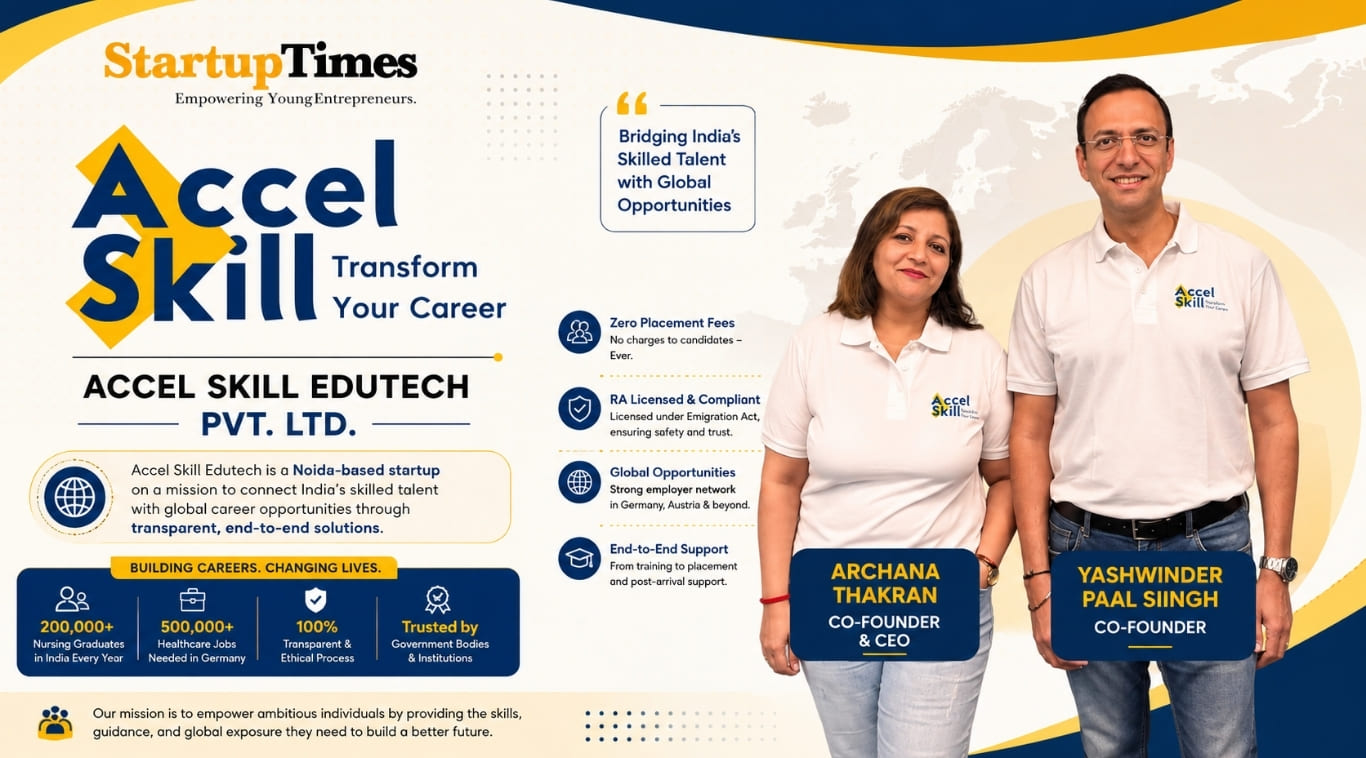
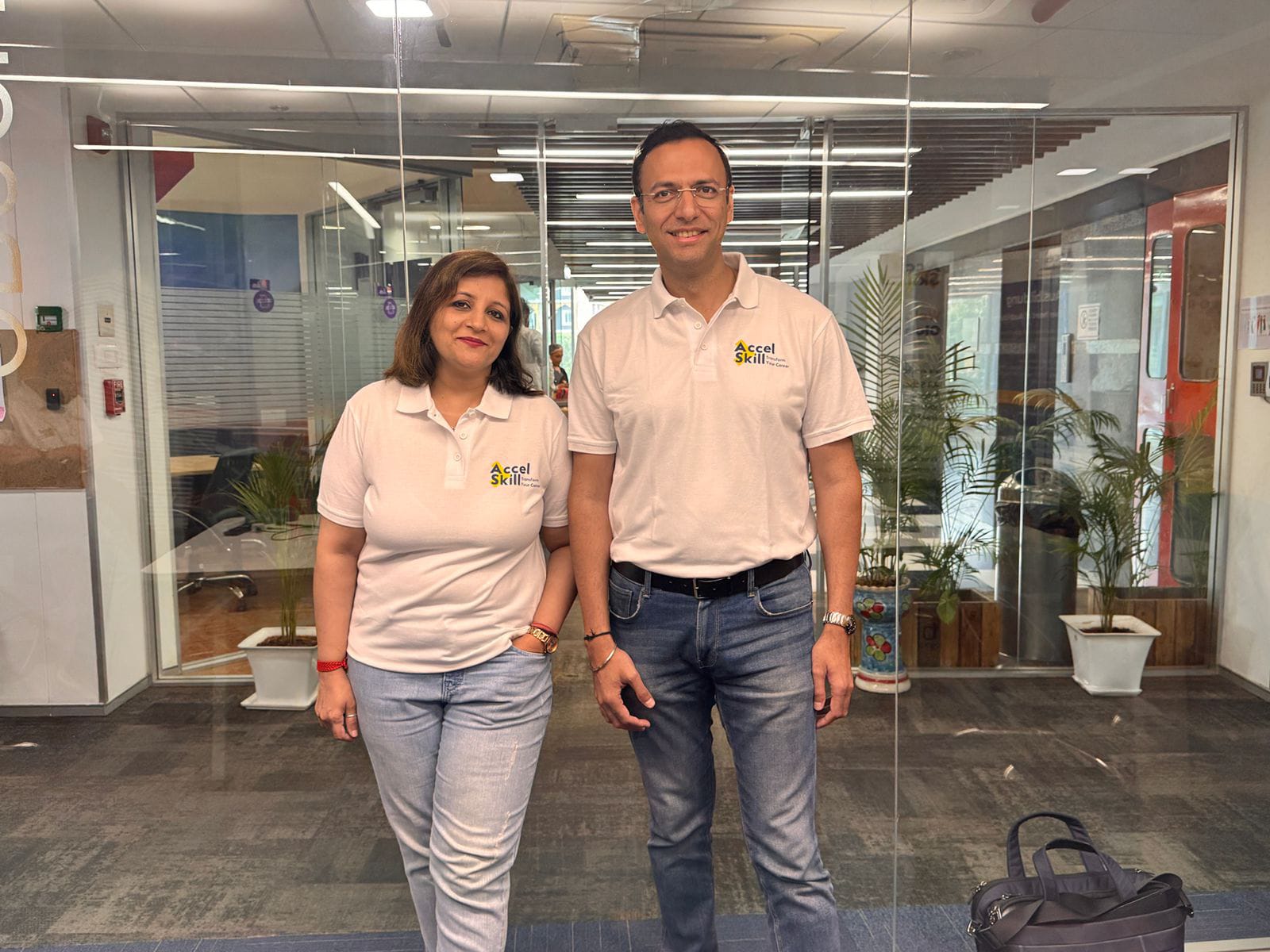
Accel Skill Edutech Pvt. Ltd., founded by Yashwinder Paal Siingh and Archana Thakran, is transforming international talent mobility through ethical, zero-placement-fee recruitment. The Last Mile Nobody Wanted to Walk highlights how the Noida-based startup empowers Indian professionals with AI-powered language training, verified global employers, and end-to-end career pathways.
India is the world’s largest exporter of talent. Europe is running out of workers. Governments on both sides are building the frameworks. So why are thousands of young Indians still falling prey to fraud, failing to cross the last mile, and watching their global career dreams dissolve? Two founders from Noida decided that was no longer acceptable.
There is a woman in Kanpur named Akshara who completed her BSc Nursing in 2023 with distinction. She speaks decent English, has a hunger for excellence, and carries the weight of her family’s hope on her shoulders. She wanted a nursing career in Germany — a country that, by its own government’s admission, needs half a million healthcare workers with urgency. Between Akshara and that job in Frankfurt lay a sprawling maze: language certificates, credential recognition, visa categories, immigration regulations, fraudulent placement agents, and a near-total absence of trustworthy guidance.
She is not alone. India produces approximately 200,000 nursing graduates every year. Germany alone cannot fill 500,000 healthcare vacancies through its domestic workforce. By every logic of economics, these two facts should resolve each other cleanly. They don’t — because the infrastructure connecting them is broken, exploitative, or absent.
This is the problem that Yashwinder Paal Siingh and Archana Thakran, Co-Founders of Accel Skill Edutech Pvt. Ltd., set out to fix when they registered their company in Noida in February 2024. Not with a new app, a new course catalogue, or another certificate mill. But with something far more radical in the Indian skilling landscape: a fully transparent, end-to-end, zero placement-fee international career pathway — built on regulatory compliance, government partnerships, and genuine accountability for outcomes.
“We are not in the EdTech business. We are in the life-transformation business. EdTech stops at course completion. We stop only when the candidate is thriving in their new country and their family’s life has changed.”
To understand why Accel Skill matters, you need to understand the scale of what is happening globally — and how comprehensively India is positioned at the centre of it.
The OECD International Migration Outlook 2025 placed India at the top of a ranking nobody expected: the world’s single largest source of migrants to developed economies. In 2023 alone, nearly 600,000 Indians moved to OECD countries — an 8% jump from the previous year. Applications for the UK’s Health and Care Worker visa from Indian nationals surged by 75%. Germany amended its Skilled Immigration Act (Fachkräfteeinwanderungsgesetz) to create new legal pathways for non-EU skilled workers, with Indian nationals among the primary intended beneficiaries.
On the demand side, the numbers are almost disorienting in their scale. Two-thirds of European companies currently face structural skill shortages — not cyclical, not seasonal, but structural. The European Union’s own Digital Decade 2030 target requires 20 million ICT specialists. Germany’s healthcare system is short 500,000 workers. The Gulf Cooperation Council nations face comparable deficits in hospitality, construction, and facility management.
600K+
Indians migrated to OECD countries in 2023
500K
Healthcare vacancies Germany cannot fill
⅔
European companies facing structural skill gaps
20M
ICT specialists EU needs by 2030
And yet, the connection between India’s supply and the world’s demand remains mediated by a network of largely unregulated, frequently exploitative intermediaries. Hundreds of thousands of workers are defrauded annually by fraudulent placement agents — losing savings, careers, and in some cases far worse. The asymmetry of information is weaponised at scale.
It is into this landscape that Accel Skill arrives — RA Licensed under India’s Emigration Act, incubated at Amity Technology Incubator under the Startup India initiative, and carrying institutional partnerships that most startups of its age and stage would not dare to claim.
Every great company built on social impact needs two things at its founding core: a visionary who sees the system clearly enough to want to change it, and an operator who has lived the change closely enough to know what it actually takes. In Accel Skill, that duality is embodied by its Co-Founder and CEO, Archana Thakran.
Archana brings to Accel Skill something that no amount of market research can replicate: personal, lived proximity to the very transformation the company is building at scale. Her close relatives completed Germany’s Ausbildung — the legendary three-year dual vocational education and training programme — and are today successfully progressing in their European careers. She has watched, at first hand, how a structured, transparent, internationally recognised pathway can fundamentally alter the trajectory of a family. She knows what the transformation looks like not from a pitch deck, but from a dining table conversation with people she loves.
“I have seen what happens when a young person from India gets a real, structured, ethical opportunity abroad. The change is not just in their career. It is in how they carry themselves. It is in what their family believes is possible. That is what we
Professionally, Archana’s background spans the higher education and skilling ecosystem. Her experience gives Accel Skill something that most talent mobility startups conspicuously lack: genuine credibility with the academic and university establishment. She understands how colleges make partnership decisions, and has cultivated a vast network of institutions across India — spanning healthcare, hotel management, engineering, and vocational education — that form Accel Skill’s candidate supply pipeline.
Together, Yashwinder and Archana cover both ends of the corridor. He brings the global mobility, regulatory compliance, and international employer network expertise. She brings domestic institutional credibility, higher education relationships, and the personal proof-of-concept that the Ausbildung pathway works. Between them, they cover the aspiration in India and the destination in Europe.
Founders often talk about building from pain. Yashwinder Paal Siingh’s founding impulse came from observation — from years of watching a system fail people who deserved better, and from a conviction that the failure was not inevitable.
Born into a defence family, Yashwinder grew up without a permanent address. His childhood and youth were spent moving across the length and breadth of India — from cantonment towns in the north to postings in the south, absorbing the extraordinary diversity of this country in a way that few professionals ever do. He also travelled extensively across developed countries, observing at first hand how structured, transparent, and outcome-oriented international labour markets function. It is this rare combination of deep India-rootedness and global perspective that he brings to Accel Skill.
His founding thesis is deceptively simple: the Indian skilling and overseas placement sector is broken not because of a lack of demand or supply, but because of a fundamental trust deficit. Candidates don’t know who to trust. Employers don’t know which Indian recruitment partners are legitimate. Governments struggle to enforce standards across a fragmented, largely informal sector. The result is a market that functions well for exploitation and poorly for genuine mobility.
“The most important decision we made on Day One was to get the RA licence before we signed our first client. It cost us time. It cost us money. But it told everyone we worked with — candidates, employers, government bodies — that we were in this for
Accel Skill’s compliance-first posture is not merely a brand position. It is operationally embedded. The company holds a Registered Recruiting Agent licence under India’s Emigration Act — a legal designation that subjects it to regulatory oversight, candidate protection standards, and regular compliance audits. In a sector where the vast majority of operators function without this designation, it represents a genuine institutional differentiator.
Accel Skill was incorporated in February 2024. By the end of its first year of operations, it had secured incubation at Amity Technology Incubator, formalised MoUs with the Meghalaya State Skill Development Society and Medhavi Skills University in Sikkim, and received its first seed tranche of capital. For a pre-seed EdTech startup focused on overseas placement, this pace of institutional validation is notable.
Most skilling platforms in India are, in practice, course delivery businesses. They measure success in enrolments, certificates issued, and Net Promoter Scores. Placement, where it happens at all, is often a bolt-on — a job board, a WhatsApp group of employers, a placement cell that functions as an afterthought.
Accel Skill’s architecture is built on a different premise: that the value delivered to a candidate is precisely zero until they are in a verified job, performing well, and financially stable in their destination country. Everything before that moment is input cost. Only the outcome counts.
The candidate journey begins with Accel Skill’s proprietary Language Learnability Assessment — a psychometric tool that maps the candidate’s cognitive learning profile, optimal learning modality, and predicted language acquisition trajectory. The output is a personalised learning roadmap, not a generic course assignment. Training delivery combines AI-powered adaptive modules with live virtual classrooms led by certified language trainers. For Germany-bound candidates, this means a structured journey from German A1 through B2.
Nursing & Allied Health
BSc Nursing graduates prepared for German hospital placements — A1–B2 language training, credential recognition, cultural orientation, and full visa support.
Ausbildung — Germany
Germany’s dual vocational training system. Candidates earn a European salary while gaining world-class certification in mechatronics, logistics, IT, and hospitality.
Hospitality
Hotel management and culinary graduates placed with verified employers across Europe, the Gulf, Mauritius, and emerging corridors.
Beyond training, Accel Skill’s operational stack covers credential verification, employer matching through a curated network of verified German and Austrian employers, visa documentation support, pre-departure cultural orientation, and — crucially — post-placement handholding through the candidate’s first three to six months in-country.
The post-placement layer is where Accel Skill most sharply diverges from the market. For most placement agencies, the transaction ends at the job offer. For Accel Skill, it continues until the candidate is genuinely stable. This is not charity — it is rational business logic. Candidate success is the product.
“Every time I see a candidate from a small town in Rajasthan secure a verified nursing role in Germany, I know we are on the right track. That call they make to their parents — that is our real metric.”
Accel Skill does not operate in isolation. It operates within a rapidly maturing policy environment that, for the first time in India’s history, is creating structured, bilateral, government-backed frameworks for international talent mobility.
Germany’s amended Skilled Immigration Act (Fachkräfteeinwanderungsgesetz) now creates explicit legal pathways for Indian professionals in healthcare, vocational trades, and skilled services. India and Germany have formalised a Migration and Mobility Partnership Agreement, creating reciprocal frameworks for skilled workers, students, and trainees. The India-Austria bilateral framework is similarly active, with Ausbildung placements forming a growing component.
India’s own regulatory environment has simultaneously strengthened, with stricter enforcement of the Emigration Act’s Registered Recruiting Agent framework — the very compliance infrastructure that Accel Skill built from Day One. Where once this was an administrative burden, it is now a competitive moat: the majority of placement operators remain unlicensed, informal, and increasingly exposed to regulatory risk.
India’s Ministry of External Affairs has also been actively building state-level emigration management infrastructure, engaging governments in Assam, Meghalaya, Sikkim, and across the Northeast to create formal talent mobility pipelines to Europe. Accel Skill’s MoU with the Meghalaya State Skill Development Society is a direct product of this policy momentum.
“The governments have built the framework. The employers have the vacancies. The candidates have the aspiration. Accel Skill builds the bridge — one verified placement, one transformed life at a time.”
Impact investors and development finance institutions increasingly ask: which Sustainable Development Goals does your business model structurally advance, and how does scale make the impact larger rather than merely replicating it?
Accel Skill’s answer is unusually clean. Its model directly advances SDG 4 (Quality Education) through its AI-personalised, outcome-oriented learning platform; SDG 8 (Decent Work and Economic Growth) through verified, RA-licensed, fee-free placement in above-market international roles; SDG 10 (Reduced Inequalities) through its deliberate focus on tier-2 and tier-3 cities and the Northeast; and SDG 5 (Gender Equality) through the disproportionate representation of women — particularly in nursing — among its beneficiaries.
Each successful international placement generates remittances that support a family, funds a sibling’s education, and demonstrates to a community that global careers are possible. At scale, Accel Skill’s model is a poverty-reduction mechanism, an inequality-reduction mechanism, and a gender empowerment mechanism simultaneously — all structured as a commercially sustainable business.
SDG 4 — Quality Education
AI-personalised training democratises quality education regardless of geography or economic background.
SDG 5 — Gender Equality
Women form the majority of Accel Skill’s beneficiary base in nursing and hospitality.
SDG 8 — Decent Work
RA-licensed, zero-fee, verified placements deliver decent work at international wage levels.
SDG 10 — Reduced Inequalities
Deliberate focus on tier-2/3 cities and Northeast India addresses deep geographic inequality.
SDG 17 — Partnerships
Government MoUs, Startup India recognition, and bilateral policy alignment reflect a genuine partnership architecture.
Why This Is Hard to Copy
The EdTech and overseas placement sectors in India are both crowded. What makes Accel Skill defensible lies in a combination of regulatory compliance, institutional trust, and operational depth that takes years to build and cannot be manufactured overnight.
Regulatory compliance is the first moat. The RA licence under India’s Emigration Act excludes the majority of placement operators who function informally. It signals to international employers that Accel Skill operates within a legal framework they can partner with. And crucially, the licence prohibits charging placement fees to candidates.
Institutional trust is the second moat, and it compounds. The Meghalaya State Skill Development Society MoU is a government’s endorsement of Accel Skill as a trustworthy actor for its most vulnerable youth. Creating a Centre of Excellence at RBMI Campus creates a credentialing layer. Amity Technology Incubator’s backing signals institutional validation to investors and media alike. Each partnership makes the next one more accessible.
Operational depth is the third moat — and arguably the hardest to replicate. Building a functioning pipeline of verified European employers requires time, relationship capital, and consistent delivery. Building the language training infrastructure to take candidates from zero German to B2 requires curriculum investment. None of this is fast, and none of it is cheap.
“We built the hard things first. Compliance before clients. Credibility before scale. This is not the fastest path to growth. It is the only path to the kind of growth that lasts.”
Behind every strategic framework and institutional partnership is the human reality that makes it matter.
Devyani is from Churu, Rajasthan — a small city not known as a launch pad for international careers. Before enrolling with Accel Skill, she had never spoken to a European employer, had no German language, and no clear sense of whether her dream was even possible. Today, she is working through German A2, her credential verification is in process, and she describes the feeling of believing her future is genuinely in her hands.
Mukul from Delhi is navigating the Ausbildung pathway. He describes Accel Skill as the first organisation that gave him a clear, honest, step-by-step roadmap rather than a sales pitch — one that told him the hard things as well as the good ones.
Akshara from Kanpur — the woman with whom this story opened — is now in an advanced stage of her Germany nursing application. Her German B1 certificate is complete. The maze has not disappeared — but she is navigating it with a guide who has walked it before.
These are representative of a pipeline of candidates — primarily from tier-2 and tier-3 cities, primarily women, disproportionately from states with limited access to international career infrastructure — who are moving through a process that, for the first time, has clarity, honesty, and institutional backing.
The Vision: 50,000 Lives, 15 States, 10 Countries
Accel Skill’s current focus is Germany and Austria across three verticals — nursing, hospitality, and Ausbildung. The five-year roadmap is deliberately sequenced: depth before breadth, credibility before scale, outcome track records before geographic expansion.
Phase two targets 15 state-level MoUs by 2028 — with emphasis on Northeast India, Bihar, Rajasthan, and Madhya Pradesh. Phase three extends to the UK, Japan, Canada, and Gulf nations. Accel Skill’s compliance-first architecture is designed to be portable across destination country regulatory environments.
50,000
Target verified placements by 2029
15+
State partnerships by 2028
10+
Destination countries by 2030
₹0
Placement fee — ever
The fundraising narrative is built on this foundation. Accel Skill is in active conversations with impact investors and social venture funds — specifically those with a mandate for SDG-aligned, outcomes-measurable investments in emerging market talent mobility.
Why This Moment Is the Right Moment
Germany’s Skilled Immigration Act amendments, the India-Germany Migration & Mobility Partnership, active bilateral frameworks with Austria and Gulf nations, and India’s strengthened Emigration Act enforcement are all converging simultaneously. This creates a window that will not remain open indefinitely.
Platforms that establish trusted pipelines, institutional relationships, and outcome track records in this window will enjoy compounding advantages as the corridor matures. Accel Skill is among the few who have chosen to build it the hard, right, compliant way — with founders who understand the difference between moving fast and moving well, and who have chosen the latter consistently.
For Investors, Partners & Institutions
Accel Skill is currently raising its seed round and actively seeking:
• Impact investors and social venture funds with SDG-aligned mandates
• State Skill Development Society MoU partnerships
• International employer network partnerships in Germany, Austria, UK, and Gulf
• Academic and university partnerships for candidate pipelines
• Contact: www.accelskill.com
The Last Mile
Yashwinder Paal Siingh ends conversations the same way he begins them — with a candidate, not a metric.
“There is a phone call that happens when one of our candidates lands in Germany for the first time and calls their parents,” he says. “That call — the sound of it — is why we do this. Not the placement rate. Not the revenue multiple. That call.”
The India-EU talent mobility corridor is, by any measure, one of the most consequential economic relationships of the next decade. What has been missing — what Accel Skill is methodically building — is the trusted, transparent, accountable last mile that ensures the opportunity reaches the people it is meant for: not the well-connected, the urban, the privileged, but the nursing graduate in Kanpur, the mechanic in Rajasthan, the hospitality aspirant from Meghalaya.
That last mile is the hardest mile. It is also the most important one.
About Accel Skill Edutech Pvt. Ltd.
Accel Skill Edutech Pvt. Ltd. is a pre-seed international talent mobility platform founded in February 2024 and headquartered in Noida, Uttar Pradesh. The company operates an end-to-end international career pathway platform across three verticals — Nursing & Allied Health (Germany), Hospitality (Europe & Gulf), and Ausbildung (Germany) — covering AI-powered language training, employer matching, visa guidance, and post-placement support.
The company holds a Registered Recruiting Agent licence under India’s Emigration Act, is incubated at Amity Technology Incubator (Startup India recognised), holds MoUs with the Meghalaya State Skill Development Society and Medhavi Skills University (Sikkim), and is a member of the Indo-German Chamber of Commerce. Zero placement fees — always.
I am an entrepreneur, marketer, and mentor with a certification in entrepreneurship from IIT Delhi, one of the most prestigious institutions in India. I have a passion for connecting businesses with their ideal customers, solving real-world problems, and inspiring the next generation of founders.I founded and lead DevoByte, a digital marketing agency that provides a range of services, from SEO a
Leave a comment
Your email address will not be published. Required fields are marked *