
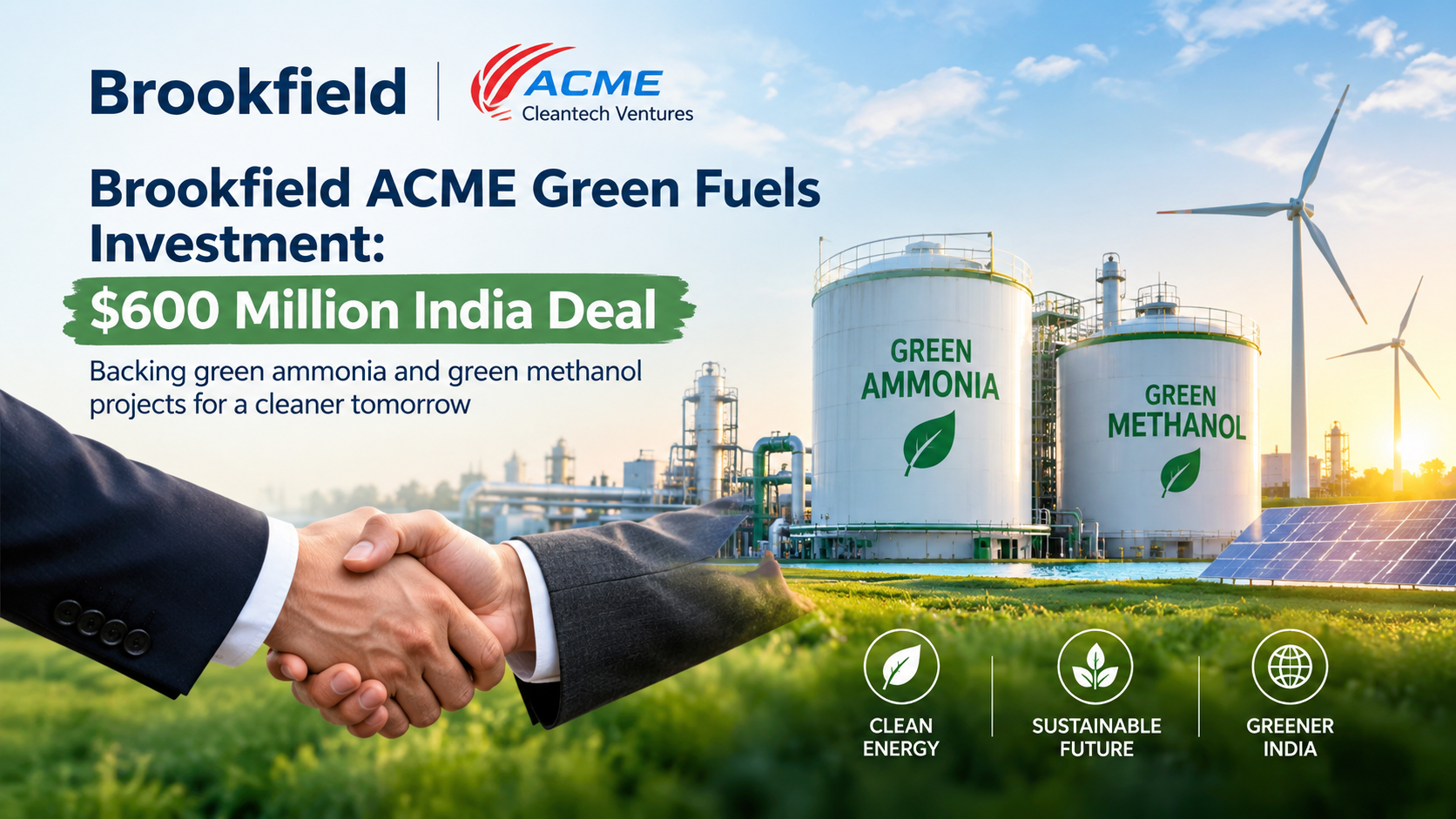
Brookfield ACME Green Fuels Investment: $600 Million India Deal
Brookfield ACME Green Fuels Investment could reach $600 million as Brookfield backs ACME Cleantech Ventures for green ammonia and green methanol projects in India.
Brookfield ACME Green Fuels Investment has emerged as a significant development in the clean-energy sector, with global investment firm Brookfield planning to invest up to $600 million in ACME Cleantech Ventures. The investment is aimed at supporting the development and construction of ACME’s green-molecule projects, including green ammonia and green methanol facilities in India and Oman.
Announced on September 17, 2026, the investment marks Brookfield’s entry into the region’s green-molecules sector through its Brookfield Global Transition Fund strategy. The deal also highlights the growing role of institutional capital in financing large-scale clean-energy infrastructure and low-carbon fuel projects.
ACME Cleantech Ventures is a UK-based entity within the ACME Group focused on the group’s green-molecules business. The company is developing projects intended to supply low-carbon fuels and feedstocks to domestic and international markets, with applications across sectors such as fertilisers, shipping, chemicals, refineries and other industries that face challenges in reducing emissions.
Brookfield ACME Green Fuels Investment: Key Details
The Brookfield ACME Green Fuels Investment represents a major capital commitment toward the development of green molecules. According to Reuters, Brookfield will invest up to $600 million in ACME Cleantech Ventures to help develop and build green ammonia and green methanol projects.
The investment will be made through Brookfield’s Global Transition Fund strategy, which focuses on opportunities associated with the transition toward a lower-carbon economy.
| Particular | Details |
|---|---|
| Investor | Brookfield |
| Investment | Up to $600 million |
| Company | ACME Cleantech Ventures |
| Parent Group | ACME Group |
| Sector | Green Energy / Green Molecules |
| Key Products | Green Ammonia and Green Methanol |
| Project Markets | India and Oman / West Asia |
| Investment Strategy | Brookfield Global Transition Fund |
| Announcement Date | September 17, 2026 |
| Target Markets | Domestic and International |
| Applications | Fertilisers, Shipping, Chemicals, Refineries and Heavy Industry |
Why the Brookfield ACME Investment Matters
The investment comes at a time when companies and governments are looking for alternatives to conventional fossil-fuel-based energy and industrial feedstocks. Green molecules such as green hydrogen, green ammonia and green methanol are being developed for applications where direct electrification can be more difficult.
For ACME, the investment provides additional capital to advance its project pipeline. For Brookfield, the transaction expands its exposure to the emerging low-carbon fuels market in India and the Middle East.
Brookfield already has a substantial renewable-energy presence in India. Reuters reported that the investment firm has approximately 50 GW of wind and solar assets either operating or in its pipeline in the country.
The transaction therefore connects Brookfield’s existing renewable-energy footprint with the developing green-molecules value chain.
Green Ammonia: An Important Part of the Energy Transition
Green ammonia is attracting significant attention as a potential low-carbon fuel and industrial feedstock.
Ammonia is traditionally produced using processes that depend heavily on fossil fuels. Green ammonia aims to reduce the emissions associated with production by using renewable electricity to produce hydrogen, which is then combined with nitrogen.
One potential application is the shipping industry, where ammonia is being explored as a lower-carbon fuel option. Green ammonia can also be used in fertiliser production and other industrial applications.
The development of green ammonia projects requires substantial investment in renewable power, electrolysers, storage facilities, processing infrastructure and transportation networks. Large-scale investments such as the Brookfield-ACME transaction can therefore support development across multiple parts of this value chain.
ACME’s Green Ammonia Projects
ACME already has an operating green ammonia facility in Bikaner, Rajasthan, according to Economic Times and Business Standard. The company is also developing a green ammonia project in Duqm, Oman, while working on additional facilities in Odisha.
The Odisha development follows a Green Ammonia Purchase Agreement with the Solar Energy Corporation of India (SECI). ACME is also involved in a strategic joint venture with Japan’s IHI Corporation and has an offtake agreement with Mitsubishi Gas Chemicals.
These developments indicate that ACME’s strategy extends beyond individual projects toward building a broader green-molecules platform serving multiple markets.
Green Methanol Adds Another Growth Opportunity
Alongside green ammonia, green methanol is another important component of ACME’s development pipeline.
Green methanol can be produced using renewable hydrogen and suitable carbon dioxide sources. It is being explored for applications including shipping, chemical production and industrial processes.
The development of commercial-scale green methanol production could create demand for renewable electricity, hydrogen-production equipment, carbon-management technologies, storage facilities and transportation infrastructure.
For India, the development of these industries could potentially contribute to the growth of a wider clean-energy manufacturing and services ecosystem.
ACME Has Secured Multiple Offtake Relationships
An important feature of ACME’s green-molecules strategy is its relationships with potential customers and offtakers.
According to reports, ACME has secured supply or offtake arrangements involving companies such as Yara International, IHI Corporation and Mitsubishi Gas Chemical, along with Indian fertiliser companies including IFFCO, Paradeep Phosphates, Coromandel International and Indorama India.
Long-term offtake agreements can be important for large clean-energy projects because they provide visibility around potential future demand. However, the final commercial performance of individual projects will depend on factors such as project costs, financing, construction timelines, technology, regulatory conditions and market demand.
India’s Growing Green-Fuel Ecosystem
India has been developing policies and infrastructure around renewable energy, green hydrogen and its derivatives. Green ammonia and green methanol are part of the broader discussion around building domestic clean-energy capabilities and developing export opportunities.
The Indian government’s National Green Hydrogen Mission has identified green hydrogen and its derivatives as areas for development, with objectives including expanding production, use and export.
The policy environment is particularly relevant because green-fuel projects typically require significant upfront capital and long development timelines.
The Brookfield-ACME transaction adds another example of international capital being directed toward this emerging segment of India’s energy economy.
Investment Could Support Infrastructure Development
The development of green molecules requires much more than production facilities alone.
Projects can require:
- Renewable electricity generation
- Electrolysers for hydrogen production
- Water-treatment infrastructure
- Ammonia and methanol processing facilities
- Storage systems
- Transportation infrastructure
- Port and export facilities
- Power transmission infrastructure
- Industrial equipment
- Monitoring and emissions-management systems
As these projects expand, opportunities could emerge for engineering and construction companies, equipment manufacturers, renewable-energy developers, logistics providers and technology companies.
This makes the green-molecules sector relevant not only to energy companies but also to a wider network of industrial businesses.
Brookfield Expands Its Clean-Energy Exposure
The investment also fits within Brookfield’s wider energy-transition strategy.
Brookfield has already developed a significant renewable-energy presence in India through wind and solar assets. Its investment in ACME gives the firm exposure to a different part of the energy-transition value chain — the production of low-carbon fuels and industrial molecules.
The transaction therefore demonstrates how renewable-energy investment is increasingly extending beyond electricity generation into fuels, industrial feedstocks and other applications.
Focus on Hard-to-Abate Industries
One of the major potential applications for green molecules is in hard-to-abate sectors.
Some industrial activities cannot easily shift entirely to direct electricity because of their operating requirements, energy density needs or existing industrial processes.
Green ammonia and green methanol are being considered for applications in areas such as:
Shipping: Green ammonia and methanol are being explored as potential lower-carbon marine fuels.
Fertilisers: Ammonia is a major industrial input for fertiliser production, making lower-carbon ammonia relevant to the agricultural supply chain.
Chemicals: Methanol and other green molecules can serve as industrial feedstocks.
Refineries and Heavy Industry: Hydrogen and its derivatives may have applications in industrial processes where emissions reduction is more challenging.
Reuters reported that ACME’s projects are aimed at serving domestic and export markets as demand develops.
Potential Economic Impact for Businesses
The expansion of green-fuel projects could create opportunities across India's business ecosystem.
Engineering companies could participate in project development and construction, while equipment manufacturers may see demand for electrolysers, storage systems and other specialised infrastructure.
Renewable-energy developers could also benefit from increased demand for dedicated power supplies for green hydrogen and green-molecule facilities.
Logistics and transportation companies may have opportunities related to the movement and export of green ammonia and methanol.
At the same time, the sector remains capital intensive and technologically complex, meaning companies will need to manage financing, infrastructure and operational challenges carefully.
India Could Strengthen Its Role in Global Green-Fuel Supply Chains
The development of green ammonia and green methanol projects in India and Oman also has an international dimension.
India has access to significant renewable-energy resources and a large industrial base, while its geographic position could support connections with major energy-consuming markets in Asia and beyond.
Oman, meanwhile, is also developing green-hydrogen and green-molecule projects, creating the potential for a broader regional supply network.
ACME’s development strategy across India and Oman reflects the international nature of the emerging green-molecules market.
Challenges Facing the Green-Fuel Industry
Despite the investment momentum, the green-fuel sector still faces several challenges.
The first is cost competitiveness. Producing green molecules can currently require substantial capital expenditure and access to competitively priced renewable electricity.
The second challenge is infrastructure. Large-scale production requires dedicated infrastructure for power, hydrogen, processing, storage and transportation.
Another factor is technology development. Improvements in electrolysers and related technologies could influence production economics over time.
There is also the question of market demand. Green fuels need sufficient long-term demand and commercially viable offtake arrangements to support large-scale project development.
Finally, government policies and international regulations can influence the economics of green-fuel projects, particularly when products are intended for export markets.
What the $600 Million Investment Could Mean for ACME
For ACME, the proposed investment provides capital to advance its green-molecules portfolio and potentially accelerate project development.
The company has been building a portfolio that combines green ammonia and green methanol projects with relationships with domestic and international customers.
The investment could therefore help ACME move further from project development toward the construction and scaling of commercial facilities, although the timing and execution of individual projects will depend on project-specific factors.
The company has described its long-term objective as building a global green-molecules platform serving customers across Asia, Europe and other markets.
What the Investment Means for India’s Clean-Energy Market
The Brookfield-ACME transaction illustrates the increasing attention being directed toward India's next phase of energy development.
India's renewable-energy expansion has primarily been associated with solar and wind power, but the energy-transition economy is increasingly extending into green hydrogen and its derivatives.
Green ammonia and green methanol can connect renewable electricity with sectors that require fuels or chemical feedstocks rather than electricity alone.
As more capital enters the sector, the development of production facilities, transportation networks and export infrastructure could become an important part of India's broader clean-energy ecosystem.
Key Takeaways
The major points from the Brookfield ACME Green Fuels Investment include:
- Brookfield plans to invest up to $600 million in ACME Cleantech Ventures.
- The investment will support the development and construction of green-molecule projects.
- Key products include green ammonia and green methanol.
- Projects are being developed across India and Oman/West Asia.
- The investment is being made through Brookfield's Global Transition Fund strategy.
- ACME has existing and planned green-ammonia projects, including developments in Rajasthan, Odisha and Oman.
- ACME has secured relationships with several international and Indian companies.
- Brookfield already has a substantial renewable-energy presence in India.
- Green molecules are being explored for sectors such as fertilisers, shipping, chemicals, refineries and heavy industry.
- The sector's future growth will depend on costs, infrastructure, technology, regulation and long-term demand.
Outlook for Green Fuels in India
The Brookfield ACME Green Fuels Investment comes at a time when the global energy industry is moving beyond conventional renewable electricity toward a broader range of low-carbon technologies.
Green ammonia and green methanol are still developing markets, and their long-term commercial growth will depend on whether production costs can become competitive, whether infrastructure develops at the required scale and whether domestic and international buyers continue to commit to low-carbon fuels.
For India, the development of these projects could support the expansion of renewable-energy capacity while creating new industrial opportunities around hydrogen production, equipment manufacturing, engineering, logistics and exports.
The Brookfield investment also demonstrates the role that international institutional capital can play in scaling emerging clean-energy technologies. As ACME advances its projects in India and Oman, the execution of these developments, the availability of renewable power and the strength of future offtake demand will remain important factors to watch.
Conclusion
The Brookfield ACME Green Fuels Investment represents a significant development in India's emerging green-molecules industry. Brookfield's planned investment of up to $600 million in ACME Cleantech Ventures is intended to support the development and construction of green ammonia and green methanol projects across India and Oman.
The transaction brings together Brookfield's institutional investment capabilities and ACME's experience in renewable energy and green-molecule development. It also reflects the growing interest in using renewable energy to produce fuels and industrial feedstocks for sectors where decarbonisation can be more challenging.
For India's clean-energy ecosystem, the development is relevant beyond the investment itself. Large-scale green-fuel projects can create demand for renewable electricity, engineering services, specialised equipment, transportation and supporting infrastructure. At the same time, the commercial success of these projects will depend on project economics, technology, infrastructure, policy support and sustained demand from domestic and international customers.
As India continues to expand its renewable-energy and green-hydrogen ecosystem, investments such as this could become part of a broader transition toward new clean-energy supply chains. The Brookfield-ACME partnership therefore provides another important development to watch as India's green-fuel industry moves from project development toward larger-scale commercial deployment.
To read more such News Articles Visit Startup Times


Leave a comment
Your email address will not be published. Required fields are marked *
Add a newsletter to your widget area.
Top Stories