
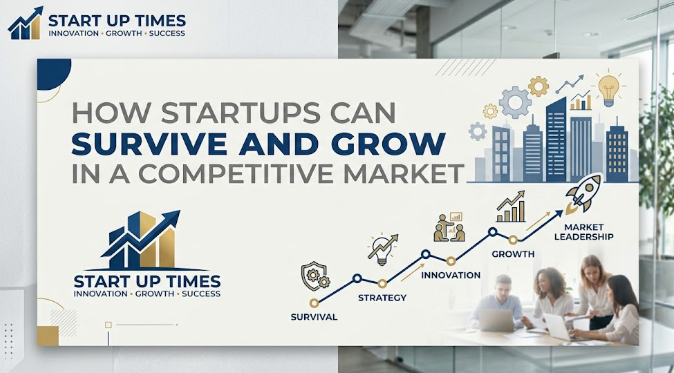
How Startups Can Survive and Grow in a Competitive Market
Startups face intense competition, limited resources, changing customer expectations, and constant market disruption. To survive and grow in a competitive market, startups need a clear value proposition, strong customer understanding, efficient operations, smart marketing, financial discipline, and the ability to adapt quickly. This article explores practical strategies startups can use to build a
Starting a business is challenging, but building a startup that can survive and grow in a competitive market is even more demanding.
Today, startups operate in an environment where customers have more choices, competitors can enter markets quickly, technology changes rapidly, and businesses are expected to deliver better experiences at competitive prices.
A great product alone may not be enough.
Startups also need to understand their customers, communicate their value clearly, manage their finances carefully, build a strong brand, and respond quickly to changes in the market.
For early-stage companies, the biggest challenge is often not simply attracting customers. It is creating a business model that can continue to work as the company grows.
So, how can startups survive and grow in a competitive market?
The answer involves combining customer-focused strategies, smart marketing, operational efficiency, innovation, and long-term planning.
Here are some practical strategies startups can use to build a sustainable business.
- Identify a Clear Market Need
Before trying to compete with established businesses, startups need to understand the problem they are solving.
Many startups fail to differentiate themselves because they enter a market without clearly identifying what customers actually need.
A strong startup begins with a specific problem.
Instead of asking, "What product can we sell?"
Founders should ask, "What problem are customers experiencing, and how can we solve it better?"
Market research can help startups understand customer pain points, purchasing behavior, existing alternatives, and gaps in the market.
Startups can use customer interviews, surveys, competitor research, social media discussions, reviews, and industry reports to gather insights.
The more clearly a startup understands the problem, the easier it becomes to develop a relevant product and communicate its value.
- Build a Strong Unique Value Proposition
In a competitive market, customers need a reason to choose one business over another.
This is where a strong unique value proposition becomes important.
A value proposition clearly explains what a company offers, who it serves, and why customers should consider it.
For example, saying "We provide marketing services" is too broad.
A more specific positioning could be "We help early-stage B2B startups generate qualified leads through content and LinkedIn marketing."
The second statement communicates the target audience, service, and outcome more clearly.
Startups should make sure their website, social media profiles, advertisements, sales presentations, and other marketing materials communicate a consistent value proposition.
- Know Your Target Customer
Trying to sell to everyone can make it difficult for a startup to build a strong market position.
Instead, startups should identify their ideal customer.
This can include factors such as age, location, income, industry, company size, interests, challenges, purchasing behavior, and goals.
For B2B startups, the ideal customer profile may include company size, industry, decision-maker role, budget, technology stack, and business needs.
Understanding the target audience helps startups create more relevant products and marketing campaigns.
It also allows businesses to spend limited marketing budgets more efficiently.
The better a startup understands its customers, the easier it becomes to communicate with them.
- Focus on Customer Experience
Acquiring customers is important, but retaining them can be equally important for sustainable growth.
Customers remember how a company makes them feel throughout their journey.
This includes the website experience, purchasing process, product quality, customer support, communication, and after-sales service.
Startups can improve customer experience by making processes simple and responding quickly to questions or complaints.
They can also collect customer feedback regularly.
Reviews, surveys, support conversations, and product feedback can reveal problems that may otherwise remain unnoticed.
A startup that listens to customers can identify opportunities to improve its product and build stronger relationships.
- Build a Strong Brand
Branding is not only about having an attractive logo.
A startup's brand includes its identity, messaging, values, visual style, tone of communication, customer experience, and reputation.
In a crowded market, strong branding can help a startup become more recognizable.
Consistency is important.
A startup should maintain consistent messaging across its website, LinkedIn page, Instagram account, advertisements, email campaigns, and other communication channels.
A strong brand can also help businesses build trust, particularly when customers are comparing an emerging startup with established competitors.
- Use Digital Marketing Strategically
Digital marketing gives startups access to customers without requiring the large advertising budgets that some established companies may have.
However, startups should avoid trying every marketing channel at the same time.
Instead, they should identify where their target audience spends time and focus their resources there.
Depending on the business, useful channels can include SEO, content marketing, social media marketing, email marketing, LinkedIn marketing, paid advertising, influencer marketing, and partnerships.
For example, a B2B startup may focus heavily on LinkedIn, SEO, email marketing, and industry partnerships.
A consumer-focused startup may find opportunities through Instagram, YouTube, influencer marketing, SEO, and paid social campaigns.
The right marketing mix depends on the target audience and business model.
- Invest in Content Marketing and SEO
Content marketing can help startups build visibility and credibility over time.
Instead of constantly promoting products, startups can create content that solves problems for their target audience.
For example, a CRM startup could publish articles about sales automation, CRM implementation, customer relationship management, lead generation, and sales productivity.
SEO can help this content reach people who are actively searching for related information.
Startups should focus on search intent rather than simply inserting keywords into articles.
Useful content should answer real questions, provide practical information, and offer original insights.
Over time, a well-planned SEO and content strategy can create a valuable source of organic visibility.
- Keep Customers at the Center of Innovation
Innovation does not always mean creating a completely new technology.
Sometimes, innovation means improving an existing solution.
Startups should continuously observe how customers use their products and identify areas for improvement.
Customer feedback can help businesses discover:
Product features that are missing
Problems with the user experience
Unnecessary steps in the customer journey
New use cases
Changing customer expectations
Potential new markets
This customer-driven approach can help startups improve their products while reducing the risk of building features that customers do not actually need.
- Use Technology and AI Efficiently
Technology can help startups operate more efficiently with limited resources.
AI and automation can assist with tasks such as customer support, content research, data analysis, marketing automation, lead management, reporting, and administrative work.
However, startups should not adopt technology simply because it is trending.
Every tool should solve a specific business problem.
For example, a startup might use a CRM to organize leads, marketing automation to manage email campaigns, or AI tools to analyze customer feedback.
The objective should be to save time, reduce repetitive work, improve decision-making, and allow employees to focus on higher-value activities.
- Manage Cash Flow Carefully
Financial discipline is one of the most important factors for startup survival.
A startup can have a strong product and growing customer base but still face difficulties if it does not manage cash flow properly.
Founders should closely monitor revenue, expenses, customer acquisition costs, salaries, technology costs, marketing spending, and other operational expenses.
It is also useful to distinguish between essential and non-essential spending.
Before making a major expense, startups should ask whether it directly contributes to product development, customer acquisition, retention, revenue, or operational efficiency.
Careful financial management can give startups more flexibility during uncertain periods.
- Build a Lean and Adaptable Team
Startups often operate with smaller teams than established companies.
This means every team member can have a significant impact on the business.
Hiring should therefore focus not only on technical skills but also on adaptability, communication, problem-solving, and ownership.
Startups also need clear responsibilities.
When employees understand their roles and priorities, teams can move faster and avoid unnecessary duplication of work.
As the business grows, founders can gradually build specialized teams for areas such as marketing, sales, product development, finance, and customer success.
- Monitor Competitors Without Copying Them
Competitor research is important, but startups should avoid becoming obsessed with copying competitors.
Instead, businesses should study what competitors are doing and identify opportunities to differentiate themselves.
Startups can analyze competitor pricing, product features, customer reviews, content strategy, social media activity, positioning, and customer experience.
Negative customer reviews can be particularly useful because they can reveal problems that a startup may be able to solve.
The objective is not to become another version of an existing competitor.
The objective is to understand the market and identify where the startup can create additional value.
- Build Multiple Customer Acquisition Channels
Depending on a single customer acquisition channel can create risks for a growing startup.
For example, if a company depends entirely on one advertising platform, an increase in advertising costs or a change in platform policies could significantly affect its growth.
Startups can gradually diversify their acquisition strategy through SEO, referrals, partnerships, social media, email marketing, communities, events, content marketing, and paid advertising.
Diversification does not mean using every channel immediately.
It means building additional channels as the business gains resources and knowledge.
- Track the Right Business Metrics
Growth should be measured using meaningful metrics rather than vanity numbers.
A startup may have thousands of social media followers but relatively few customers.
Important metrics can include customer acquisition cost, customer lifetime value, conversion rate, retention rate, monthly recurring revenue, revenue growth, churn rate, and return on marketing investment.
The specific metrics will depend on the startup's business model.
Tracking the right numbers allows founders to understand what is working and where resources need to be changed.
Data can turn business decisions from assumptions into measurable experiments.
- Adapt Quickly to Market Changes
Markets can change because of technology, customer preferences, regulations, economic conditions, new competitors, or changes in consumer behavior.
Startups often have an advantage in their ability to experiment and change direction quickly.
However, adaptability does not mean changing the business strategy every few weeks.
Instead, startups should regularly review their assumptions and use customer and market data to make informed adjustments.
Small experiments can help businesses test new products, pricing models, marketing channels, or customer segments before making larger investments.
This approach can reduce unnecessary risk while allowing startups to discover new opportunities.
- Focus on Sustainable Growth
Rapid growth can look attractive, but growth without a sustainable business model can create significant operational and financial pressure.
Startups should consider whether their processes, team, technology, customer support, and finances can handle increasing demand.
Sustainable growth means building systems that can support the business as it expands.
This may involve improving internal processes, documenting workflows, investing in technology, developing employees, and strengthening customer support.
The objective is not simply to grow quickly but to create a company that can continue operating effectively as its customer base increases.
Common Mistakes Startups Should Avoid
Startups can face several common challenges while trying to compete.
One mistake is trying to serve everyone instead of defining a clear target market.
Another is spending heavily on marketing before understanding whether the product meets customer needs.
Some startups also focus too much on competitors and lose sight of their own customers.
Ignoring customer feedback can make it difficult to identify product problems.
Poor cash-flow management can also create unnecessary pressure.
Finally, relying entirely on one marketing channel or one major customer can make a business vulnerable to sudden changes.
Recognizing these risks early can help founders make better-informed decisions.
Conclusion
Surviving and growing in a competitive market requires more than having a good business idea.
Startups need to understand their customers, solve meaningful problems, communicate a clear value proposition, build a recognizable brand, use digital marketing strategically, manage finances carefully, and continuously improve their products.
Technology and AI can help startups operate more efficiently, but sustainable growth still depends on understanding people and delivering real value.
The most important focus for a startup should be building a business that customers find useful and are willing to continue supporting.
By combining customer insight, innovation, financial discipline, effective marketing, and adaptability, startups can build a stronger foundation for long-term growth in an increasingly competitive market.


Leave a comment
Your email address will not be published. Required fields are marked *
Add a newsletter to your widget area.
Top Stories