
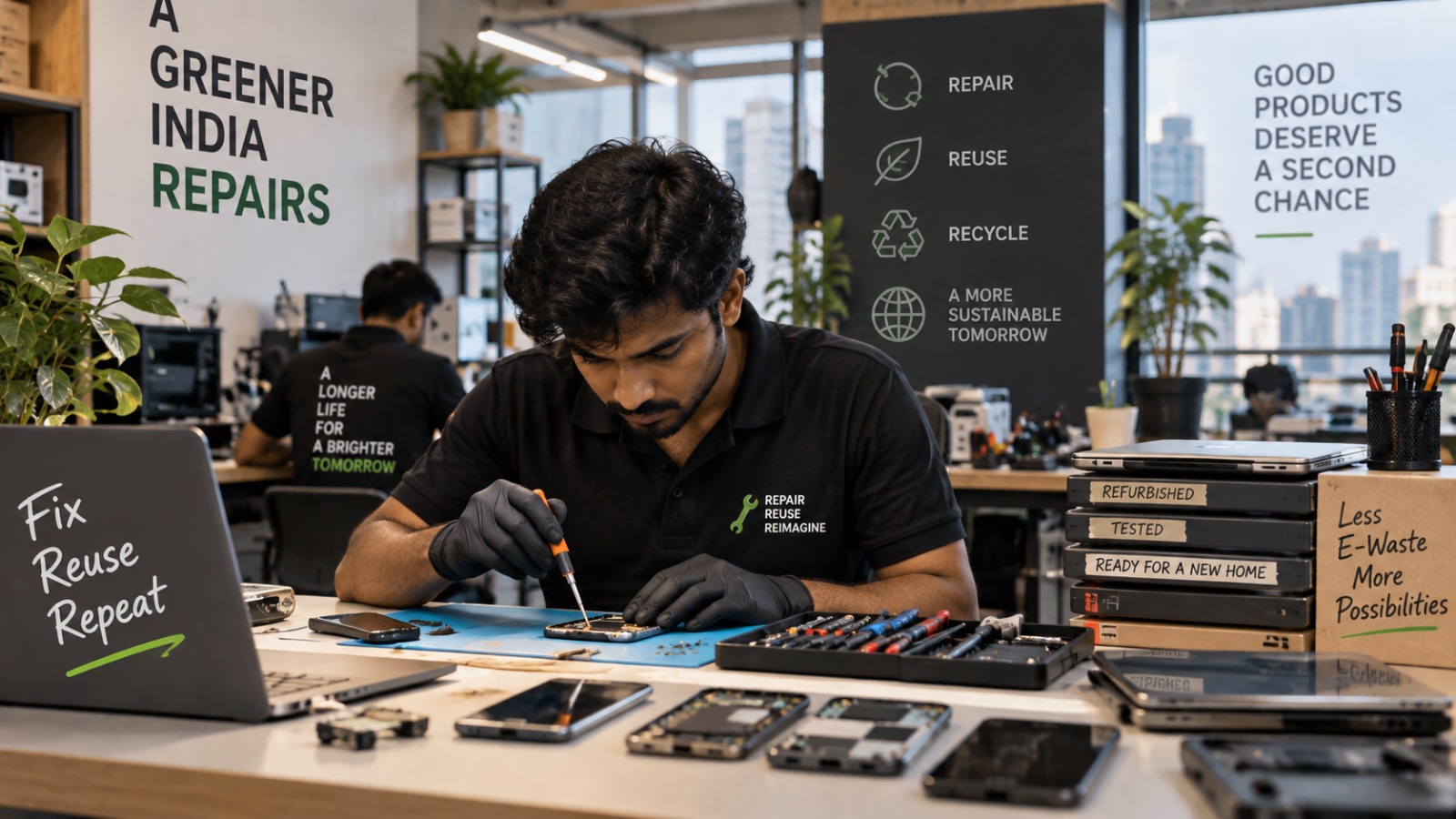
India’s Repair Economy: Why Fixing Products Could Become the Next Startup Opportunity
India’s growing consumption of electronics, appliances and everyday products is creating a new opportunity for repair, refurbishment and reuse startups.
India’s consumption story has long been associated with buying more—new smartphones, laptops, appliances, vehicles and other products entering homes every year. But another market is quietly developing alongside this consumption boom: the market for keeping those products in use for longer. Repair, refurbishment, reuse and maintenance are increasingly becoming part of a broader economic opportunity, and this could create space for a new generation of Indian startups.
For years, repair has largely been viewed as a local service rather than a technology or startup industry. A customer with a broken phone visits a neighbourhood repair shop; a household appliance stops working and a technician is called; an old laptop is repaired or sold to another user. These activities happen every day across India, but much of the sector remains fragmented, informal and difficult to discover digitally. The opportunity for startups lies in organising this fragmented market and making repair more convenient, transparent and trustworthy.
The shift is also being supported by growing attention to the idea of a “Right to Repair.” India’s Right to Repair initiative aims to make repair-related information, warranty details, spare-parts information and service networks more accessible to consumers. The initiative covers sectors including mobile and electronic devices, consumer durables, automobiles and farming equipment. This signals a broader change in the way product ownership is being viewed: buying a product does not necessarily have to mean replacing it when one component stops working.
For consumers, the economics of repair can be straightforward. A device that has developed a battery problem, damaged display or faulty component may still have significant useful life left. Replacing the entire product can be expensive, while a reliable repair or replacement of a specific component can extend its working life. The challenge is that consumers often have limited information about repair costs, spare-part availability, technician quality and whether a product is worth repairing at all. This information gap is exactly where startups can build new services.
One opportunity is the development of digital repair marketplaces. Instead of searching through multiple local shops or relying entirely on recommendations, customers could use a platform to describe a problem, receive an estimated repair range, compare service providers, schedule a pickup and track the repair. Such a model could bring greater visibility to independent repair professionals while giving consumers a more structured experience. The business does not necessarily have to own every repair centre; it could operate as the technology and coordination layer connecting customers, technicians and spare-parts suppliers.
Another emerging opportunity is refurbishment. A product does not always have to be returned to its original owner to remain economically useful. Smartphones, laptops, tablets, appliances and other devices can potentially be tested, repaired, graded and resold. A startup could build a business around collecting used products, diagnosing their condition, replacing necessary components, certifying functionality and selling them with appropriate warranties. This creates a bridge between the traditional second-hand market and the more organised world of consumer technology.
Trust, however, becomes particularly important in refurbishment. Consumers need to know whether a device has actually been tested, whether its major components have been replaced, how long it is expected to function and what happens if it fails. This creates room for startups to develop standardised grading systems, diagnostic software, digital inspection reports and limited warranties. Instead of simply selling a “used phone” or “refurbished laptop,” businesses can potentially sell a measurable level of reliability.
Spare parts represent another important part of the repair economy. A repair business can only operate efficiently when the required components are available at reasonable prices and within a reasonable time. India’s Right to Repair initiative specifically focuses on improving access to information around spare parts, repair services and other product-related details. This creates potential opportunities for startups that can build better spare-parts discovery, inventory and distribution systems.
Technology could make this ecosystem even more efficient. Artificial intelligence and computer vision could eventually assist technicians in identifying common faults from images or diagnostic information. A customer could upload a photograph or describe a problem through an app and receive an initial assessment before visiting a technician. Software could help repair businesses manage inventory, customer histories, quotations and warranties. Data from thousands of repairs could also help businesses understand which components fail most frequently and which products are more economical to repair.
The opportunity extends beyond electronics. The Right to Repair framework covers categories ranging from tractors, harvesters and water-pump motors to refrigerators, washing machines, air conditioners, passenger vehicles and electric vehicles. That makes the repair economy much larger than the familiar image of a mobile-phone repair shop. It potentially includes agricultural equipment servicing, appliance maintenance, vehicle components, EV servicing, industrial equipment and specialised refurbishment.
Electric vehicles could create another interesting layer of this ecosystem. As EV adoption grows, businesses will need capabilities around diagnostics, component servicing, battery health assessment and eventually the reuse and second-life management of batteries. Not every business in this space needs to manufacture vehicles or batteries. Some could build specialised services around maintaining the products already on the road.
There is also a strong connection between repair and the circular economy. A traditional linear model can be simplified as “make, use and dispose.” A circular approach attempts to keep products and materials useful for longer through maintenance, repair, reuse, refurbishment and recycling. Repair sits much earlier in this cycle than recycling because the product itself can continue providing value rather than immediately becoming waste. India’s Right to Repair initiative links longer product life, reuse, upgrading and repair with broader circular-economy objectives.
For startups, this creates an interesting distinction between solving a waste problem and building a business. Sustainability alone does not automatically create a sustainable company. A repair startup still needs to answer basic commercial questions: Who is the customer? How much will they pay? How quickly can the service be delivered? How can quality be maintained? What happens when a product is too expensive to repair? How can technicians be trained and verified? How can spare parts be sourced reliably? The companies that solve these operational problems could have an advantage over businesses that focus only on the environmental message.
The informal nature of much of India’s repair market is both a challenge and an opportunity. Local technicians often possess years of practical knowledge, but their businesses may have limited digital presence, standardised pricing or formal customer-management systems. Startups could provide these businesses with tools rather than trying to replace them. A technician could remain an independent service provider while using a platform for customer acquisition, payments, inventory, scheduling and warranty management.
This could also create employment opportunities. As more products become technologically sophisticated, technicians need to understand electronics, software diagnostics, batteries and specialised components. A stronger repair ecosystem could therefore generate demand not only for traditional technicians but also for digitally trained repair professionals. The broader Right to Repair discussion has also highlighted employment opportunities and support for local repairers.
However, the repair economy will not grow simply because consumers want cheaper alternatives. Product design itself matters. If devices are difficult to open, components are unavailable, software support ends quickly or repairs cost almost as much as replacement, consumers may still choose a new product. This is why repairability has become an important part of the conversation. Discussions around repairability have explored factors such as spare-part availability, access to tools, software updates and how easily products can be repaired.
Manufacturers will also remain an important part of the ecosystem. A future repair market does not necessarily have to be a battle between manufacturers and independent repair businesses. There could be opportunities for manufacturers to provide authorised repair networks, spare parts, diagnostic tools and refurbishment programmes while independent businesses serve customers outside traditional service networks.
For entrepreneurs, perhaps the most interesting part of the opportunity is that the repair economy does not require inventing an entirely new consumer behaviour. Indians have been repairing and reusing products for decades. What is changing is the possibility of organising this existing behaviour through technology, standardisation and better customer experiences. The startup opportunity may therefore not be to convince people that repair exists, but to make repair easier, more predictable and more trustworthy.
India’s next wave of repair startups could look very different from the traditional neighbourhood repair shop. Some may build marketplaces connecting customers and technicians. Others may specialise in refurbishment, diagnostics, spare-parts logistics, appliance servicing, EV components or repair-management software. Some could focus on enterprise customers such as offices, schools, hospitals and retailers that manage hundreds or thousands of devices.
The larger question is whether India can transform repair from a fragmented necessity into a structured industry. With growing consumer demand for value, increasing attention to product longevity, digital adoption and policy interest in repairability, the foundations for such an ecosystem are emerging. The opportunity is not simply about fixing broken products. It is about extending the economic life of products that still have value—and building businesses around the idea that sometimes the next big opportunity is not selling something new, but finding a smarter way to keep something useful in use.
For more insights into India’s evolving startup ecosystem, emerging industries and business trends, visit Startup Times and stay updated with the latest Industry Insights.


Leave a comment
Your email address will not be published. Required fields are marked *
Add a newsletter to your widget area.
Top Stories