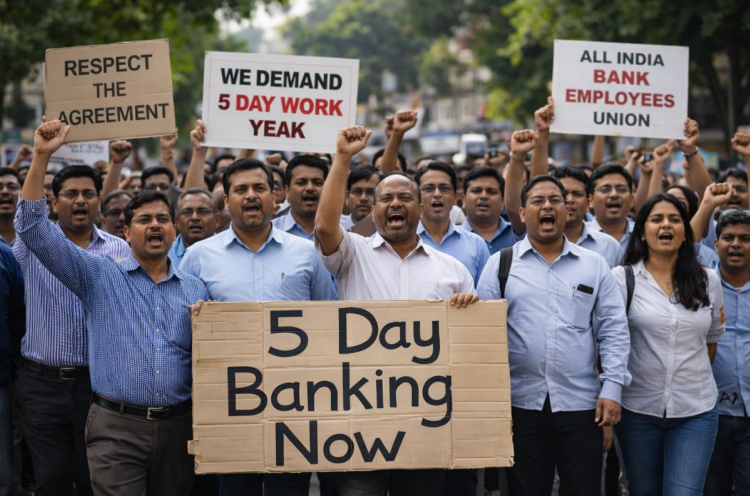
India’s public sector banking system witnessed a sweeping shutdown on Tuesday as nearly eight lakh employees participated in a nationwide strike demanding a long-delayed transition to a five-day work week. The strike, led by the United Forum of Bank Unions (UFBU), effectively paralysed physical banking operations across major states just a day after Republic Day, creating a four-day service disruption that reverberated across households, small businesses and financial markets.
Branches of leading nationalised banks remained shut, cheque clearances slowed to a trickle, and end-of-month transactions were forced into delays, drawing attention to a labour demand that has lingered unresolved for nearly two years.
The impact was immediate. Cheque clearances slowed, loan disbursements were stalled, and cash-based transactions were deferred across several states, particularly in Odisha, Uttar Pradesh, Punjab, Tamil Nadu, and Maharashtra. Coming directly after the Republic Day weekend, the strike created a four-day service gap in many regions, escalating customer anxiety and business-level disruptions.
Background of the Event
The roots of the agitation lie in a series of bipartite agreements signed between the bank unions and the Indian Banks’ Association (IBA), including a key settlement in March 2024 which recommended declaring all Saturdays as holidays. In exchange, weekday working hours were to be extended by up to forty minutes to ensure that the total weekly operational time remained intact.
The proposal had been widely seen as a natural progression in India's rapidly digitising financial sector where digital transactions now dominate volume and value.
Yet, unlike institutions such as the Reserve Bank of India, insurance corporations, stock exchanges and several central government departments that already operate five days a week, public sector banks have continued with a staggered six-day model.
Union leaders argue that the workload has only intensified with expanding customer bases, compliance requirements and audit cycles, creating a mismatch between the demands of modern banking and the hours employees are required to maintain. The unions maintain that they have exhausted negotiation channels and that the absence of clear government action has pushed them toward this nationwide mobilisation.
Scale of Disruption
The strike on January 27 created one of the most extensive disruptions in recent years. Cities such as Lucknow, Trichy, Bhubaneswar, Chandigarh, Pune, Chennai and Mumbai experienced a near-total halt to branch services.
Some of the most notable impacts included:
In Lucknow, operations across more than 900 public sector branches were stalled, affecting an estimated ₹2,500 crore worth of transactions in a single day.
In Odisha, where a state-wide bandh had already affected commercial activity the previous day, banking disruptions compounded the challenges for traders and MSMEs.
In Tamil Nadu, thousands of employees participated in demonstrations outside major branch complexes, forcing customers entirely toward digital banking routes.
Urban hubs across Maharashtra and Delhi saw long queues at ATMs earlier in the day, although cash replenishment teams later stabilised the flow.
The timing—coming immediately after the Republic Day holiday and Sunday closure—amplified the cumulative service outage, leaving many customers with no branch access for several consecutive days.
Emphasis on Fairness and Well-Being
Union representatives reiterated that the strike was driven by accumulated frustration rather than confrontation with customers. Senior UFBU officials stated that the five-day week is essential not merely as a convenience but as a structural reform that aligns Indian banking with global standards.
They emphasised that employees are managing one of the world’s largest retail banking populations during a period of exceptional regulatory change and digital acceleration, increasing mental and physical strain on staff.
One union communiqué captured the sentiment clearly: “A rested banker serves the nation better.”
Employees participating in protests across multiple states echoed similar concerns, pointing to extended working hours, continuous customer flow, year-end pressure cycles and increased documentation responsibilities. Many referenced internal surveys showing high burnout levels, especially among frontline clerical staff.
The unions have also indicated that if the government does not respond promptly, they are prepared to escalate the agitation into longer-duration strikes or coordinated national marches.
Service Impact
Customers across metros and small towns alike reported delays in cheque clearances, stalled loan processing and postponed branch transactions. While digital systems such as UPI, net banking and mobile applications continued to operate seamlessly, several essential services—particularly those requiring physical verification, signature checks or KYC documents—were completely unavailable.
ATMs remained functional but experienced slower restocking in some regions due to staff shortages. MSMEs depending on cheque-based settlements at month-end faced liquidity strains, and many cooperative societies reported delays in disbursing routine payments.
Though banks deployed minimal staff to oversee backend systems, the absence of full staffing restricted their ability to mitigate service gaps. The repeated closures over the long weekend created a sense of uncertainty among businesses that rely on predictable financial processing cycles.
The Road Ahead
The Department of Financial Services held consultations on January 26, but no formal breakthrough emerged before the strike commenced. The government faces pressure to consider the financial and operational implications of designating all Saturdays as holidays, particularly for rural and semi-urban regions where physical branches remain essential.
However, the unions argue that digital penetration has grown significantly enough for weekend closures to be manageable with proper planning.
The next steps remain uncertain. Union leaders expect the government to issue a notification before the upcoming Budget Session, failing which they may announce extended or multi-day strikes. The banking sector, still navigating credit expansion targets and post-pandemic financial consolidation, now faces the additional challenge of stabilising morale within one of its most important workforces.
Conclusion
The January 27 strike stands as one of the most forceful labour actions in recent years, bringing the longstanding demand for a five-day banking week back into national focus. With operational continuity, employee welfare and customer convenience intersecting sharply, the government’s decisions in the coming weeks will shape not only labour relations within the banking sector but also the broader narrative of workplace reforms across India’s public institutions.