The Rise of Invisible Startups: The Companies You Never See but Use Every Day
From payments and cybersecurity to communication and digital infrastructure, invisible startups are quietly powering the digital products we use every day.
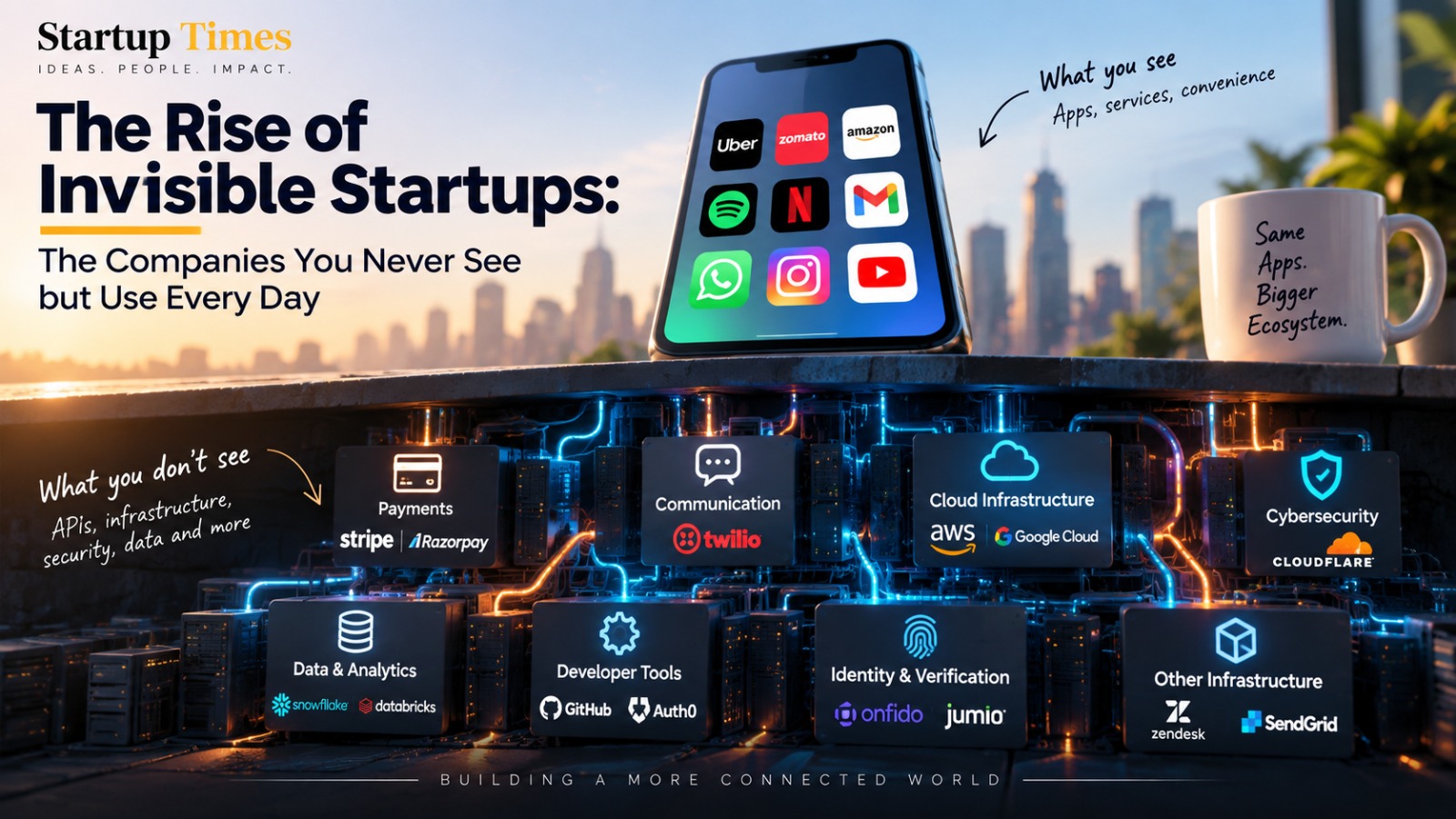
When we think about startups, we usually think about brands we can see. We picture an app on our phone, a website we visit, a food delivery platform, a shopping marketplace or perhaps a new fintech company whose advertisements appear on our social media feeds. Startup success is often associated with visibility: millions of downloads, large social media followings, recognizable logos and customers who know exactly which company they are using. But beneath this visible layer of the digital economy is another world of companies that most people rarely notice. These are the startups building the infrastructure that makes other digital products possible. You may never download their applications, visit their websites or recognize their names, but their technology could be working every time you make a payment, receive an authentication message, open a website or interact with an online service. These are the invisible startups.
The idea is relatively simple. Instead of building a product that consumers interact with directly, an invisible startup often builds technology that other businesses use behind the scenes. Its product could be an API, a payment system, cybersecurity infrastructure, cloud technology, communication platform, identity-verification service, data infrastructure or another specialized technology. The end customer may never know which company is providing that service. What they experience is simply a website that loads, a payment that succeeds or a message that arrives. The technology underneath, however, may involve several different companies working together.
Consider something as ordinary as buying a product online. From a customer's perspective, the process appears straightforward. You select a product, enter your details, choose a payment method and click the payment button. Within seconds, you receive a confirmation. But behind that simple experience is a much larger technological process. Payment information needs to be processed securely, transactions need to communicate with financial institutions, suspicious activity may need to be detected, the payment needs to be confirmed and the merchant needs to receive information about whether the transaction succeeded. The customer sees a button. Behind that button can be an entire infrastructure ecosystem.
This is where companies such as Stripe and Razorpay become interesting examples. Stripe has built financial infrastructure that businesses can integrate into their websites and applications instead of developing an entire payment system from scratch. Razorpay has similarly built payment and financial infrastructure for businesses in India. For the consumer, the experience may simply look like a payment screen. The infrastructure provider may remain almost completely invisible. Yet without that infrastructure, the digital transaction may not happen in the same way.
The same pattern can be seen outside payments. Think about the last time you received a verification message, appointment reminder or delivery notification. You probably focused on the company whose name appeared in the message, not on the technology that delivered it. Communication platforms such as Twilio allow businesses to integrate messaging, voice and other communication capabilities into their own applications. The customer sees the message from the company they are interacting with. The infrastructure provider remains in the background.
The internet itself provides even more examples. When a website loads quickly or protects itself from malicious traffic, most users do not stop to ask what is happening underneath. Companies such as Cloudflare provide technologies related to web performance, security and networking that operate between users and online services. Again, the consumer generally interacts with the website, not the infrastructure company supporting it. This creates an interesting distinction between the product people see and the technology that makes the product possible.
This distinction is becoming increasingly important because modern businesses no longer need to build every part of their technology themselves. A startup launching an online marketplace does not necessarily need to develop its own payment infrastructure. A healthcare platform does not necessarily need to create an entire communication system. A software company does not necessarily need to build every element of its cloud infrastructure. Instead, businesses can connect specialized services through APIs and other technologies.
This has fundamentally changed the way startups can be built.
In the past, creating a technology company could require enormous amounts of infrastructure, specialized engineering and capital. Today, entrepreneurs can combine existing technologies to create new products much faster. One company can provide payments, another can provide authentication, another can provide cloud infrastructure and another can provide communication tools. The startup building the final product can focus on solving the specific problem it understands best.
This has created what can almost be described as a digital supply chain.
A customer may see one application, but behind that application could be dozens of different technology providers. One company might handle payments. Another might provide identity verification. Another might provide cloud hosting. Another might provide analytics. Another might protect the application from cyberattacks. Another might provide communication tools. The final product feels like a single experience to the customer, but it is actually the result of multiple layers of technology working together.
And that creates a different kind of startup opportunity.
Consumer startups often compete for attention. They want people to download their app, remember their brand and return regularly. Infrastructure startups can operate differently. Their goal is often to become deeply integrated into another company's operations. Once a business builds an important part of its product around a particular infrastructure provider, changing that provider may require significant time, engineering work and testing.
This does not mean that infrastructure companies are automatically successful or immune to competition. They still need to offer competitive pricing, reliability, security, performance and customer support. But the relationship with their customers can be different from the relationship between a consumer and an ordinary mobile application. The infrastructure becomes part of the customer's technology stack.
That also means that reliability becomes a product feature.
Imagine opening an application and discovering that the payment system is not working. The customer may not know which infrastructure provider is responsible. They simply see an error and blame the application. From the outside, the infrastructure company may appear invisible. From the perspective of the business depending on it, however, reliability can be critical.
This is one of the strange characteristics of invisible startups: when they work perfectly, nobody notices them.
A customer does not usually think about the payment infrastructure when a transaction succeeds. They do not think about cloud infrastructure when a website loads normally. They do not think about communication infrastructure when a verification code arrives instantly. They do not think about cybersecurity infrastructure when a malicious request is blocked.
But when something fails, the hidden infrastructure suddenly becomes very important.
The rise of artificial intelligence could make this invisible layer even larger.
The AI products that consumers interact with are only one part of the emerging AI ecosystem. Behind an AI application can be model providers, cloud computing infrastructure, data platforms, vector databases, security systems, authentication services, monitoring tools and specialized APIs. As businesses begin deploying AI agents and AI-powered applications, they will need infrastructure that allows these systems to communicate with databases, access information, make payments, authenticate users and perform actions.
This could create an entirely new generation of invisible companies.
The next major startup may not be the chatbot or application that millions of people download. It could be the company providing the technology that allows thousands of those applications to function.
That possibility changes the question entrepreneurs should ask when looking for startup opportunities. Instead of asking only, “What product can I build for consumers?”, entrepreneurs can also ask, “What problem will thousands of businesses have that I can solve for them?”
That shift from consumer products to business infrastructure can reveal opportunities that are easy to overlook.
India is particularly interesting in this context. The country's rapid adoption of digital payments, smartphones, cloud services and online commerce has created demand for infrastructure that can support millions of digital interactions. The visible layer may consist of familiar consumer applications, but underneath it is a growing ecosystem of companies working on payments, identity, logistics, cybersecurity, cloud computing, developer tools and financial technology.
The opportunity is therefore not limited to building the next famous consumer brand. There is also an opportunity to build the technology that helps those brands operate.
This is why the term “invisible startup” is useful. It does not mean the company is insignificant. In many cases, the opposite can be true. It simply means that the company's contribution is hidden from the final consumer.
The digital economy is increasingly becoming a layered ecosystem. At the top are the products people recognize: the apps, websites and platforms they interact with every day. Underneath are APIs, payment systems, databases, cloud infrastructure, security tools, communication networks and developer platforms. Each layer depends on the one beneath it.
As technology becomes more complex, the companies building these underlying layers may become increasingly important.
The future of startups, therefore, may not only belong to the companies that consumers know by name. It may also belong to the companies quietly building the systems everyone else depends on.
You may never see their logo.
You may never download their app.
You may never even realize that their technology is being used.
But the next time a payment goes through in seconds, a website loads instantly, a verification code arrives on your phone or an AI application responds to your request, there may be an invisible startup somewhere behind the screen making it happen.
The most important company in the room may not always be the one everyone can see. Sometimes, it is the one making everything else work.
For more stories, insights, and deep dives into the startups and technologies shaping tomorrow, visit Startup Times.

Leave a comment
Your email address will not be published. Required fields are marked *
Add a newsletter to your widget area.
Top Stories