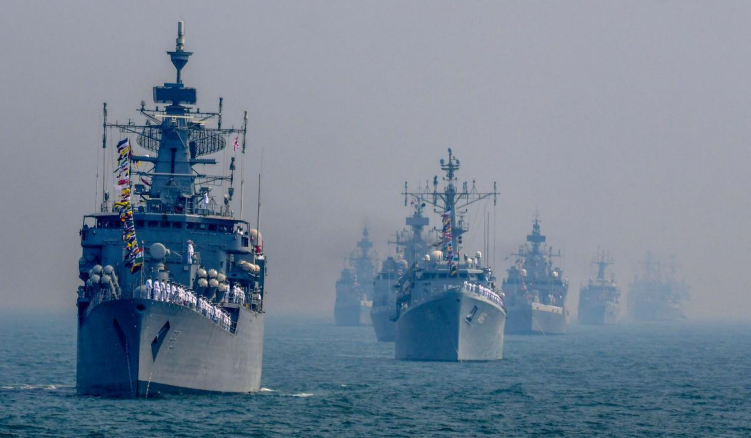
From 15 to 21 February 2026, Visakhapatnam is hosting one of the largest multinational naval assemblies in recent years, bringing together 71 warships and 50 aircraft from approximately 70 countries for the International Fleet Review (IFR) 2026, the MILAN 2026 multilateral naval exercise, and the Indian Ocean Naval Symposium (IONS) Conclave.
The convergence reflects India’s growing stature as a maritime power and its increasing role in shaping cooperative security frameworks in the Indo-Pacific.
The scale of participation underscores broad international engagement across continents, with naval assets arriving from Asia, Europe, Africa, the Americas and Oceania. Indian naval authorities coordinated extensive harbour operations, aerial movements and diplomatic protocols to accommodate this unprecedented concentration of global maritime forces, positioning Visakhapatnam as a focal point of international naval diplomacy.
International Fleet Review
The International Fleet Review serves as the ceremonial centrepiece of the gathering, bringing together naval commanders, defence representatives and diplomatic officials to witness a coordinated maritime display.
Participating fleets include destroyers, frigates, corvettes, offshore patrol vessels and auxiliary support ships, alongside maritime patrol aircraft and helicopters. The diversity of platforms reflects the multifaceted nature of contemporary naval operations.
Fleet reviews historically combine symbolism with strategic messaging. In this instance, the assembly reinforces shared commitments to freedom of navigation, respect for international maritime law and cooperative engagement in contested waters.
Senior naval representatives emphasised that the display is not a demonstration of rivalry, but a visible affirmation of stability and partnership among nations that rely on open sea lanes for trade and energy security.
MILAN 2026: Enhancing Operational Interoperability
Alongside ceremonial events, MILAN 2026 focuses on operational coordination and tactical exercises. Originally conceived as a modest multilateral engagement, MILAN has evolved into a major naval exercise attracting expanded global participation.
The present edition reflects the growing recognition that maritime security challenges require collaborative responses.
Participating navies are engaged in coordinated manoeuvres, communication drills, maritime interdiction simulations and search-and-rescue operations. Analysts note that such exercises strengthen interoperability among diverse fleets operating different technologies and command systems.
The ability to respond collectively to piracy, humanitarian emergencies and maritime terrorism depends on precisely this kind of practical coordination.
Command-level exchanges and professional discussions form an integral part of the exercise. Naval officers are sharing perspectives on maritime domain awareness, technological advancements and crisis-response frameworks, reinforcing professional networks that extend beyond the duration of the event.
Indian Ocean Naval Symposium Policy Coordination
The Indian Ocean Naval Symposium component of the gathering provides a platform for strategic dialogue among senior naval leaders.
Discussions are centred on cooperative mechanisms to address shared maritime challenges, including illegal fishing, trafficking, environmental degradation and disaster response.
Participants have emphasised the need for transparent communication channels and joint capacity-building initiatives.
The Indo-Pacific remains one of the world’s most economically significant regions, carrying a substantial share of global trade through its sea routes. Ensuring the security and sustainability of these waters requires both military preparedness and policy-level coordination.
Officials highlighted that maritime security increasingly intersects with climate resilience and humanitarian considerations. Naval forces often serve as first responders in disaster-stricken coastal regions, making multilateral planning essential.
The symposium thus extends the scope of the convergence beyond traditional defence concerns into broader regional cooperation.
Strategic Implications for the Indo-Pacific
The assembly of 71 warships and 50 aircraft carries clear strategic implications.
Analysts interpret the convergence as a demonstration of collective commitment to maintaining a rules-based maritime order in the Indo-Pacific. In an era of shifting geopolitical alignments and emerging security tensions, visible cooperation among diverse naval powers reinforces confidence in multilateral engagement.
India’s role as host enhances its diplomatic profile. By convening a wide array of nations under a unified maritime framework, India strengthens bilateral relationships and deepens defence partnerships.
The event reflects India’s broader maritime vision that emphasises inclusivity, transparency and respect for international norms.
Beyond defence considerations, the convergence also highlights the economic dimension of maritime security. Secure sea lanes underpin global commerce, and disruptions in shipping routes can have far-reaching economic consequences.
Cooperative naval frameworks therefore contribute directly to economic stability.
Local Impact and Institutional Capacity
For Visakhapatnam, the gathering represents both a logistical challenge and an opportunity.
The city’s port infrastructure and naval facilities have been operating at heightened capacity to manage the influx of ships, aircraft and delegations. Hospitality, transportation and ancillary services have experienced increased activity during the week-long events.
Local authorities coordinated security arrangements and civic management initiatives to ensure smooth operations.
The successful hosting of such a large-scale international assembly reinforces Visakhapatnam’s standing as a strategic maritime hub on India’s eastern coast.
The ability to organise and manage an event of this magnitude reflects institutional preparedness within the Indian Navy and associated agencies.
Coordinating multinational participation requires diplomatic precision, operational planning and infrastructural resilience.
Conclusion
The convergence in Visakhapatnam represents more than a ceremonial spectacle. It illustrates evolving maritime realities in which collaboration is essential to navigate shared security challenges.
By combining the International Fleet Review, MILAN 2026 and the Indian Ocean Naval Symposium within a cohesive framework, India has projected both capability and commitment.
In a world where maritime routes remain central to trade, energy flows and geopolitical strategy, cooperative naval engagement serves as a stabilising force.
The participation of around 70 countries signals widespread recognition that maritime security cannot be pursued in isolation.
As fleets depart and exercises conclude, the enduring outcome of this convergence will lie in strengthened partnerships, enhanced interoperability and reaffirmed dedication to safeguarding international waters.
Visakhapatnam’s hosting of this historic gathering underscores the continuing importance of naval diplomacy in shaping regional and global stability.