
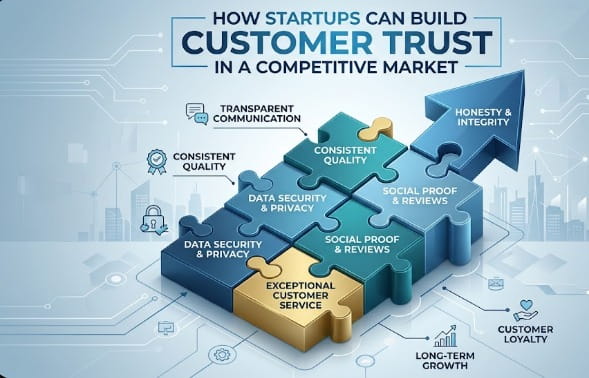
How Startups Can Build Customer Trust in a Competitive Market ?
Discover how startups can build customer trust through transparency, consistent service, social proof, data security, customer support, and authentic communication.
Introduction
For startups, attracting customers is only the first step. The bigger challenge is convincing those customers to stay, purchase again, recommend the brand, and eventually become loyal supporters.
In a competitive market, customers have more choices than ever. They can compare prices, read reviews, check social media profiles, explore competitors, and research a company before making a purchase. This makes customer trust one of the most important factors influencing business growth.
Established companies often have years of reputation behind them. Startups, on the other hand, have to build credibility from the ground up. A strong product is important, but customers also want to know whether a company is reliable, transparent, responsive, and genuinely focused on solving their problems.
For startups, building customer trust is therefore not a one-time marketing activity. It is an ongoing process that influences customer acquisition, retention, brand reputation, and long-term growth.
Here are some practical ways startups can build customer trust in a competitive market.
1. Be Transparent About Your Product or Service
Transparency is one of the simplest ways for startups to establish credibility. Customers should clearly understand what they are buying, how the product works, what it costs, and what they can realistically expect from it. Startups should avoid making exaggerated claims simply to increase conversions.
For example, if a software startup offers an AI-powered tool, its website should clearly explain its features, limitations, pricing, and terms of use. Similarly, an e-commerce brand should provide accurate information about materials, delivery timelines, returns, and product availability.
Being transparent may sometimes mean admitting limitations. However, honest communication can help create realistic expectations and reduce disappointment later.
Clear information builds confidence, while exaggerated promises can damage credibility.
2. Deliver a Consistent Customer Experience
Trust is built through repeated experiences. A startup may attract a customer through an impressive advertisement, but the actual customer experience determines whether that trust continues.
Everything from website navigation and payment processes to delivery, onboarding, customer support, and after-sales service contributes to the overall brand experience.
Startups should aim to make every customer interaction consistent. The messaging on social media should not contradict the information on the website. Sales representatives should provide accurate information, while customer support should follow the same service standards.
Consistency signals reliability.
When customers know what to expect from a company, they are more likely to feel comfortable purchasing from it again.
3. Use Customer Reviews and Testimonials
Social proof can play an important role in building trust.
Potential customers often want to know how other people experienced a product or service before making a decision. Reviews, ratings, testimonials, case studies, and customer stories can provide this reassurance.
Startups can feature genuine customer feedback on their website, social media platforms, product pages, and marketing materials.
However, authenticity matters.
Companies should avoid creating fake reviews or misleading testimonials. If a customer provides permission, startups can share their experience along with relevant details about the problem the product solved.
For B2B startups, case studies can be particularly useful. A case study can explain the customer’s initial challenge, the solution provided by the startup, and the results achieved.
Instead of simply saying “customers love our product,” showing real experiences gives potential customers more context.
4. Build a Strong and Authentic Online Presence
Before interacting with a startup, many customers will research it online.
A startup’s website, LinkedIn page, Instagram profile, Google Business presence, and other digital channels can influence how credible the business appears.
A professional online presence does not necessarily require an expensive design. What matters is that the information is accurate, updated, and consistent.
Startups should clearly communicate:
* What the company does
* Who it serves
* What problem it solves
* How customers can contact it
* What makes its offering different
* Relevant products or services
* Customer reviews or success stories
Content can also help startups demonstrate expertise. Educational blogs, founder insights, industry research, tutorials, and useful social media posts can show that a company understands its market rather than simply trying to sell.
5. Protect Customer Data and Privacy
Data security has become an important part of customer trust, particularly for technology companies, e-commerce businesses, fintech startups, health platforms, and SaaS companies.
Customers may provide names, phone numbers, email addresses, payment details, business information, or other personal data while using a product.
Startups should therefore take reasonable steps to protect customer information and communicate their privacy practices clearly.
Privacy policies should be easy to find and written in understandable language. Businesses should also avoid collecting unnecessary information and should clearly explain how customer data is used.
For startups handling sensitive or financial information, demonstrating appropriate security practices can be particularly important when establishing credibility with potential customers.
6. Provide Responsive Customer Support
Problems are inevitable in business. What matters is how a company responds when something goes wrong.
A customer who receives a delayed order, encounters a technical problem, or receives an incorrect product may be frustrated. A quick, respectful, and solution-oriented response can help protect the relationship.
Startups should provide clear customer support channels such as email, chat, phone, or social media support, depending on their business model.
Customer support teams should focus on understanding the issue before providing a solution. Automated responses can improve efficiency, but customers should also have a way to reach a human representative when necessary.
In many cases, how a startup handles a problem can influence trust more than how it handles a routine transaction.
7. Communicate With Customers Regularly
Silence can create uncertainty.
Startups should communicate important updates proactively instead of waiting for customers to ask questions.
For example, an e-commerce company can inform customers about shipping delays. A SaaS company can notify users about maintenance or service interruptions. A subscription business can clearly communicate renewal dates and pricing changes.
Regular communication does not mean sending customers constant promotional messages.
Useful communication can include educational content, product updates, helpful tips, company announcements, and relevant information.
The goal should be to stay useful rather than simply stay visible.
8. Make Pricing and Policies Easy to Understand
Unexpected charges can quickly damage customer confidence.
Startups should make pricing information as clear as possible. Customers should understand the total cost, subscription terms, cancellation rules, refund policies, shipping charges, and other relevant conditions before completing a transaction.
If a startup uses a subscription model, it should clearly communicate recurring billing.
Simple and visible policies reduce confusion and help customers make informed decisions.
This is especially important for startups competing with established brands because a complicated buying process can give customers another reason to choose a competitor.
9. Show the People Behind the Startup
People often connect with people before they connect with companies.
Founder-led content has become an important way for startups to communicate their vision, values, expertise, and journey.
Founders can share lessons learned, product development stories, industry observations, customer challenges, and the reasons behind starting the company.
This does not mean every founder needs to become an influencer.
Instead, authentic communication can make a startup feel more human and approachable.
For example, sharing how a product was developed to solve a specific customer problem can create a stronger connection than simply publishing another promotional advertisement.
10. Admit Mistakes and Take Responsibility
No startup gets everything right.
Products may experience technical problems. Deliveries can be delayed. Marketing campaigns can miss their intended audience. Customers may encounter issues.
Trying to hide every mistake can create a bigger problem.
When appropriate, startups should acknowledge errors, explain what happened, communicate the solution, and take steps to prevent similar problems.
Taking responsibility demonstrates accountability.
Customers do not necessarily expect perfection. They often want businesses to be honest and responsive when something goes wrong.
11. Focus on Customer Feedback
Customer feedback can help startups improve both their products and their relationships with customers.
Startups should create opportunities for customers to share their experiences through surveys, reviews, interviews, support conversations, and social media.
However, collecting feedback is only the beginning.
Companies should identify recurring problems and use those insights to improve their offerings.
For example, if multiple customers report difficulty using a particular feature, the startup can simplify the user experience or create better educational resources.
When customers see that their feedback leads to meaningful improvements, they may feel more valued and connected to the brand.
12. Avoid Overpromising
Startups often operate in highly competitive markets where every company wants to appear innovative.
However, constantly claiming to be “the best,” “number one,” or “revolutionary” may not be enough to convince informed customers.
Instead, startups should communicate specific and measurable value.
Rather than saying a product will “completely transform your business,” explain what it actually helps customers accomplish.
Specific claims are easier for customers to understand and evaluate.
Credibility grows when marketing messages match the real customer experience.
13. Build Trust Before Asking for the Sale
One of the biggest mistakes startups can make is focusing exclusively on immediate conversions.
Customers may not be ready to purchase the first time they discover a brand.
Startups can build relationships by providing useful information before asking customers to buy.
This can include:
* Educational blog posts
* Free guides
* Product demonstrations
* Webinars
* Helpful social media content
* Industry insights
* FAQs
* Free trials or consultations where appropriate
This approach allows potential customers to understand the company’s expertise and offering before making a purchase decision.
14. Turn Trust Into Long-Term Customer Relationships
Customer trust should not end after the first purchase.
Startups should continue supporting customers after conversion through onboarding, educational resources, product updates, loyalty initiatives, and responsive service.
A customer who receives consistent value is more likely to consider the company for future purchases.
Over time, trusted customers can also become brand advocates by recommending the startup to colleagues, friends, or their professional networks.
This can create a cycle in which positive customer experiences contribute to stronger reputation and future growth.
Conclusion
In a competitive market, startups cannot rely only on attractive branding, aggressive advertising, or low prices to win customers.
Customer trust is built through consistent actions.
Transparency, reliable customer experiences, authentic communication, genuine reviews, data protection, responsive support, clear pricing, and accountability can all contribute to stronger relationships between startups and their customers.
The most important principle is simple: make the experience match the promise.
Startups that consistently deliver what they communicate can gradually turn first-time buyers into repeat customers and, eventually, loyal advocates.
Building trust takes time, but it can become one of a startup’s most valuable long-term business assets.


Leave a comment
Your email address will not be published. Required fields are marked *
Add a newsletter to your widget area.
Top Stories