
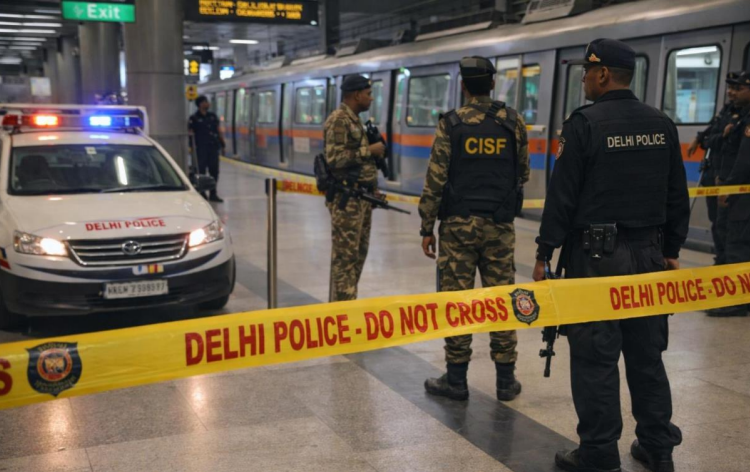
A major counterterror breakthrough unfolded this week after a series of provocative Anti-India Posters Delhi appeared across Delhi Metro stations, triggering a high-level security alert that ultimately led to the discovery of a Pakistan-linked Lashkar-e-Taiba (LeT) terror cell operating across multiple Indian states. What initially seemed like an isolated act of vandalism rapidly escalated into one of the most significant intelligence operations of the year, when investigators from the Delhi Police Special Cell realised the posters were not spontaneous political mischief but part of a coordinated psychological-operation tactic. The phrases printed on the posters were crafted to incite separatist sentiment and challenge the authority of the Indian state, a method long associated with Pakistan-backed proxies attempting to create symbolic unrest ahead of planned terror activities.
According to senior officials, the posters were placed strategically across high-footfall metro stations including Kashmere Gate, Rajiv Chowk and New Delhi station, signalling deliberate reconnaissance. Upon reviewing CCTV footage, metro logs and digital traces on suspected devices, the Special Cell expanded the probe nationwide, eventually uncovering a sleeper network linked to LeT handlers operating from Bangladesh and Pakistan. The arrests of eight operatives, seven of them Bangladeshi nationals carrying forged Aadhaar cards, revealed an elaborate cross-border network blending digital indoctrination, illegal migration routes and clandestine financial channels. Officials say the propaganda poster incident acted as the “first signal” of a much deeper terror plan that India’s security agencies managed to disrupt in its preparatory stages.
Posters That Sparked a National Security Operation
The security alert began when commuters reported Anti-India Posters Delhi posters at multiple metro stations early in the morning, prompting metro authorities to alert Delhi Police. Initial forensic assessment showed the posters were printed in bulk using commercially available equipment, but the messaging and placement pattern suggested a planned act. Senior officers stated that the content resembled earlier propaganda material produced by Pakistan-backed digital networks attempting to inflame separatist narratives and test India’s on-ground surveillance readiness. The Special Cell immediately activated its intelligence grid, categorising the incident as a “security precursor” that warranted escalation beyond municipal or local jurisdiction.
Within hours, investigators obtained CCTV footage showing two individuals placing the posters quickly and avoiding exposure to station entry cameras. Facial identification tools flagged anomalies, prompting the team to examine digital traces from vendor shops, printing outlets and nearby WiFi access points. The rapid mobilisation of cyber forensic teams added urgency to the investigation, revealing that online search histories from associated devices contained keywords tied to known terrorist propaganda themes. Authorities soon realised the poster operation was not an isolated stunt, but an entry point to uncovering a clandestine network preparing for activities extending far beyond propaganda.
Multi-State Raids and the Arrest of Eight Suspects
As investigators traced digital footprints to mobile phones active on the night of the poster placements, signals led them to Tamil Nadu and West Bengal. This triggered coordinated raids led by the Delhi Police Special Cell with support from local police forces. The breakthrough occurred in Tiruppur, Tamil Nadu, where four Bangladeshi nationals working in a textile unit were apprehended with forged Indian identity documents. Subsequent raids in Chennai and Kolkata yielded four more suspects, completing an eight-member network operating silently across multiple states. Officials stated that nearly all suspects had entered India illegally through porous border routes and established themselves under false identities.
During the raids, authorities recovered smartphones, encrypted messaging logs, foreign SIM cards, and partially drafted propaganda material. Investigators discovered digital instructions associated with anonymous handlers, maps indicating potential reconnaissance zones, and photos of metro stations taken days before the poster incident. Forensic examination revealed that the suspects had been collecting information on sensitive areas in Delhi that have historically been targets of terror plots. With the seizure of forged Aadhaar cards and SIM cards, officers emphasised the dangerous scale at which identity fraud is being weaponised by cross-border groups to embed operatives into Indian states unnoticed.
Pakistan-Linked Handler Identified as Shabir Ahmad Lone
Delhi Police have identified Shabir Ahmad Lone, a known LeT operative originally from Srinagar, as one of the key handlers orchestrating the module from Bangladesh. Lone has a long history of involvement in terror activity, including training in Muzaffarabad under LeT supervision and links to a 2007 explosives recovery case in Jammu & Kashmir. After fleeing India, Lone is believed to have resettled in Dhaka under the protection of networks connected to Pakistan’s ISI, from where he resumed recruitment and indoctrination activities targeting illegal migrant clusters. Intelligence intercepts reveal that Lone communicated with operatives using encrypted channels and instructed them to carry out “low-risk, high-visibility” acts in their initial phase consistent with the poster campaign.
Officials say Lone’s operational blueprint mirrors Pakistan-backed hybrid warfare tactics seen in recent years, where propaganda triggers are used as staged precursors to test coordination and operational discipline. The Special Cell is investigating whether Lone intended to escalate the module’s activities into disruptive acts in Delhi’s high-density public areas. Senior intelligence sources stated that his strategy relied heavily on exploiting illegal migration routes to infiltrate operatives into India, where they were trained to blend into labour clusters and avoid detection. Indian agencies are now coordinating with Bangladesh for further information on Lone’s possible safe houses and his network’s financial channels.
Evidence Suggests Early-Stage Reconnaissance for Wider Plot
Documents and digital data recovered during the raids indicate that the operatives were studying Delhi’s security-sensitive zones, including religious corridors, historical monuments and metro interchange hubs. Investigators found screenshots of Delhi tourist maps, GPS logs showing repeated location tagging near Jama Masjid, Red Fort and Chandni Chowk areas, and search queries related to “crowd density timings” and “festival footfall.” Though no weapons or explosives were recovered, officers say the module appeared to be in an “information-gathering phase” that often precedes operational activities. The poster act, they emphasised, was likely a loyalty demonstration and a test of the group’s ability to execute coordinated instructions.
Multiple suspects admitted during interrogation that the posters were meant to be a “signal” confirming operational readiness to their handler. Investigators believe the group may have been instructed to prepare for reconnaissance exercises aimed at identifying soft targets. Intelligence officials added that the rapid movement of operatives between Kolkata, Chennai and Delhi fit the behavioural pattern of pre-attack positioning used by Pakistan-affiliated modules, where dispersed cells gather information and await further instructions. The Special Cell is examining whether this module was linked to any previous failed attempts or coordinated with other digital indoctrination groups active in eastern India.
National Security Implications and Counterterror Strategy Ahead
Security experts warn that the case reflects a dangerous shift in Pakistan-backed terror architecture, one that prioritises psychological disruption, decentralised sleeper recruitment and digital indoctrination over traditional cross-border infiltration. The use of posters as the starting point of a terror chain underscores how physical provocations are increasingly being fused with online radicalisation and encrypted coordination. Officials have highlighted the urgent need for greater surveillance on illegal migration networks and stricter monitoring of identification fraud, which has emerged as a key vulnerability exploited by foreign handlers.
The operation has reinforced confidence in India’s intelligence ecosystem, particularly its ability to treat seemingly minor provocations as potential national security triggers. The Special Cell’s swift action, multi-state coordination and cyber forensic mobilisation prevented a deeper plot from unfolding. However, authorities remain cautious, noting that the disruption of this module may only represent one layer of a wider network. Intelligence agencies are now strengthening cooperation with West Bengal, Assam, Tamil Nadu and Bangladesh to track additional operatives and financial operators linked to the module. Senior officials stated that India’s vigilance must adapt to hybrid warfare tactics where terror networks use “small sparks to ignite larger instability.”