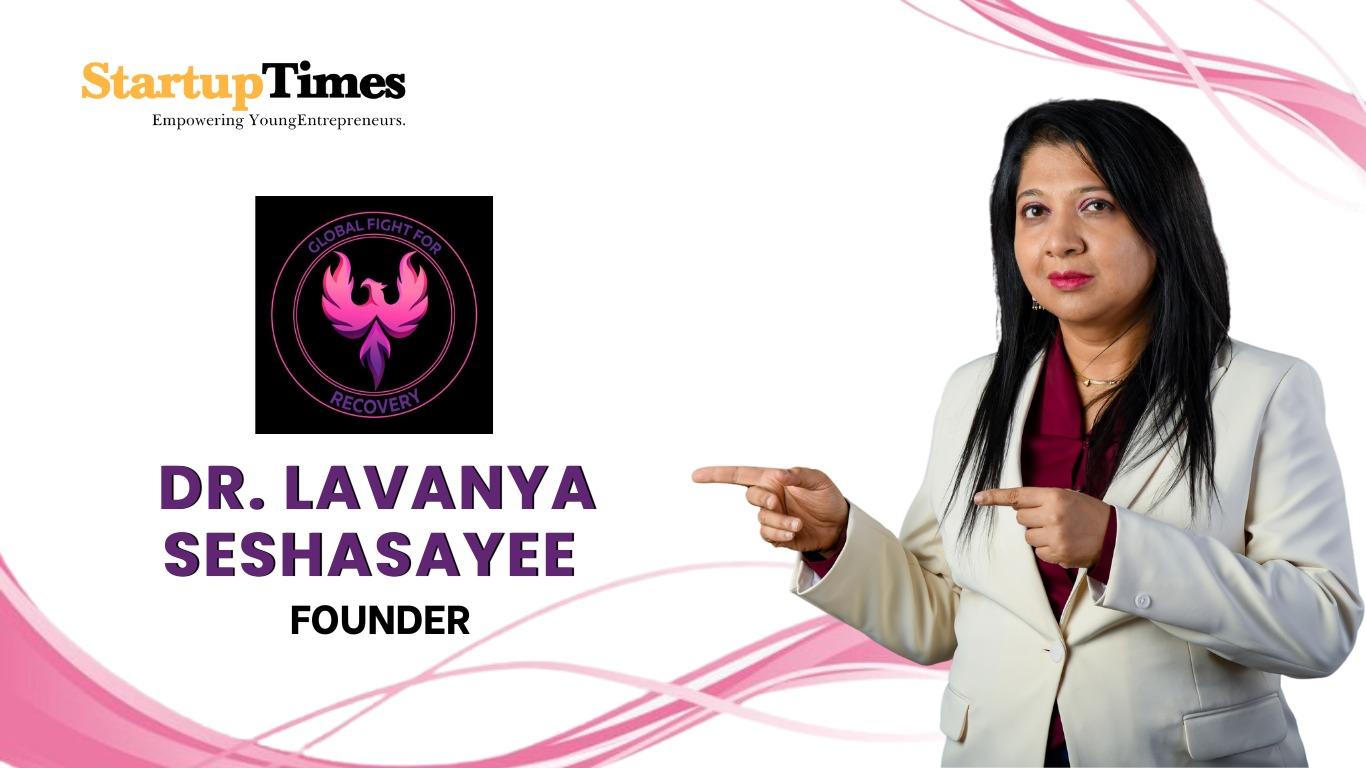
A powerful story of lived experience, rights-based recovery, and how Dr. Lavanya Seshasayee is transforming mental health through dignity, voice, and empowerment.
In a country where mental health is still spoken of in whispers, where healing is too often reduced to prescriptions, compliance, and clinical labels, the work of Dr. Lavanya Seshasayee stands apart with rare moral clarity. Her approach begins not with diagnosis, but with dignity; not with control, but with listening.
A clinician, researcher, survivor, caregiver, and one of India’s foremost mental health advocates, Dr. Lavanya is widely recognized as the country’s first Recovery Specialist. She holds a PhD in Women’s Mental Health and is the founder of the Global Fight for Recovery (GFR)—a rights-based, lived-experience-driven mental health movement that challenges the very foundations of how psychological distress is understood and treated.
Yet titles alone cannot contain the depth of her work. Dr. Lavanya has lived inside the mental health system as a patient diagnosed with schizophrenia, worked within it as a clinician and researcher, challenged it as a legal self-advocate, and transformed it as the architect of an entirely new recovery paradigm: CSEA — Client Self-Empowerment and Advocacy.
A Life Where Experience Became Expertise
Dr. Lavanya’s professional journey cannot be separated from her personal one. Diagnosed with schizophrenia early in life, she spent years navigating a mental health system that frequently spoke about her, but rarely to her. Like millions across the world, she was reduced to symptoms and compliance, while the deeper social, emotional, relational, and gendered roots of her distress were systematically ignored.
Instead of being diminished by this experience, she transformed it into a lifelong inquiry.
Over the years, Dr. Lavanya studied intensively, engaging with over 1,800 research papers, many sourced from the U.S. National Institutes of Health, spanning psychiatry, psychology, neuroscience, social psychiatry, feminist theory, disability rights, and recovery-oriented practice. She travelled to ten countries, presenting papers on mental health, lived experience, and recovery, and contributed to international, national, and rural mental health initiatives across medical, community-based, rights-based, and alternative frameworks.
She actively participated in consultations connected to the United Nations Convention on the Rights of Persons with Disabilities (UNCRPD) and played a role in India’s historic shift from the Mental Health Act of 1987 to the more progressive Mental Healthcare Act of 2017, which foregrounds autonomy, legal capacity, and patient rights.
Her work has received global recognition. She has been interviewed on BBC World Radio, authored multiple books including Against All Odds: Rising Above Schizophrenia and Cracking the Schizophrenia Code (Part I), which received a National Award in 2022, and written extensively on Legal Mental Health, self-advocacy, and rights-based recovery. She also completed a three-year tenure with India’s Ministry of Health and Family Welfare, contributing her expertise at a national policy level.
Yet one of the most defining chapters of her journey unfolded far from academic conferences. In 2012, Dr. Lavanya was part of a community mental health initiative where she singlehandedly successfully helped 50 residents of Bangalore’s Beggars’ Colony—many of whom had lived on the streets for years—heal, reconnect with their families, and re-enter society. That experience crystallised her conviction that recovery, when supported with insight and humanity, can radically transform lives.
The Moment That Sparked a Movement
The idea for the Global Fight for Recovery did not originate in a boardroom or policy meeting. It was born in a psychiatrist’s office.
Repeated encounters with a psychiatrist who consistently dismissed her lived reality forced Dr. Lavanya to confront a devastating truth: once a person is labelled a psychiatric patient, their voice often ceases to matter. Caregivers are heard over clients. Textbooks override lived experience. Patriarchal assumptions silently shape therapy rooms. Women who question authority are labelled resistant, manipulative, or lacking insight.
Her emotional pain was repeatedly reframed as pathology. Her attempts at self-understanding were met with demands for compliance. At one point, even those actively contributing to her trauma were validated over her.
That systematic silencing had an unexpected consequence.
It ignited resolve.
In a moment of fierce clarity, Dr. Lavanya made herself a promise: one day, she would challenge this system—ethically, intellectually, and courageously. That promise eventually became CSEA, and later, the Global Fight for Recovery.
Importantly, Dr. Lavanya does not reject psychiatry outright. She acknowledges that medication can play a vital role during periods of extreme distress. What she challenges is over-medicalisation, over-sedation, and the erasure of personhood. In a striking turn of events, even the psychiatrist who once dismissed her later transformed her own clinical approach after witnessing Dr. Lavanya’s academic achievements, professional authority, and complete personal empowerment.
Why the Existing System Falls Short
CSEA did not emerge from ideology; it emerged from observation.
Across hospitals, institutions, and family systems, Dr. Lavanya witnessed recurring patterns: human rights violations, erosion of legal capacity, coercive care models, and an obsessive reliance on chemical imbalance theories that lacked conclusive evidence yet justified stripping individuals of dignity and agency.
Care packages were often prohibitively expensive, narrowly individual-focused, and fundamentally flawed because they ignored toxic family dynamics, social context, gender realities, and structural violence. Cognitive Behavioural Therapy was frequently misapplied. Recovery principles were largely absent from psychiatric training. Most critically, the client’s voice—the single most important source of insight—was sidelined.
CSEA arose as a corrective to these failures. It is not anti-medicine. It is pro-human.
Why CSEA Works
Dr. Lavanya’s own life stands as the most compelling evidence for CSEA.
While many individuals with equal or greater access to resources remain trapped in cycles of chronic disability, she went on to earn a doctorate, author award-winning books, present internationally, influence national policy, build a global movement, and flourish professionally, intellectually, and creatively.
CSEA works because it restores what conventional systems remove: autonomy, capability, emotional validation, creativity, purpose, legal awareness, and agency.
Through her CSEA-based support system, Dr. Lavanya has helped at least 50 individuals achieve full functional recovery, many showing remarkable improvements in short time frames. These individuals are not merely stable; they are thriving, continuing to evolve toward their maximum potential.
At its core are rights-based recovery programmes grounded in CSEA, supporting individuals to move from patienthood to citizenship and restore maximum work and emotional functionality, awareness of their unlimited potential and leadership. Medication is used selectively and ethically where beneficial. For treatment-resistant cases, robust non-psychiatric pathways are available. Rights education, legal literacy, self-advocacy, creative expression, and social reintegration are central pillars.
GFR also offers training and certification programmes for caregivers, mental health professionals, peer-support workers, and individuals recovering from psychiatric harm. The goal is not merely healing, but the creation of future recovery leaders.
Digitally, GFR is building scalable platforms—courses, webinars, global communities, and AI-enabled education—to democratise recovery knowledge worldwide. Through books, public dialogue, and policy engagement, GFR continues to challenge the dominance of the sickness model and advocate for a capabilities-informed, humane future.
Building Against Resistance
Building GFR has not been easy. Dr. Lavanya has faced resistance from entrenched psychiatric establishments and rigid anti-psychiatry camps alike—each unsettled by a model that refuses extremism and centres lived wisdom. Caregivers often resist self-examination. Professionals sometimes lack the experiential insight needed to bridge theory and reality and don’t like it when she doesn’t support medication of treatment-resistant individuals. And anti-psychiatrists hate the fact that she does completely support medication of individuals even if it is helping them only somewhat.
A pivotal turning point came with the arrival of Manasvi, GFR’s Chief Operating Officer, whose leadership and organisational strength enabled crucial internal restructuring. Together, they are shaping GFR for its next phase of global impact.
Looking Ahead
In the coming years, Dr. Lavanya envisions GFR transforming lives across continents. Her commitment is unwavering: to stand with those the system has written off, and to demonstrate that recovery—however it is defined—is not only possible, but profoundly empowering.
Her message to aspiring entrepreneurs and change-makers is simple and hard-earned: stay solution-focused. Every problem carries the seed of its solution. Cultivate the courage to say “I can” even when the world insists you cannot.
Closing Reflections
The Global Fight for Recovery is not a rejection of science. It is a restoration of balance. A return of humanity to healing. A declaration that no one should feel unheard, invalidated, or powerless simply because they sought help.
At its heart lies a radical truth: when people are supported to reclaim their voice and capacity, the sky is not a metaphor—it is a real horizon.
Passionate about driving impactful digital marketing strategies, I have honed my skills over 5 years in the industry, primarily through my roles at Quantel and Startup Times. At Quantel, I served as a Digital Marketing Specialist, where I successfully led campaigns that increased website traffic by 50% and improved conversion rates through targeted SEO and PPC strategies. Collaborating closely wit
Leave a comment
Your email address will not be published. Required fields are marked *