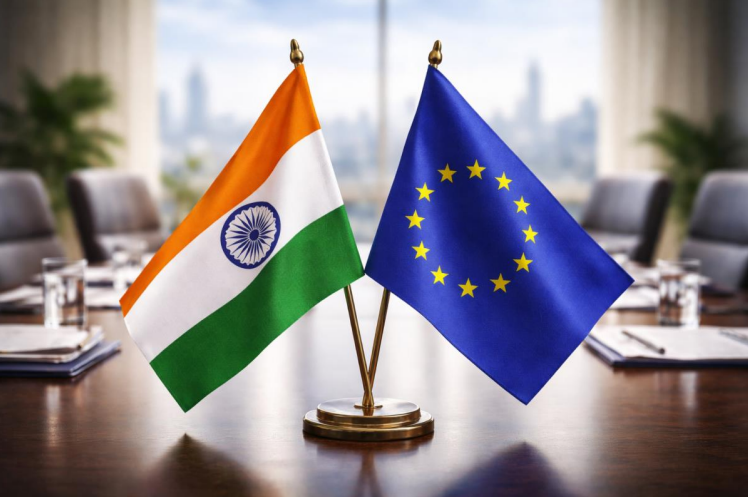
India and the European Union formally concluded negotiations on a landmark Free Trade Agreement (FTA) on January 27, 2026, marking the end of nearly 18 years of consultations, interruptions and renewed efforts aimed at creating one of the world’s most ambitious and far-reaching bilateral economic partnerships.
The agreement, which negotiators have dubbed the “mother of all trade deals”, represents a major milestone for two of the world’s most influential economic blocs and signals a decisive shift in global trade architecture amid the rapid rebalancing of strategic alliances.
The conclusion of the talks was announced at the 16th India–EU Summit in New Delhi, attended by senior representatives from both sides, including India’s Commerce and Industry Minister and high-level EU commissioners responsible for trade, economy and strategic partnerships.
The deal positions India to integrate more deeply with global value chains, while allowing European industries expanded access to one of the fastest-growing major markets in the world.
The long-awaited agreement follows a renewed push that began in mid-2022, when both sides agreed to accelerate talks amidst growing global economic fragmentation, rising protectionism and increased competition in high-technology sectors.
Negotiators confirmed that the final text will now undergo legal review and harmonization, a process expected to take several months before formal signature and ratification procedures begin.
Timeline and Negotiation Dynamics
The India–EU FTA has one of the longest gestation periods in modern trade diplomacy. Initial discussions began in 2007, driven by rising bilateral trade and the EU’s interest in engaging India more deeply in global supply chains.
By 2013, talks had stalled due to differences over tariff coverage, intellectual property protections, service mobility and agricultural safeguards.
Negotiations remained dormant for nearly a decade until 2022, when shifting geopolitical realities—including disruptions in global energy markets, supply-chain vulnerabilities exposed during the pandemic and increasing emphasis on friend-shoring—brought India and the EU back to the negotiating table.
A major breakthrough occurred in late 2024, when both sides completed the most contentious chapters related to cars, spirits, digital trade governance and rules-of-origin procedures.
By mid-2025, negotiators had finalized critical frameworks on dispute resolution, investment facilitation, customs transparency and sustainable development commitments.
Commerce Secretary Rajesh Agrawal described the completed negotiations as “balanced, strategic and mutually beneficial,” adding that both sides had shown flexibility while safeguarding domestic economic priorities. European officials echoed this view, noting that the agreement was designed to align with the EU’s green transition agenda while supporting India’s growth trajectory.
Economic Impact and Key Market Gains
Bilateral trade between India and the EU reached approximately $136 billion during the fiscal year ending March 2025, making the EU India’s largest trading partner.
With the FTA now concluded, trade analysts project that bilateral exchanges could rise substantially, potentially adding $80–100 billion in new trade flows over the coming decade, depending on global commodity trends, tariff phase-downs and post-implementation adjustments.
One of the most significant components of the agreement relates to automobile imports. Under the new framework, India will gradually reduce tariffs on select European passenger vehicles from rates of 70–110 percent down to approximately 40 percent over a phased period.
This measure is expected to increase European access to India’s premium automobile market, while India anticipates investment commitments in domestic EV manufacturing as part of balancing provisions.
For India, key export sectors gaining improved access to the EU market include:
Textiles and garments, with simplified rules-of-origin and reduced technical barriers
Pharmaceuticals, due to streamlined regulatory procedures and expanded mutual recognition pathways
Specialty chemicals and machinery, traditionally strong export performers
Information technology and professional services, supported by smoother mobility channels
European exporters will gain enhanced access to Indian markets for machinery, medical technology, alcoholic beverages, renewable-energy equipment and advanced components, with many tariffs being gradually reduced or removed entirely.
Strategic, Geopolitical and Labor Mobility Dimensions
The India–EU FTA extends beyond the conventional scope of trade agreements by incorporating broader strategic and political considerations.
With the global economy undergoing a phase of realignment, the deal reinforces Europe’s efforts to deepen partnerships with trusted, high-growth economies and India’s ambition to diversify its trade portfolio.
European Commission President Ursula von der Leyen stated that “India’s success contributes directly to global stability, prosperity and security,” underscoring Europe’s view of India as a crucial partner in the Indo-Pacific region.
The agreement also opens structured channels for Indian skilled professionals to access opportunities across EU member states, addressing labour shortages in technology, healthcare, engineering and research.
Mobility provisions are expected to expand work visas, ease recognition of qualifications and allow temporary movement of service professionals.
India’s Prime Minister Narendra Modi described the FTA as “a transformational opportunity for businesses, youth and the next generation of innovators across continents.” Analysts see the mobility chapter as one of the most forward-looking elements of the agreement, strengthening human-capital linkages between the regions.
Implementation, Ratification and Sectoral Sensitivities
Although negotiations have concluded, the FTA must pass several procedural hurdles before going into effect, including:
Legal verification of the complete agreement text
Signature by both governments, expected later in 2026
Approval by the European Parliament and relevant national legislatures
Ratification by the Government of India
Implementation will be phased, with certain tariff cuts activated immediately and others scheduled over multi-year timelines.
Sensitive sectors, including agriculture, dairy and low-value manufacturing, will see gradual or limited changes aligned with domestic priorities.
India has preserved safeguards to protect small-scale industries and farmers while expanding space for technology-intensive sectors.
The EU will introduce monitoring frameworks to ensure sustainability commitments relating to environment, labour standards and carbon reporting are maintained in cross-border commerce.
Conclusion
The finalisation of the India–EU Free Trade Agreement stands as one of the most consequential international economic achievements of the decade.
After nearly twenty years of negotiation, the pact has the potential to reshape bilateral commerce, deepen strategic cooperation and position both India and the EU as stabilising forces in a fragmented global trading system.
With its mix of tariff reductions, regulatory reforms, mobility provisions and sustainability measures, the agreement reflects a modern approach to trade partnership that blends economic ambition with long-term strategic vision.
As the agreement enters the ratification phase through 2026, stakeholders across sectors—from exporters and importers to technology firms, universities and worker associations—will closely assess its operational contours and sectoral impacts.
The deal signals India’s emergence as a central player in global value chains and the EU’s commitment to deeper Indo-Pacific engagement, marking the beginning of a new chapter built on cooperation, mutual benefit and shared economic resilience.