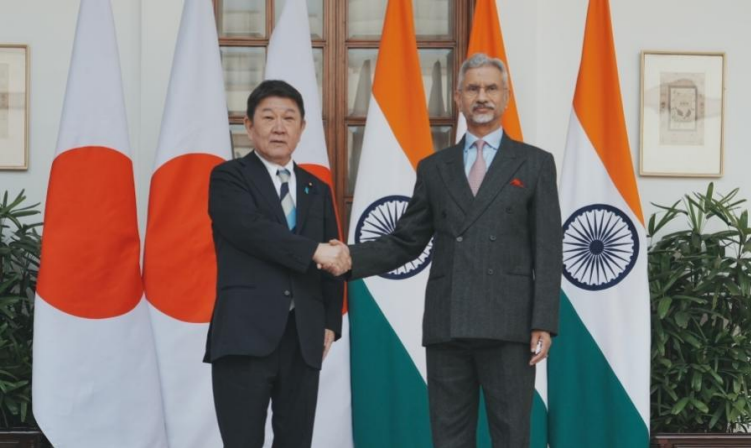
India and Japan took a significant step forward in strengthening their technological and economic partnership during Japanese Foreign Minister Toshimitsu Motegi’s high-level visit to New Delhi this week. The two nations agreed to launch a dedicated India–Japan AI Dialogue and fast-track cooperation on critical minerals, a sector central to global supply chains for electric vehicles, semiconductors and renewable energy technologies.
The agreements reflect a broader alignment between Asia’s two major democracies as they navigate supply chain vulnerabilities, rapid technological disruptions and the strategic push for a resilient Indo-Pacific order. With both governments emphasising innovation, industrial security and economic diversification, the latest initiatives add momentum to a partnership already marked by robust investments and defence collaboration.
A Strategic Visit Rooted in Technology and Trust
Foreign Minister Toshimitsu Motegi met with India’s External Affairs Minister Dr. S. Jaishankar in New Delhi, reaffirming the countries’ shared vision for a “free, open and rules-based Indo-Pacific.” The visit placed special emphasis on emerging technologies, notably artificial intelligence, semiconductors and digital governance.
In a joint statement, both ministers highlighted the need for “responsible and secure use of advanced technologies that serve inclusive economic growth.” Motegi noted Japan’s commitment to supporting India’s digital transformation, while Jaishankar underlined the growing role of tech partnerships in shaping global economic leadership.
The optics of the meeting were clear: India and Japan recognise the strategic urgency of building joint capabilities in areas that will define the next decade of global competitiveness.
AI Dialogue: Building the Next Frontier of Innovation
One of the most significant outcomes was the announcement of a formal India–Japan AI Dialogue, a platform designed to connect policymakers, scientists, research institutions and industry leaders.
The dialogue will focus on:
Ethical, safe and trusted deployment of AI
Use-cases in healthcare, language technologies and climate modelling
AI for smart manufacturing and Industry 4.0
Cyber-security and data protection frameworks
Japan’s long-standing strength in robotics and high-precision engineering aligns with India’s rapid scaling of AI startups, digital public infrastructure and large computational ecosystem. The partnership is expected to stimulate joint R&D projects, academic exchange and AI-driven industrial solutions.
A senior official described the initiative as “a necessary step, not an optional one, for ensuring innovation translates into economic resilience and regional stability.”
Critical Minerals: Securing the Supply Chains of the Future
With global competition intensifying for minerals essential to batteries, clean energy technology and semiconductor manufacturing, both countries announced a strengthened partnership to secure critical mineral supply chains.
Japan, one of the world’s largest importers of rare earth elements, is seeking reliable partners to reduce its dependence on single-country sourcing. India, meanwhile, is expanding exploration across states including Andhra Pradesh, Rajasthan, Chhattisgarh and Odisha, and recently set up bodies to accelerate processing and value-chain integration.
During the talks, the two nations agreed to:
Establish a Joint Working Group on Critical Minerals
Facilitate Japanese investment in India’s mining and processing projects
Collaborate on recycling technologies and supply-chain tracking
Link mineral cooperation with broader semiconductor and EV initiatives
This builds on earlier Japanese investments through JOGMEC (Japan Oil, Gas and Metals National Corporation) and India’s pursuit of rare earth partnerships with Australia and Africa.
Economic and Geopolitical Implications
The agreements arrive at a moment of global economic rebalancing. Disruptions in shipping routes, volatility in energy markets and the race for semiconductor independence have compelled nations to build trusted technological alliances.
For India, Japan remains one of its most committed partners in infrastructure financing (DMIC, MMLP, bullet train project), semiconductor manufacturing, defence and maritime cooperation, and the clean energy transition.
For Japan, India offers a large talent base, rising manufacturing capacity and policy stability, making it an essential link in its Indo-Pacific economic strategy. Both ministers reiterated support for the Quadrilateral Security Dialogue (Quad) and emphasised collaboration on secure digital frameworks, resilient supply chains and high-technology innovation.
Looking Ahead
The India–Japan partnership is expected to grow deeper over the coming year, with follow-up meetings planned between trade, technology and digital economy ministries. Officials also hinted at collaborative opportunities in 5G/6G R&D, hydrogen energy, semiconductor packaging and talent mobility.
As the world restructures its supply chains and competition intensifies across emerging technologies, the India–Japan relationship is shifting from traditional development cooperation to a high-value, innovation-centric strategic partnership.
For both nations, this is more than a diplomatic alignment — it is a bet on a shared technological future.