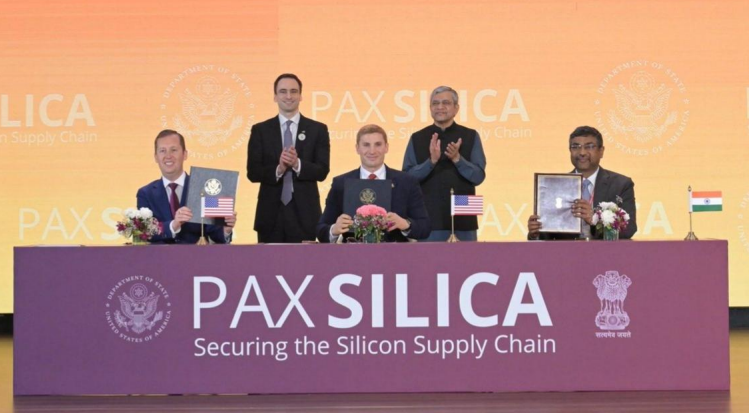
In a major geopolitical and technological development, India has formally joined the US-led Pax Silica Initiative, a multilateral programme aimed at securing supply chains for critical minerals, semiconductor-grade silica, rare earths and AI-enabling materials. The announcement was confirmed during a high-level ministerial meeting involving representatives from the United States, India, Japan, Australia and select EU partners, signalling a new era of coordinated resource security.
The initiative focuses on ensuring reliable access to minerals essential for AI compute infrastructure, advanced chips, quantum devices, EV batteries and renewable energy systems. Indian officials said the decision aligns with the country's ambitions under the India Semiconductor Mission, National Quantum Mission and Research Linked Incentives (RLI) framework. U.S. Commerce Secretary Gina Raimondo described India as a “pillar nation” in the global minerals restructuring effort, while India’s External Affairs Minister emphasised that the partnership “cements India’s role in shaping responsible AI and future technology governance.”
Techno-Mineral Partnership
India’s inclusion in Pax Silica is seen as a calculated step toward insulating global technology supply chains from geopolitical disruptions. With 2026 political cycles in the U.S. and EU likely to reshape industrial policy, Washington has prioritised building alliances that can reduce dependencies on single-country mineral dominance, particularly in the silica, gallium, germanium and rare-earth segments. India, with its emerging exploration infrastructure and refining capability, offers both diversification and long-term supply stability.
Officials highlighted that India’s new mineral exploration reforms—under which offshore silica sand and lithium deposits in Rajasthan, Jharkhand and Karnataka have entered accelerated development—made New Delhi an attractive partner. U.S. officials also noted India’s rising technological demand, driven by the need for high-performance compute clusters, AI datacentres and chip fabrication plants. The partnership is being positioned as mutually reinforcing: India gains technology access and export pathways, while the Pax Silica consortium gains a stable democratic supplier with scaling capability.
AI Infrastructure Boost
A core objective of the Pax Silica framework is ensuring that countries have uninterrupted access to materials required for producing semiconductor wafers, photonics components, AI accelerators and fibre-optic systems. India is expected to integrate the initiative into its rapidly expanding AI infrastructure commitments, particularly the GenAI Compute Grid, which aims to deploy over 50,000 GPUs nationwide by 2027.
Government sources stated that India’s upcoming Amaravati Quantum Valley, Gujarat’s Dholera Semi-Fab City, and Karnataka’s AI Datacentre Corridor will directly benefit from access to consortium-backed mineral channels. American companies including Nvidia, Micron and Applied Materials have already expressed interest in deeper cooperation through the initiative, particularly in long-term silica contracts and AI hardware co-development. Analysts say this alignment could accelerate India’s goal of emerging as an AI-manufacturing and compute hub for the Global South.
Critical Minerals Security
The Pax Silica Initiative aims to reduce global exposure to volatile mineral markets that have seen price spikes of up to 300% over the past five years. By joining the initiative, India gains access to shared stockpiles, coordinated procurement mechanisms and technology support for domestic processing. U.S. Geological Survey experts will assist India in mapping high-purity silica reserves and upgrading extraction facilities to meet semiconductor-grade standards.
Meanwhile, India is expected to lead the consortium’s South-South minerals task force, focusing on partnerships with African and Southeast Asian nations for sustainable mining and transparent export frameworks. This could elevate India’s geopolitical influence across emerging markets. A senior official from India’s Ministry of Mines said the collaboration “ensures that we are no longer price-takers in critical mineral markets but co-architects of a stable, resilient ecosystem.”
Diplomatic Significance
For Washington, bringing India into Pax Silica reinforces its Indo-Pacific strategy that aims to build a decentralised, democratic technology grid spanning Asia, Europe and the Americas. For India, the initiative complements its ongoing efforts through the Quad, IPEF and the Global Partnership on AI (GPAI) to shape global norms for responsible AI, open technology standards and secure mineral trade corridors.
Diplomats said the move also signals India's rising credibility as a long-term technology partner at a time when countries are re-evaluating export controls, dependency risks and mineral weaponisation trends. Japan and Australia both welcomed the decision, calling India a “crucial stabiliser” in the mineral-AI nexus. Officials hinted that the initiative may evolve into a broader governance framework that integrates supply chain cybersecurity, AI transparency standards and green-tech mineral certifications.
Economic Outlook and Industrial Impact
Economists project that India’s participation could attract $8–10 billion in foreign investments across mineral refining, chip-grade silica processing and AI hardware manufacturing over the next five years. Domestic firms like Vedanta, Tata Electronics, Hindustan Silica Corporation and Bharat Rare Earths are expected to secure long-term offtake agreements with U.S. and Japanese companies, ensuring predictable demand and pricing.
Industry leaders say the initiative will speed up India’s transition from being primarily a mineral importer to becoming an integrated producer in global semiconductor and AI value chains. The collaboration could also enable India to localise parts of the silicon photonics and optical-AI stack segments currently dominated by East Asian suppliers. Technology analysts believe this partnership marks one of the most concrete steps in India’s journey toward becoming a central force in future AI infrastructure, minerals geopolitics and high-tech manufacturing.