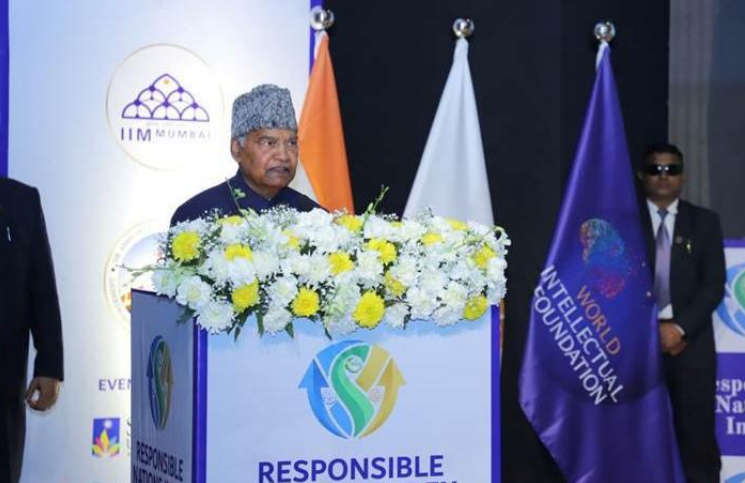
India has secured the 16th position out of 154 countries on the newly introduced Responsible Nations Index (RNI) 2026, a benchmark designed to evaluate how countries conduct themselves in the modern world beyond traditional measures of economic strength. The RNI was unveiled this week at the Dr. Ambedkar International Centre in New Delhi, in a ceremony led by former President Ram Nath Kovind, who emphasised that responsibility — not power alone — should guide how nations are judged globally.
Developed by the World Intellectual Foundation (WIF) with academic collaboration from Jawaharlal Nehru University and Indian Institute of Management Mumbai, the RNI represents the culmination of a three-year research and policy effort. Its purpose is to shift the global conversation from old yardsticks of economic and military might to a new understanding of what it means for a nation to be truly responsible toward its own citizens, the environment, and the global community.
The inclusion of India among the top twenty highlights a broader shift in global governance norms, where moral authority, long-term sustainability, and human-focused policy choices are seen as critical indicators of national maturity. India’s ranking positions it as a nation capable of balancing ambition with conscience, an achievement that resonates strongly in today’s unpredictable geopolitical environment.
What the Index Measures and Why It Matters
Unlike conventional rankings that prioritise GDP, military strength, or geopolitical influence, the RNI assesses performance through a responsibility lens. The framework is grounded in transparent, internationally sourced data, drawing on trusted global indicators to measure ethical conduct and societal outcomes.
The index evaluates nations across three core dimensions:
Internal Responsibility: How a country protects the rights, dignity, and well-being of its citizens
Environmental Responsibility: Efforts to conserve natural resources, address climate change, and pursue sustainable development
External Responsibility: Commitment to peace, cooperation, and constructive engagement with the wider world
This design reflects a growing global consensus that national success depends not only on wealth, but also on how that wealth is used to advance human dignity, ecological balance, and international trust. By embedding moral and ethical considerations into a comparative ranking, the RNI introduces an innovative global benchmark.
India’s Stand Among 154 Nations
India’s placement at 16th is significant for several reasons. With an overall score of 0.551513, India ranks well ahead of many wealthier and more economically dominant nations, including France, the United Kingdom, the United States (ranked 66th), and China (ranked 68th).
At the top of the 2026 RNI rankings, Singapore secured first place with a score of 0.61945, followed by Switzerland and Denmark. Countries such as Cyprus, Sweden, Belgium, and Germany also featured prominently, reflecting strong traditions of social welfare, environmental stewardship, and inclusive governance. The Central African Republic ranked last, illustrating the wide spectrum of national performance captured by the index.
India’s position ahead of advanced economies underscores that responsible conduct — especially in areas like human rights, climate action, transparency, and global cooperation — is not solely tied to economic capacity. Rather, it can be shaped by policy choices and institutional commitments that prioritise ethical governance and inclusive development.
Expert Perspectives and Official Statements
At the launch event, Shri Sudhanshu Mittal, Founder and Secretary of the World Intellectual Foundation, described the index as a deliberate attempt to prompt nations to reflect on the ethical dimensions of power and influence. He noted that the RNI asks a fundamental question: How responsibly does a nation wield its influence toward its people and the planet?
By focusing on responsibility as a metric, he said, the index aims to encourage governance that is humane, sustainable, and oriented toward global well-being.
Former President Ram Nath Kovind, in his remarks, stressed that responsibility must be central to national progress, observing that wealth and power without moral purpose cannot deliver sustainable peace or prosperity. His address underscored the index’s role not as a tool for competition, but as a mirror reflecting a nation’s moral and ethical commitments in a rapidly interconnected world.
Broader Implications and Future Outlook
India’s strong performance in the RNI carries implications beyond rankings. It offers a fresh narrative about India’s place in the world — one anchored in ethical governance, environmental responsibility, and active engagement with global challenges.
As nations grapple with climate change, social inequality, and geopolitical instability, frameworks like the RNI could influence how international institutions, investors, and civil society evaluate national leadership.
For India, the ranking reinforces policy directions that emphasise social welfare programmes, environmental initiatives, and diplomatic efforts aimed at peaceful cooperation. While India’s economic growth remains central to its global engagement, the RNI highlights that responsibility and values-based governance are gaining equal recognition on the world stage.
Policymakers and scholars suggest that future editions of the index could further refine its dimensions and expand engagement with nations seeking to strengthen their performance. Meanwhile, India’s 16th-place ranking is likely to shape discussions on global governance, sustainable development, and the emerging idea that responsible nationhood is as critical as national power.