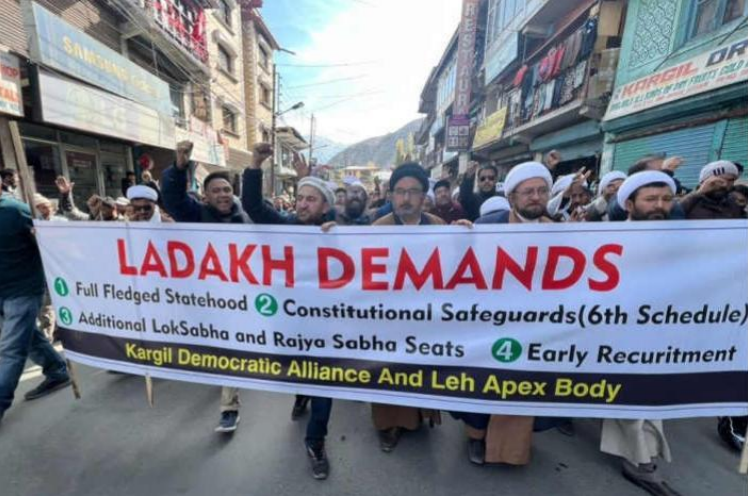
Thousands of residents across Ladakh took to the streets in a powerful show of collective dissent as the region witnessed a widespread shutdown and mass demonstrations demanding full statehood and constitutional safeguards under the Sixth Schedule of the Constitution.
Protesters marched through the main markets of Leh and Kargil, carrying banners and slogans that called for greater political autonomy and stronger protections for Ladakh’s land, culture and employment opportunities. Markets remained shut across large parts of the region as the agitation gained momentum, reflecting the depth of public sentiment behind the demands.
The demonstrations were organised following a joint call by two major regional political and social organisations, the Leh Apex Body (LAB) and the Kargil Democratic Alliance (KDA). These bodies represent a broad coalition of civil society groups, political leaders and community organisations in Ladakh. The shutdown was intended to send a clear message to the central government that negotiations on the region’s political future must address long-standing demands for democratic representation and constitutional safeguards.
The protests came amid growing frustration over stalled dialogue between Ladakhi leaders and the Union government regarding the region’s political status. Since Ladakh was separated from the former state of Jammu and Kashmir and made a Union Territory without a legislative assembly in 2019, many residents have expressed concerns about limited political representation and the protection of local interests. Demonstrators emphasized that their movement seeks constitutional solutions to safeguard Ladakh’s unique cultural and ecological landscape.
Mass Shutdown Across Leh and Kargil
The shutdown witnessed strong participation across Ladakh, with large rallies taking place simultaneously in Leh, Kargil and several smaller towns. Shops and businesses remained closed in many areas as residents joined marches through local markets and public squares. Protesters carried placards and banners calling for “Full Statehood for Ladakh” and “Sixth Schedule Now,” reflecting the core demands of the movement.
In Kargil, the demonstrations began in the city’s central areas and moved through key commercial districts before culminating in large public gatherings where community leaders addressed the crowds. Despite large numbers participating, the protests remained largely peaceful and orderly, with organisers urging demonstrators to maintain discipline and avoid confrontations. Local authorities also reported no major incidents during the rallies.
Participation in the shutdown extended beyond urban centres, with residents from remote regions such as Zanskar also joining the agitation. Community leaders described the mobilisation as one of the most significant expressions of public unity in recent years, illustrating how the demand for greater political autonomy has resonated across Ladakh’s diverse social and cultural groups.
Core Demands: Statehood and Sixth Schedule Protection
At the heart of the protests lies a four-point agenda that Ladakhi leaders have repeatedly presented to the central government. The key demands include granting full statehood to Ladakh, extending constitutional safeguards under the Sixth Schedule, ensuring reservation and protection of jobs for local residents, and establishing separate parliamentary constituencies for the Leh and Kargil regions.
The Sixth Schedule of the Constitution provides special administrative arrangements for tribal areas, granting them greater autonomy through elected district councils with powers over land, resources and local governance. Protest leaders argue that extending these provisions to Ladakh would help protect its fragile ecosystem, cultural identity and traditional livelihoods from unchecked external development.
Activists and community leaders also warn that without constitutional safeguards, Ladakh could face demographic and economic pressures that threaten the region’s social fabric. The movement has drawn support from various segments of society including youth groups, religious organisations, traders and civil society activists, many of whom view the demand for statehood and Sixth Schedule protections as essential to preserving Ladakh’s long-term future.
Leadership and Organisation Behind the Movement
The agitation has been spearheaded by the Leh Apex Body (LAB) and the Kargil Democratic Alliance (KDA), two umbrella organisations representing political parties, religious groups and civil society institutions across Ladakh. Together, these groups have coordinated protests, negotiations and public campaigns aimed at drawing national attention to Ladakh’s demands.
These organisations have been engaged in discussions with the Union Ministry of Home Affairs through a government-appointed High-Powered Committee, which was formed to examine issues related to Ladakh’s governance and development. However, Ladakhi leaders have expressed frustration over what they describe as slow progress and inconclusive negotiations, prompting renewed mobilisation on the streets.
Prominent voices within the movement have emphasized that the protests are peaceful and democratic. Leaders have repeatedly stated that their struggle is not directed against the Indian state but rather aimed at securing constitutional protections that they believe are necessary to safeguard Ladakh’s identity and autonomy within the Indian Union.
Historical and Political Context of the Ladakh Movement
The current agitation is rooted in political developments that followed the 2019 reorganisation of Jammu and Kashmir, when Ladakh was carved out as a separate Union Territory without its own legislative assembly. While the move was initially welcomed by some sections of Ladakhi society, concerns soon emerged about the region’s governance structure and limited political representation.
Unlike many other Union Territories in India, Ladakh currently does not have an elected legislative assembly. Instead, governance is primarily administered through the Lieutenant Governor and the central government, along with two autonomous hill development councils in Leh and Kargil. Critics argue that this structure leaves residents with limited decision-making power over key issues affecting the region.
Over the past several years, civil society groups and activists have organised rallies, hunger strikes and marches to draw attention to these concerns. Among the most prominent figures associated with the movement is environmentalist and innovator Sonam Wangchuk, who has advocated for constitutional protections for Ladakh and raised concerns about environmental sustainability and local governance in the Himalayan region.
Conclusion
The large-scale shutdown and protests in Ladakh underscore the growing political momentum behind the region’s demand for statehood and constitutional safeguards. With thousands of residents participating in rallies across Leh, Kargil and other towns, the demonstrations highlight a broad consensus among Ladakhi communities about the need for greater autonomy and stronger institutional protections.
The movement’s leaders have indicated that protests will continue until meaningful progress is made in negotiations with the central government. While authorities have encouraged dialogue and engagement through formal committees, the persistence of mass demonstrations suggests that many residents believe their concerns have yet to be adequately addressed.
Looking ahead, the future of Ladakh’s political status will likely remain a significant national issue. The region’s strategic location, fragile ecosystem and unique cultural identity make its governance questions particularly complex. Whether through constitutional reforms, administrative changes or renewed negotiations, the challenge for policymakers will be to find a solution that balances national interests with the aspirations of Ladakh’s people for democratic representation and self-governance.