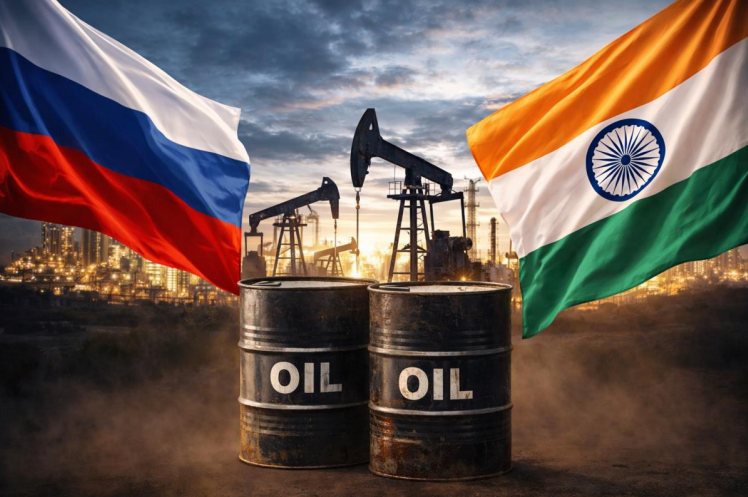
In a significant turn of international economic and diplomatic discourse today, Donald Trump publicly stated that India would stop importing Russian crude oil in fulfilment of a broader trade agreement between the United States and India. This assertion, made in a press briefing early on February 4, sparked immediate global attention due to its implications for energy markets, geopolitical alliances and India’s longstanding energy strategy. However, within hours, officials in Moscow issued a categorical denial, saying India had made no commitment to halt Russian oil purchases.
The conflicting narratives have drawn sharp reactions from energy analysts, diplomats, and policymakers, highlighting the complexities of energy diplomacy and the sensitivities surrounding India’s foreign economic policy. The discrepancy between Washington’s statement and Moscow’s response has prompted questions about communication between the three capitals and the strategic interpretation of recent bilateral agreements.
Trump’s Assertion and Its Context in India–U.S. Relations
In comments delivered during a White House event on February 4, President Trump said that as part of an overarching economic and trade understanding, India would phase out purchases of Russian crude oil. He characterised the development as a step toward strengthening India’s alignment with United States foreign policy objectives and reducing geopolitical dependencies on Moscow.
Trump noted that “India has agreed to transition away from Russian oil imports” and presented this as a key element of closer U.S.–India cooperation, especially within the context of the newly finalised trade deal that includes tariff reductions and expanded bilateral trade commitments. He framed the statement as a signal of India’s evolving strategic posture, emphasising the shared values of the two largest democracies.
The remarks came amid broader discussions on energy security, diversification of crude sources and the U.S. push to expand its liquid natural gas and crude exports. Officials accompanying Trump mentioned that enhanced energy cooperation could support India’s energy needs while advancing mutual economic interests. However, these claims immediately came under scrutiny due to contrasting reactions from New Delhi and Moscow.
Russia’s Swift Denial and Moscow’s Interpretation
Shortly after Trump’s statement, the Kremlin issued a firm rebuttal, stressing that India had not communicated any intention or agreement to stop purchasing Russian oil. Russian officials noted that energy cooperation with India continues to be robust and is driven by long-term commercial contracts, particularly in the oil and gas sector.
Russia is one of India’s key suppliers of crude oil, with purchases rising significantly since 2022 when global energy markets were disrupted by geopolitical tensions. Indian refiners have imported discounted Russian crude, which accounted for an estimated 15–20 percent of India’s total oil imports in 2025, helping the country balance fiscal pressures on energy costs.
Russian officials characterised Trump’s remarks as a misinterpretation of ongoing economic dialogues and emphasised that India’s sovereign energy policy cannot be unilaterally stipulated by third parties. They reaffirmed existing supply agreements and stated that decisions on future energy sourcing remain subject to India’s economic calculations and bilateral negotiations. The public divergence highlighted by Moscow’s response has raised diplomatic sensitivities, with analysts interpreting it as a reflection of differing strategic emphases by the United States and Russia concerning India’s role in global energy realignments.
India’s Energy Strategy and Statements from New Delhi
Indian government spokespeople were quick to distance themselves from the claim attributed to Washington. In statements issued later on February 4, New Delhi reaffirmed that no formal commitment had been made to halt purchases of Russian crude oil. Officials reiterated that India’s energy partnerships are guided by commercial considerations, energy security imperatives, and the nation’s broader geopolitical autonomy.
India remains the world’s third-largest oil importer, with crude oil accounting for nearly 80 percent of total energy consumption in 2025. The country’s energy mix relies on diversified sources, including the Middle East, Africa, and Russia, and refined imports have been central to meeting domestic demand. While India has been increasing its crude purchases from the United States and other suppliers, Indian policymakers have emphasised that decisions on energy sourcing will continue to be grounded in price competitiveness, supply reliability and economic feasibility.
At a press briefing in New Delhi, India’s Commerce Ministry clarified that “India maintains an independent energy policy and engages with global partners on the basis of mutual economic interests.” Government representatives stated that discussions with the United States and Russia on energy cooperation are ongoing and that any future shifts in sourcing would be transparently communicated through proper diplomatic channels.
Market Reactions and Economic Implications
Financial markets responded swiftly to the conflicting statements. Crude oil prices experienced volatility in early trading as traders assessed the potential impact of the claims on global energy demand patterns. Brent crude futures and benchmark international prices showed fluctuations within a narrow range, reflecting investor uncertainty over the true policy stance.
Energy analysts noted that if India were to significantly reduce Russian crude imports without securing alternative sources at competitive prices, the move could strain refinery margins and affect fuel pricing domestically. Several Indian refiners, which have invested heavily in infrastructure to process heavier crude grades typically supplied by Russia, would face transitional challenges. This could also influence India’s strategic petroleum reserves and import diversification timelines.
In addition, the news had a notable impact on currency markets in both Russia and India. The Indian rupee briefly strengthened amid speculation about shifting trade dynamics, while the Russian rouble experienced mild pressure. Analysts cautioned that such market responses could be short-lived unless further clarification emerges from government statements.
Geopolitical Interpretations and Diplomatic Nuance
The conflicting statements from Washington and Moscow have broader geopolitical implications, especially as India continues to navigate its role in emerging multipolar alignments. India’s foreign policy has traditionally emphasised strategic autonomy, and this episode has underscored the careful balance New Delhi maintains between major global powers.
Strategic experts highlighted that India’s engagement with the United States has deepened across trade, defence and technology, but energy cooperation remains a separate domain driven by long-term contracts and domestic imperatives. Meanwhile, India’s longstanding relationship with Russia—encompassing defence procurement, energy supplies and diplomatic cooperation—has continued through changing geopolitical currents.
The diplomatic controversy has drawn responses from several international observers, who noted that such discrepancies can arise from differing interpretations or extrapolations in public speeches versus formal agreements. A European foreign policy analyst remarked that “public statements by national leaders often aim to signal alignment or ambition, but they must be verified against actual treaties and signed commitments.”
Conclusion
The dispute over India’s purported commitment to halt Russian oil purchases has highlighted the complexity of global energy diplomacy and the sensitivities of balancing strategic alliances. While the United States’ portrayal suggests a future realignment, Moscow’s denial emphasises continuity in longstanding commercial ties. New Delhi’s position reinforces its sovereign approach to energy decisions based on economic imperatives.
As diplomatic channels adjust to clarify these contrasting narratives, the episode serves as a reminder that geopolitical rhetoric must be carefully calibrated against policy realities. The global energy market, in turn, continues to watch closely for official confirmations that could influence sourcing strategies, trade flows and economic alignments in the months ahead.